The World Health Organization on Friday released a formal statement blasting a US-funded vaccine trial as "unethical," because it would withhold an established, safe, and potentially lifesaving vaccine against hepatitis B from some newborns in Guinea-Bissau, Africa.
"In its current form, and based on publicly available information, the trial is inconsistent with established ethical and scientific principles," the WHO concluded, after providing a bullet-point list of reasons the trial was harmful and low quality.
The trial has drawn widespread condemnation from health experts since notice of the US funding was published in the Federal Register in December. The notice revealed that the Centers for Disease Control and Prevention—under anti-vaccine Health Secretary Robert F. Kennedy Jr.—had awarded $1.6 million to Danish researchers for their non-competitive, unsolicited proposal to conduct the trial.
Rising evidence that secondhand vapour from e-cigarettes poses health risks, government says
Vaping in cars carrying anyone under 18 will be banned in England under government plans to reduce the harm caused by smoking and e-cigarettes.
The move is included in the tobacco and vapes bill, which will also outlaw smoking, vaping and using heated tobacco in playgrounds and outside schools and hospitals.
There are tears in the audience as Patrick Darling’s song begins to play. It’s a heartfelt song written for his great-grandfather, whom he never got the chance to meet. But this performance is emotional for another reason: It’s Darling’s first time on stage with his bandmates since he lost the ability to sing two years ago.
The 32-year-old musician was diagnosed with amyotrophic lateral sclerosis (ALS) when he was 29 years old. Like other types of motor neuron disease (MND), it affects nerves that supply the body’s muscles. People with ALS eventually lose the ability to control their muscles, including those that allow them to move, speak, and breathe.
Darling’s last stage performance was over two years ago. By that point, he had already lost the ability to stand and play his instruments and was struggling to sing or speak. But recently, he was able to re-create his lost voice using an AI tool trained on snippets of old audio recordings. Another AI tool has enabled him to use this “voice clone” to compose new songs. Darling is able to make music again.
“Sadly, I have lost the ability to sing and play my instruments,” Darling said on stage at the event, which took place in London on Wednesday, using his voice clone. “Despite this, most of my time these days is spent still continuing to compose and produce my music. Doing so feels more important than ever to me now.”
Losing a voice
Darling says he’s been a musician and a composer since he was around 14 years old. “I learned to play bass guitar, acoustic guitar, piano, melodica, mandolin, and tenor banjo,” he said at the event. “My biggest love, though, was singing.”
He met bandmate Nick Cocking over 10 years ago, while he was still a university student, says Cocking. Darling joined Cocking’s Irish folk outfit, the Ceili House Band, shortly afterwards, and their first gig together was in April 2014. Darling, who joined the band as a singer and guitarist, “elevated the musicianship of the band,” says Cocking.
Patrick Darling (second from left) with his former bandmates, including Nick Cocking (far right).
COURTESY OF NICK COCKING
But a few years ago, Cocking and his other bandmates started noticing changes in Darling. He became clumsy, says Cocking. He recalls one night when the band had to walk across the city of Cardiff in the rain: “He just kept slipping and falling, tripping on paving slabs and things like that.”
He didn’t think too much of it at the time, but Darling’s symptoms continued to worsen. The disease affected his legs first, and in August 2023, he started needing to sit during performances. Then he started to lose the use of his hands. “Eventually he couldn’t play the guitar or the banjo anymore,” says Cocking.
By April 2024, Darling was struggling to talk and breathe at the same time, says Cocking. For that performance, the band carried Darling on stage. “He called me the day after and said he couldn’t do it anymore,” Cocking says, his voice breaking. “By June 2024, it was done.” It was the last time the band played together.
Re-creating a voice
Darling was put in touch with a speech therapist, who raised the possibility of “banking” his voice. People who are losing the ability to speak can opt to record themselves speaking and use those recordings to create speech sounds that can then be activated with typed text, whether by hand or perhaps using a device controlled by eye movements.
Some users have found these tools to be robotic sounding. But Darling had another issue. “By that stage, my voice had already changed,” he said at the event. “It felt like we were saving the wrong voice.”
Then another speech therapist introduced him to a different technology. Richard Cave is a speech and language therapist and a researcher at University College London. He is also a consultant for ElevenLabs, an AI company that develops agents and audio, speech, video, and music tools. One of these tools can create “voice clones”—realistic mimics of real voices that can be generated from minutes, or even seconds, of a person’s recorded voice.
The tool is already helping some of those users. “We’re not really improving how quickly they’re able to communicate, or all of the difficulties that individuals with MND are going through physically, with eating and breathing,” says Gabi Leibowitz, a speech therapist who leads the program. “But what we are doing is giving them a way … to create again, to thrive.” Users are able to stay in their jobs longer and “continue to do the things that make them feel like human beings,” she says.
Cave worked with Darling to use the tool to re-create his lost speaking voice from older recordings.
“The first time I heard the voice, I thought it was amazing,” Darling said at the event, using the voice clone. “It sounded exactly like I had before, and you literally wouldn’t be able to tell the difference,” he said. “I will not say what the first word I made my new voice say, but I can tell you that it began with ‘f’ and ended in ‘k.’”
COURTESY OF PATRICK DARLING
Re-creating his singing voice wasn’t as easy. The tool typically requires around 10 minutes of clear audio to generate a clone. “I had no high-quality recordings of myself singing,” Darling said. “We had to use audio from videos on people’s phones, shot in noisy pubs, and a couple of recordings of me singing in my kitchen.” Still, those snippets were enough to create a “synthetic version of [Darling’s] singing voice,” says Cave.
In the recordings, Darling sounded a little raspy and “was a bit off” on some of the notes, says Cave. The voice clone has the same qualities. It doesn’t sound perfect, Cave says—it sounds human.
“The ElevenLabs voice that we’ve created is wonderful,” Darling said at the event. “It definitely sounds like me—[it] just kind of feels like a different version of me.”
ElevenLabs has also developed an AI music generator called Eleven Music. The tool allows users to compose tracks, using text prompts to choose the musical style. Several well-known artists have also partnered with the company to license AI clones of their voices, including the actor Michael Caine, whose voice clone is being used to narrate an upcoming ElevenLabs documentary. Last month, the company released an album of 11 tracks created using the tool. “The Liza Minnelli track is really a banger,” says Cave.
Eleven Music can generate a song in a minute, but Darling and Cave spent around six weeks fine-tuning Darling’s song. Using text prompts, any user can “create music and add lyrics in any style [they like],” says Cave. Darling likes Irish folk, but Cave has also worked with a man in Colombia who is creating Colombian folk music. (The ElevenLabs tool is currently available in 74 languages.)
Back on stage
Last month, Cocking got a call from Cave, who sent him Darling’s completed track. “I heard the first two or three words he sang, and I had to turn it off,” he says. “I was just in bits, in tears. It took me a good half a dozen times to make it to the end of the track.”
Darling and Cave were making plans to perform the track live at the ElevenLabs summit in London on Wednesday, February 11. So Cocking and bandmate Hari Ma each arranged accompanying parts to play on the mandolin and fiddle. They had a couple of weeks to rehearse before they joined Darling on stage, two years after their last performance together.
“I wheeled him out on stage, and neither of us could believe it was happening,” says Cave. “He was thrilled.” The song was played as Darling remained on stage, and Cocking and Ma played their instruments live.
Cocking and Cave say Darling plans to continue to use the tools to make music. Cocking says he hopes to perform with Darling again but acknowledges that, given the nature of ALS, it is difficult to make long-term plans.
“It’s so bittersweet,” says Cocking. “But getting up on stage and seeing Patrick there filled me with absolute joy. I know Patrick really enjoyed it as well. We’ve been talking about it … He was really, really proud.”
From ‘honour’ killings to nuclear war, some screen works have led directly legislative action – despite what jury head Wenders suggested at the Berlin film festival
Should film festivals be more than just screenings and red carpets? Should they prompt us to think about the role cinema plays in the world? Novelist Arundhati Roy certainly thinks so. She pulled out of the jury at the Berlin festival in protest at jury president Wim Wenders’ claim that films should “stay out of politics”; she said Wenders’ stance was “unconscionable”, and that to “hear [him] say that art should not be political is jaw-dropping.”
Wenders had suggested that cinema is a way to build empathy, but not directly change politicians’ minds. However this is simply not true. Some films – both documentary and narrative – have not only changed public opinion about social issues but led directly to legislation. Despite evidence to the contrary, politicians are people too. They can be moved. And sometimes they are even moved to action.
Following publication of this story, Politico reported Jim O’Neill would be leaving his current roles within the Department of Health and Human Services.
Over the past year, Jim O’Neill has become one of the most powerful people in public health. As the US deputy health secretary, he holds two roles at the top of the country’s federal health and science agencies. He oversees a department with a budget of over a trillion dollars. And he signed the decision memorandum on the US’s deeply controversial new vaccine schedule.
He’s also a longevity enthusiast. In an exclusive interview with MIT Technology Review earlier this month, O’Neill described his plans to increase human healthspan through longevity-focused research supported by ARPA-H, a federal agency dedicated to biomedical breakthroughs. At the same time, he defended reducing the number of broadly recommended childhood vaccines, a move that has been widely criticized by experts in medicine and public health.
In MIT Technology Review’sprofile of O’Neill last year, people working in health policy and consumer advocacy said they found his libertarian views on drug regulation “worrisome” and “antithetical to basic public health.”
He was later named acting director of the Centers for Disease Control and Prevention, putting him in charge of the nation’s public health agency.
But fellow longevity enthusiasts said they hope O’Neill will bring attention and funding to their cause: the search for treatments that might slow, prevent, or even reverse human aging. Here are some takeaways from the interview.
Vaccine recommendations could change further
Last month, the US cut the number of vaccines recommended for children. The CDC no longer recommends vaccinations against flu, rotavirus, hepatitis A, or meningococcal disease for all children. The move was widely panned by medicalgroups and public health experts. Many worry it will become more difficult for children to access those vaccines. The majority of states have rejected the recommendations.
In the confirmation hearing for his role as deputy secretary of health and human services, which took place in May last year, O’Neill said he supported the CDC’s vaccine schedule. MIT Technology Review asked him if that was the case and, if so, what made him change his mind. “Researching and examining and reviewing safety data and efficacy data about vaccines is one of CDC’s obligations,” he said. “CDC gives important advice about vaccines and should always be open to new data and new ways of looking at data.”
At the beginning of December, O’Neill said, President Donald Trump “asked me to look at what other countries were doing in terms of their vaccine schedules.” He said he spoke to health ministries of other countries and consulted with scientists at the CDC and FDA. “It was suggested to me by lots of the operating divisions that the US focus its recommendations on consensus vaccines of other developed nations—in other words, the most important vaccines that are most often part of the core recommendations of other countries,” he said.
“As a result of that, we did an update to the vaccine schedule to focus on a set of vaccines that are most important for all children.”
But some experts in public health have said that countries like Denmark and Japan, whose vaccine schedules the new US one was supposedly modeled on, are not really comparable to the US. When asked about these criticisms, O’Neill replied, “A lot of parents feel that … more than 70 vaccine doses given to young children sounds like a really high number, and some of them ask which ones are the most important. I think we helped answer that question in a way that didn’t remove anyone’s access.”
“CDC still recommends that all children are vaccinated against diphtheria, tetanus, whooping cough, Haemophilus influenzae type b (Hib), Pneumococcal conjugate, polio, measles, mumps, rubella, and human papillomavirus (HPV), for which there is international consensus, as well as varicella (chickenpox),” he said when asked for his thoughts on this comment.
He also said that current vaccine guidelines are “still subject to new data coming in, new ways of thinking about things.” “CDC, FDA, and NIH are initiating new studies of the safety of immunizations,” he added. “We will continue to ask the Advisory Committee on Immunization Practices to review evidence and make updated recommendations with rigorous science and transparency.”
More support for longevity—but not all science
O’Neill said he wants longevity to become a priority for US health agencies. His ultimate goal, he said, is to “make the damage of aging something that’s under medical control.” It’s “the same way of thinking” as the broader Make America Healthy Again approach, he said: “‘Again’ implies restoration of health, which is what longevity research and therapy is all about.”
O’Neill said his interest in longevity was ignited by his friend Peter Thiel, the billionaire tech entrepreneur, around 2008 to 2009. It was right around the time O’Neill was finishing up a previous role in HHS, under the Bush administration. O’Neill said Thiel told him he “should really start looking into longevity and the idea that aging damage could be reversible.” “I just got more and more excited about that idea,” he said.
When asked if he’s heard of Vitalism, a philosophical movement for “hardcore” longevity enthusiasts who, broadly, believe that death is wrong, O’Neill replied: “Yes.”
The Vitalist declaration lists five core statements, including “Death is humanity’s core problem,” “Obviating aging is scientifically plausible,” and “I will carry the message against aging and death.” O’Neill said he agrees with all of them. “I suppose I am [a Vitalist],” he said with a smile, although he’s not a paying member of the foundation behind it.
As deputy secretary of the Department of Health and Human Services, O’Neill assumes a level of responsibility for huge and influential science and health agencies, including the National Institutes of Health (the world’s largest public funder of biomedical research) and the Food and Drug Administration (which oversees drug regulation and is globally influential) as well as the CDC.
Today, he said, he sees support for longevity science from his colleagues within HHS. “If I could describe one common theme to the senior leadership at HHS, obviously it’s to make America healthy again, and reversing aging damage is all about making people healthy again,” he said. “We are refocusing HHS on addressing and reversing chronic disease, and chronic diseases are what drive aging, broadly.”
Over the last year, thousands of NIH grants worth over $2 billion were frozen or terminated, including funds for research on cancer biology, health disparities, neuroscience, and much more. When asked whether any of that funding will be restored, he did not directly address the question, instead noting: “You’ll see a lot of funding more focused on important priorities that actually improve people’s health.”
Watch ARPA-H for news on organ replacements and more
O’Neill said that “ARPA-H exists to make the impossible possible in health and medicine.” The agency has a new director—Alicia Jackson, who formerly founded and led a company focused on women’s health and longevity, took on the role in October last year.
O’Neill said he helped recruit Jackson, and that she was hired in part because of her interest in longevity, which will now become a major focus of the agency. He said he meets with her regularly, as well as with Andrew Brack and Jean Hébert, two other longevity supporters who lead departments at ARPA-H. Brack’s program focuses on finding biological markers of aging. Hebert’s aim is to find a way to replace aging brain tissue, bit by bit.
O’Neill is especially excited by that one, he said. “I would try it … Not today, but … if progress goes in a broadly good direction, I would be open to it. We’re hoping to see significant results in the next few years.”
He’s also enthused by the idea of creating all-new organs for transplantation. “Someday we want to be able to grow new organs, ideally from the patients’ own cells,” O’Neill said. An ARPA-H program will receive $170 million over five years to that end, he adds. “I’m very excited about the potential of ARPA-H and Alicia and Jean and Andrew to really push things forward.”
Longevity lobbyists have a friendly ear
O’Neill said he also regularly talks to the team at the lobbying group Alliance for Longevity Initiatives. The organization, led by Dylan Livingston, played an instrumental role in changing state law in Montana to make experimental therapies more accessible. O’Neill said he hasn’t formally worked with them but thinks that “they’re doing really good work on raising awareness, including on Capitol Hill.”
Livingston has told me that A4LI’s main goals center around increasing support for aging research (possibly via the creation of a new NIH institute entirely dedicated to the subject) and changing laws to make it easier and cheaper to develop and access potential anti-aging therapies.
O’Neill gave the impression that the first goal might be a little overambitious—the number of institutes is down to Congress, he said. “I would like to get really all of the institutes at NIH to think more carefully about how many chronic diseases are usefully thought of as pathologies of aging damage,” he said. There’ll be more federal funding for that research, he said, although he won’t say more for now.
Some members of the longevity community have more radical ideas when it comes to regulation: they want to create their own jurisdictions designed to fast-track the development of longevity drugs and potentially encourage biohacking and self-experimentation.
It’s a concept that O’Neill has expressed support for in the past. He has posted on X about his support for limiting the role of government, and in support of building “freedom cities”—a similar concept that involves creating new cities on federal land.
Another longevity enthusiast who supports the concept is Niklas Anzinger, a German tech entrepreneur who is now based in Próspera, a private city within a Honduran “special economic zone,” where residents can make their own suggestions for medical regulations. Anzinger also helped draft Montana’s state law on accessing experimental therapies. O’Neill knows Anzinger and said he talks to him “once or twice a year.”
O’Neill has also supported the idea of seasteading—building new “startup countries” at sea. He served on the board of directors of the Seasteading Institute until March 2024.
In 2009, O’Neill told an audience at a Seasteading Institute conference that “the healthiest societies in 2030 will most likely be on the sea.” When asked if he still thinks that’s the case, he said: “It’s not quite 2030, so I think it’s too soon to say … What I would say now is: the healthiest societies are likely to be the ones that encourage innovation the most.”
We might expect more nutrition advice
When it comes to his own personal ambitions for longevity, O’Neill said, he takes a simple approach that involves minimizing sugar and ultraprocessed food, exercising and sleeping well, and supplementing with vitamin D. He also said he tries to “eat a diet that has plenty of protein and saturated fat,” echoing the new dietary guidance issued by the US Departments of Health and Human Services and Agriculture. That guidance has been criticized by nutrition scientists, who point out that it ignores decades of research into the harms of a diet high in saturated fat.
We can expect to see more nutrition-related updates from HHS, said O’Neill: “We’re doing more research, more randomized controlled trials on nutrition. Nutrition is still not a scientifically solved problem.” Saturated fats are of particular interest, he said. He and his colleagues want to identify “the healthiest fats,” he said.
Americans have a new set of diet guidelines. Robert F. Kennedy Jr. has taken an old-fashioned food pyramid, turned it upside down, and plonked a steak and a stick of butter in prime positions.
Kennedy and his Make America Healthy Again mates have long been extolling the virtues of meat and whole-fat dairy, so it wasn’t too surprising to see those foods recommended alongside vegetables and whole grains (despite the well-established fact that too much saturated fat can be extremely bad for you).
Some influencers have taken the meat trend to extremes, following a “carnivore diet.” “The best thing you could do is eliminate out everything except fatty meat and lard,” Anthony Chaffee, an MD with almost 400,000 followers, said in an Instagram post.
And I almost choked on my broccoliwhen, while scrolling LinkedIn, I came across an interview with another doctor declaring that “there is zero scientific evidence to say that vegetables are required in the human diet.” That doctor, who described himself as “90% carnivore,” went on to say that all he’d eaten the previous day was a kilo of beef, and that vegetables have “anti-nutrients,” whatever they might be.
You don’t have to spend much time on social media to come across claims like this. The “traditionalist” influencer, author, and psychologist Jordan Peterson was promoting a meat-only diet as far back as 2018. A recent review of research into nutrition misinformation on social media found that the most diet information is shared on Instagram and YouTube, and that a lot of it is nonsense. So much so that the authors describe it as a “growing public health concern.”
What’s new is that some of this misinformation comes from the people who now lead America’s federal health agencies. In January Kennedy, who leads the Department of Health and Human Services, told a USA Today reporter that he was on a carnivore diet. “I only eat meat or fermented foods,” he said. He went on to say that the diet had helped him lose “40% of [his] visceral fat within a month.”
“Government needs to stop spreading misinformation that natural and saturated fats are bad for you,” Food and Drug Administration commissioner Martin Makary argued in a recent podcast interview. The principles of “whole foods and clean meats” are “biblical,” he said. The interviewer said that Makary’s warnings about pesticides made him want to “avoid all salads and completely miss the organic section in the grocery store.”
For the record: There’s plenty of evidence that a diet high in saturated fat can increase the risk of heart disease. That’s not government misinformation.
The carnivore doctors’ suggestion to avoid vegetables is wrong too, says Gabby Headrick, associate director of food and nutrition policy at George Washington University’s Institute for Food Safety & Nutrition Security. There’s no evidence to suggest that a meat-only diet is good for you. “All of the nutrition science to date strongly identifies a wide array of vegetables … as being very health-promoting,” she adds.
To be fair to the influencers out there, diet is a tricky thing to study. Much of the research into nutrition relies on volunteers to keep detailed and honest food diaries—something that people are generally quite bad at. And the way our bodies respond to foods might be influenced by our genetics, our microbiomes, the way we prepare or consume those foods, and who knows what else.
Still, it will come as a surprise to no one that there is plenty of what the above study calls “low-quality content” floating around on social media. So it’s worth arming ourselves with a good dose of skepticism, especially when we come across posts that mention “miracle foods” or extreme, limited diets.
The truth is that most food is neither good nor bad when eaten in moderation. Diet trends come and go, and for most people, the best reasonable advice is simply to eat a balanced diet low in sugar, salt, and saturated fat. You know—the basics. No matter what that weird upside-down food pyramid implies. To the carnivore influencers, I say: get your misinformation off my broccoli.
This article first appeared in The Checkup, MIT Technology Review’s weekly biotech newsletter. To receive it in your inbox every Thursday, and read articles like this first, sign up here.
Everyone should get their eyes tested every two years, but there are other ways to optimise your vision, say ophthalmologists – and yes, eating carrots may help
Eye health is often something that we take for granted until we encounter problems. But lifestyle choices such as screen time and smoking can affect your vision. Here, ophthalmologists share their tips on maintaining healthy eyes, from sight tests to sunglasses.
Vinay Prasad, the Trump administration's top vaccine regulator at the Food and Drug Administration, single-handedly decided to refuse to review Moderna's mRNA flu vaccine, overruling agency scientists, according to reports from Stat News and The Wall Street Journal.
Stat was first to report, based on unnamed FDA sources, that a team of career scientists at the agency was ready to review the vaccine and that David Kaslow, a top career official who reviews vaccines, even wrote a memo objecting to Prasad’s rejection. The memo reportedly included a detailed explanation of why the review should proceed.
The Wall Street Journal confirmed the report with its own sources, who added that FDA scientists attended an hourlong meeting with Prasad in early January, in which they laid out their objections to Prasad's plans to block the vaccine review. They reportedly told Prasad—a political appointee known for causing turmoil and espousing anti-vaccine rhetoric—that it was the wrong approach.
UK officials have seized almost 20m fake pills since 2021, many containing incorrect doses or toxic ingredients
Men have been warned against buying illegal erectile dysfunction pills online after nearly 20m pills – enough to fill two doubledecker buses – were seized in the last five years.
The “stigma and embarrassment” of erectile dysfunction is being “exploited by criminals”, according to the Medicines and Healthcare products Regulatory Agency (MHRA).
UK charity warns against excessive academic pressure and suggests reducing the number of high-stakes tests
Exam stress at age 15 can increase the risk of depression and self-harm into early adulthood, research suggests.
Academic pressure is known to have a detrimental impact on mood and overall wellbeing, but until now few studies had examined the long-term effects on mental health.
Exclusive: in 2025 briefing to Wes Streeting, officials warned reputation of tech firm behind US ICE operations would hinder rollout of data system in UK
Health officials fear Palantir’s reputation will hinder the delivery of a “vital” £330m NHS contract, according to briefings seen by the Guardian, sparking fresh calls for the deal to be scrapped.
In 2023, ministers selected Palantir, a US surveillance technology company that also works for the Israeli military and Donald Trump’s ICE operation, to build an AI-enabled data platform to connect disparate health information across the NHS.
It's been about a month since Health Secretary Robert F. Kennedy Jr.—an anti-vaccine activist and lawyer who has no background in medicine, health, or science—released dietary guidance for Americans. It's going about as well as expected for a man who drinks raw milk, peddles beef tallow, swims in sewage-tainted water, and keeps roadkill meat in his freezer. That is to say, it's going badly—so badly that even his favorite AI chatbot is openly defecting.
Of course, this hasn't slowed Kennedy. On Wednesday, he and Agriculture Secretary Brooke Rollins held an event in Washington, DC, to celebrate what they called the "implementation" of the dietary guidance, which is represented in an upside-down food pyramid—or a funnel.
However, the event, which lasted about an hour, seemed mostly focused on honoring a commercial produced to promote the nutrition guidance and a new website showcasing it, RealFood.gov. That commercial, which aired during last weekend's Super Bowl, featured tightly framed shots of world heavyweight champion Mike Tyson, who made stigmatizing remarks about how he felt "fat and nasty" earlier in life and consequently "just wanted to kill myself." He went on to decry America's "obese, fudgy" people and lambasted "processed food," before eating an apple.
It’s tempting to think that an LLM chatbot can answer any question you pose it, including those about your health. After all, chatbots have been trained on plenty of medical information, and can regurgitate it if given the right prompts. But that doesn’t mean they will give you accurate medical advice, and a new study shows how easily AI’s supposed expertise breaks down. In short, they are even worse at it than I thought.
In the study, researchers first quizzed several chatbots about medical information. In these carefully conducted tests, ChatGPT-4o, Llama 3, and Command R+ correctly diagnosed medical scenarios an impressive 94% of the time—though they were able to recommend the right treatment a much less impressive 56% of the time.
But that wasn’t a real-world test for the chatbots medical utility.
The researchers then gave medical scenarios to 1,298 people, and asked them to use an LLM to figure out what might be going on in that scenario, plus what they should do about it (for example, whether they should call an ambulance, follow up with their doctor when convenient, or take care of the issue on their own).
The participants were recruited through an online platform that reported it verifies that research subjects are real humans and not bots themselves. Some participants were in a control group that was told to research the scenario on their own, and not using any AI tools. In the end, the no-AI control group did far better than the LLM-using group in correctly identifying medical conditions, including most serious “red flag” scenarios.
How a chatbot with “correct” information can lead people astray
As the researchers write, “Strong performance from the LLMs operating alone is not sufficient for strong performance with users.” Plenty of previous research has shown that chatbot output is sensitive to the exact phrasing people use when asking questions, and that chatbots seem to prioritize pleasing a user over giving correct information.
Even if an LLM bot can correctly answer an objectively phrased question, that doesn’t mean it will give you good advice when you need it. That’s why it doesn’t really matter that ChatGPT can “pass” a modified medical licensing exam—success at answering formulaic multiple choice questions is not the same thing as telling you when you need to go to the hospital.
The researchers analyzed chat logs to figure out where things broke down. Here are some of the issues they identified:
The users didn’t always give the bot all of the relevant information. As non-experts, the users certainly didn’t know what was most important to include. If you’ve been to a doctor about anything potentially serious, you know they’ll pepper you with questions to be sure you aren’t leaving out something important. The bots don’t necessarily do that.
The bots “generated several types of misleading and incorrect information.” Sometimes they ignored important details to narrow in on something else; sometimes they recommended calling an emergency number but gave the wrong one (such as an Australian emergency number for U.K. users).
Responses could be drastically different for similar prompts. In one example, two users gave nearly identical messages about a subarachnoid hemorrhage. One response told the user to seek emergency care; the other said to lie down in a dark room.
People varied in how they conversed with the chatbot. For example, some asked specific questions to constrain the bot’s answers, but some let the bot take the lead. Either method could introduce unreliability into the LLM's output.
Correct answers were often grouped with incorrect answers. On average, each LLM gave 2.21 answers for the user to choose from. People understandably did not always choose correctly from those options.
Overall, people who didn't use LLMs were 1.76 times more likely to get the right diagnosis. (Both groups were similarly likely to figure out the right course of action, but that's not saying much—on average, they only got it right about 43% of the time.) The researchers described the control group as doing "significantly better" at the task. And this may represent a best-case scenario: the researchers point out that they provided clear examples of common conditions, and LLMs would likely do worse with rare conditions or more complicated medical scenarios. They conclude: “Despite strong performance from the LLMs alone, both on existing benchmarks and on our scenarios, medical expertise was insufficient for effective patient care.”
Chatbots are a risk for doctors, too
Patients may not know how to talk to an LLM, or how to vet its output, but surely doctors would fare better, right? Unfortunately, people in the medical field are also using AI chatbots for medical information in ways that create risks to patient care.
ECRI, a medical safety nonprofit, put the misuse of AI chatbots in the number one spot on its list of health technology hazards of 2026. While the AI hype machine is trying to convince you to give ChatGPT your medical information, ECRI correctly points out that it’s wrong to think of these chatbots as having human personalities or cognition: “While these models produce humanlike responses, they do so by predicting the next word based on large datasets, not through genuine comprehension of the information.”
ECRI reports that physicians are, in fact, using generative AI tools for patient care, and that research has already shown the serious risks involved. Using LLMs does not improve doctors’ clinical reasoning. LLMs will elaborate confidently on incorrect details included in prompts. Google’s Med-Gemini model, created for medical use, made up a nonexistent body part whose name was a mashup of two unrelated real body parts; Google told a Verge reporter that the mistake was a “typo.” ECRI argues that “because LLM responses often sound authoritative, the risk exists that clinicians may subconsciously factor AI-generated suggestions into their judgments without critical review.”
Even in situations that don’t seem like life-and-death cases, consulting a chatbot can cause harm. ECRI asked four LLMs to recommend brands of gel that could be used with a certain ultrasound device on a patient with an indwelling catheter near the area being scanned. It’s important to use a sterile gel in this situation, because of the risk of infection. Only one of the four chatbots identified this issue and made appropriate suggestions; the others just recommended regular ultrasound gels. In other cases, ECRI’s tests resulted in chatbots giving unsafe advice on electrode placement and isolation gowns.
Clearly, LLM chatbots are not ready to be trusted to keep people safe when seeking medical care, whether you’re the person who needs care, the doctor treating them, or even the staffer ordering supplies. But the services are already out there, being widely used and aggressively promoted. (Their makers are even fighting in the Super Bowl ads.) There’s no good way to be sure these chatbots aren’t involved in your care, but at the very least we can stick with good old Dr. Google—just make sure to disable AI-powered search results.
Health workers in developing countries know that isolating tuberculosis patients is an outdated and potentially harmful practice, but lack the resources to move away from it.
Asta Djouma, a tuberculosis patient in isolation at the Djarengol Kodek Health Center in Maroua, northern Cameroon, who hasn’t seen her three children since she was admitted in October. “We’re just here,” she said.
World Bank says children born today could earn 51% more over lifetime if their country’s human capital improved
Deteriorating health, education and training in many developing countries is dramatically depressing the future earnings of children born today, the World Bank has said.
In a report, the World Bank urges policymakers to focus on improving outcomes in three settings: homes, neighbourhoods and workplaces.
The states, all led by Democrats, claim the cuts were intended as retribution and will harm efforts to control H.I.V. and other sexually transmitted infections.
The headquarters of the Centers for Disease Control and Prevention in Atlanta. The agency administered block grants for H.I.V. prevention that were allocated to public health departments in California, Colorado, Illinois and Minnesota.
The Food and Drug Administration has refused to review Moderna's application for an mRNA flu vaccine, the company revealed Tuesday.
While the move came as a surprise to the high-profile vaccine maker, it is just the latest hostility toward vaccines—and mRNA vaccines in particular—from an agency overseen by the fervent anti-vaccine activist Robert F. Kennedy Jr. In his first year in office, Kennedy has already dramatically slashed childhood vaccine recommendations and canceled $500 million in research funding for mRNA vaccines against potential pandemic threats.
In a news release late Tuesday, Moderna said it was blindsided by the FDA's refusal, which the FDA cited as being due to the design of the company's Phase 3 trial for its mRNA flu vaccine, dubbed mRNA-1010. Specifically, the FDA's rejection was over the comparator vaccine Moderna used.
The National Cancer Institute is using federal funds to study whether cancer can be cured by ivermectin, a cheap, off-patent anti-parasitic and deworming drug that fringe medical groups falsely claimed could treat COVID-19 during the pandemic and have since touted as a cure-all.
Large, high-quality clinical trials have resoundingly concluded that ivermectin is not effective against COVID-19. And there is no old or new scientific evidence to support a hypothesis that ivermectin can cure cancer—or justify any such federal expenditure. But, under anti-vaccine Health Secretary Robert F. Kennedy Jr.—who is otherwise well-known for claiming to have a parasitic worm in his brain—numerous members of the medical fringe are now in powerful federal positions or otherwise hold sway with the administration.
During a January 30 event, Anthony Letai, a cancer researcher the Trump administration installed as the director of the NCI in September, said the NCI was pursuing ivermectin.
This unofficial diagnosis describes the anxiety-driven, compulsive obsession with living as long as possible. While it might seem healthy to monitor your diet, exercise and biomarkers, it can come at a huge emotional cost
It was a pitta bread that finally broke Jason Wood. It arrived with hummus instead of the vegetable crudites he had preordered in a restaurant that he had painstakingly researched, as he always did, weeks before he and his husband visited. “In that moment, I just snapped,” he recalls. “I hit rock bottom, I got angry … I started crying, I started shaking. I just felt like I couldn’t do it any more, like I had been crushed by all this pressure I put on myself.”
Today, Wood, 40, speaks calmly. Neat and groomed, he seems orderly by nature. But at that time, his attempts to control every aspect of his life had spiralled. He painstakingly monitored what he ate (sometimes only organic, sometimes raw or unprocessed; calories painstakingly counted), his exercise regime (twice a day, seven days a week), and tracked every bodily function from his heart rate to his blood pressure, body fat and sleep “schedule”. He even monitored his glucose levels repeatedly throughout the day. “I was living by those numbers,” he says.
After a sexually frustrating marriage led to divorce, I chased increasingly extreme BDSM encounters. But I never felt truly satisfied. Had I been looking for the wrong thing all along?
To everyone else, it probably looked like a regular summer’s evening. Couples and families enjoying the beer garden, people playing cricket on the green – and I was being handcuffed in the passenger seat of a 4x4 by a man I barely knew.
It is one of the most powerful involuntary actions the human body can perform. But is a big sneeze a sign of illness, pollution or something else entirely?
How worried should we be about a sneeze? It depends who you ask. In the Odyssey, Telemachus sneezes after Penelope’s prayer that her husband will soon be home to sort out her house-sitting suitors – which she sees as a good omen for team Odysseus, and very bad news for the suitors. In the Anabasis, Xenophon takes a sneeze from a soldier as godly confirmation that his army can fight their way back to their own territory – great news for them – while St Augustine notes, somewhat disapprovingly, that people of his era tend to go back to bed if they sneeze while putting on their slippers. But is a sneeze an omen of anything apart from pathogens, pollen or – possibly – air pollution?
“It’s a physical response to get rid of something that’s irritating your body,” says Sheena Cruickshank, an immunologist and professor at the University of Manchester. “Alongside the obvious nasal hairs that a few people choose to trim, all of us have cilia, or microscopic hairs in our noses that can move and sense things of their own accord. And so if anything gets trapped by the cilia, that triggers a reaction to your nerve endings that says: ‘Right, let’s get rid of this.’ And that triggers a sneeze.”
Americans are expected to devour nearly 280m pounds of avocados during Super Bowl weekend. Are they actually healthy?
Most American adults today didn’t grow up with avocados, but we’ve certainly developed a hearty appetite for them. In 1990, the United States imported 38m pounds of avocados; by 2023, that number was 2,789m, mostly from Mexico.
On average, each of us eats about 20 avocados, or 9lbs of the fruit, a year – a sixfold increase from 1998. Super Bowl guacamole alone fuels a staggering demand for the fruit; in the lead-up to this Sunday’s game, Americans are expected to devour nearly 280m pounds of avocados, a historical record.
As the 2026 Olympic Winter Games begin today, news articles are swelling with juicy claims that male ski jumpers have injected their penises with fillers to gain a flight advantage.
As the rumor goes, having a bigger bulge on a required 3D body scan taken in the pre-season could earn jumpers extra centimeters of material in their jumpsuits—and a suit's larger nether regions provide more surface area to glide to the gold. Even a small increase can make a satisfying difference in this sport. A 2025 simulation-based study published in the journal Frontiers in Sports and Active Living suggested that every 2 cm of extra fabric in a ski jumpsuit could increase drag by about 4 percent and increase lift by about 5 percent. On a jump, that extra 2 cm of fabric amounts to an extra 5.8 meters, the simulations found.
Elite ski jumpers are aware of the advantage and have already crotch-rocketed to scandal with related schemes. Last year, two Norwegian Olympic medalists, Marius Lindvik and Johann Andre Forfang, and three of their team officials were charged with cheating after an anonymous video showed the head coach and suit technician illegally restitching the crotch area of the two jumpers' suits to make them larger. The jumpers received a three-month suspension, while the head coach, an assistant coach, and the technician faced a harsher 18-month ban.
This week I want to tell you about an experimental surgical procedure that’s helping people have babies. Specifically, it’s helping people who have had treatment for bowel or rectal cancer.
Radiation and chemo can have pretty damaging side effects that mess up the uterus and ovaries. Surgeons are pioneering a potential solution: simply stitch those organs out of the way during cancer treatment. Once the treatment has finished, they can put the uterus—along with the ovaries and fallopian tubes—back into place.
It seems to work! Last week, a team in Switzerland shared news that a baby boy had been born after his mother had the procedure. Baby Lucien was the fifth baby to be born after the surgery and the first in Europe, says Daniela Huber, the gyno-oncologist who performed the operation. Since then, at least three others have been born, adds Reitan Ribeiro, the surgeon who pioneered the procedure. They told me the details.
Huber’s patient was 28 years old when a four-centimeter tumor was discovered in her rectum. Doctors at Sion Hospital in Switzerland, where Huber works, recommended a course of treatment that included multiple medications and radiotherapy—the use of beams of energy to shrink a tumor—before surgery to remove the tumor itself.
This kind of radiation can kill tumor cells, but it can also damage other organs in the pelvis, says Huber. That includes the ovaries and uterus. People who undergo these treatments can opt to freeze their eggs beforehand, but the harm caused to the uterus will mean they’ll never be able to carry a pregnancy, she adds. Damage to the lining of the uterus could make it difficult for a fertilized egg to implant there, and the muscles of the uterus are left unable to stretch, she says.
In this case, the woman decided that she did want to freeze her eggs. But it would have been difficult to use them further down the line—surrogacy is illegal in Switzerland.
Huber offered her an alternative.
She had been following the work of Ribeiro, a gynecologist oncologist formerly at the Erasto Gaertner Hospital in Curitiba, Brazil. There, Ribeiro had pioneered a new type of surgery that involved moving the uterus, fallopian tubes, and ovaries from their position in the pelvis and temporarily tucking them away in the upper abdomen, below the ribs.
Ribeiro and his colleagues published their first case report in 2017, describing a 26-year-old with a rectal tumor. (Ribeiro, who is now based at McGill University in Montreal, says the woman had been told by multiple doctors that her cancer treatment would destroy her fertility and had pleaded with him to find a way to preserve it.)
Huber remembers seeing Ribeiro present the case at a conference at the time. She immediately realized that her own patient was a candidate for the surgery, and that, as a surgeon who had performed many hysterectomies, she’d be able to do it herself. The patient agreed.
Huber’s colleagues at the hospital were nervous, she says. They’d never heard of the procedure before. “When I presented this idea to the general surgeon, he didn’t sleep for three days,” she tells me. After watching videos from Ribeiro’s team, however, he was convinced it was doable.
So before the patient’s cancer treatment was started, Huber and her colleagues performed the operation. The team literally stitched the organs to the abdominal wall. “It’s a delicate dissection,” says Huber, but she adds that “it’s not the most difficult procedure.” The surgery took two to three hours, she says. The stitches themselves were removed via small incisions around a week later. By that point, scar tissue had formed to create a lasting attachment.
The woman had two weeks to recover from the surgery before her cancer treatment began. That too was a success—within months, her tumor had shrunk so significantly that it couldn’t be seen on medical scans.
As a precaution, the medical team surgically removed the affected area of her colon. At the same time, they cut away the scar tissue holding the uterus, tubes, and ovaries in their new position and transferred the organs back into the pelvis.
Around eight months later, the woman stopped taking contraception. She got pregnant without IVF and had a mostly healthy pregnancy, says Huber. Around seven months into the pregnancy, there were signs that the fetus was not growing as expected. This might have been due to problems with the blood supply to the placenta, says Huber. Still, the baby was born healthy, she says.
Ribeiro says he has performed the surgery 16 times, and that teams in countries including the US, Peru, Israel, India, and Russia have performed it as well. Not every case has been published, but he thinks there may be around 40.
Since Baby Lucien was born last year, a sixth birth has been announced in Israel, says Huber. Ribeiro says he has heard of another two births since then, too. The most recent was to the first woman who had the procedure. She had a little girl a few months ago, he tells me.
No surgery is risk-free, and Huber points out there’s a chance that organs could be damaged during the procedure, or that a more developed cancer could spread. The uterus of one of Ribeiro’s patients failed following the surgery. Doctors are “still in the phase of collecting data to [create] a standardized procedure,” Huber says, but she hopes the surgery will offer more options to young people with some pelvic cancers. “I hope more young women could benefit from this procedure,” she says.
Ribeiro says the experience has taught him not to accept the status quo. “Everyone was saying … there was nothing to be done [about the loss of fertility in these cases],” he tells me. “We need to keep evolving and looking for different answers.”
This article first appeared in The Checkup, MIT Technology Review’s weekly biotech newsletter. To receive it in your inbox every Thursday, and read articles like this first, sign up here.
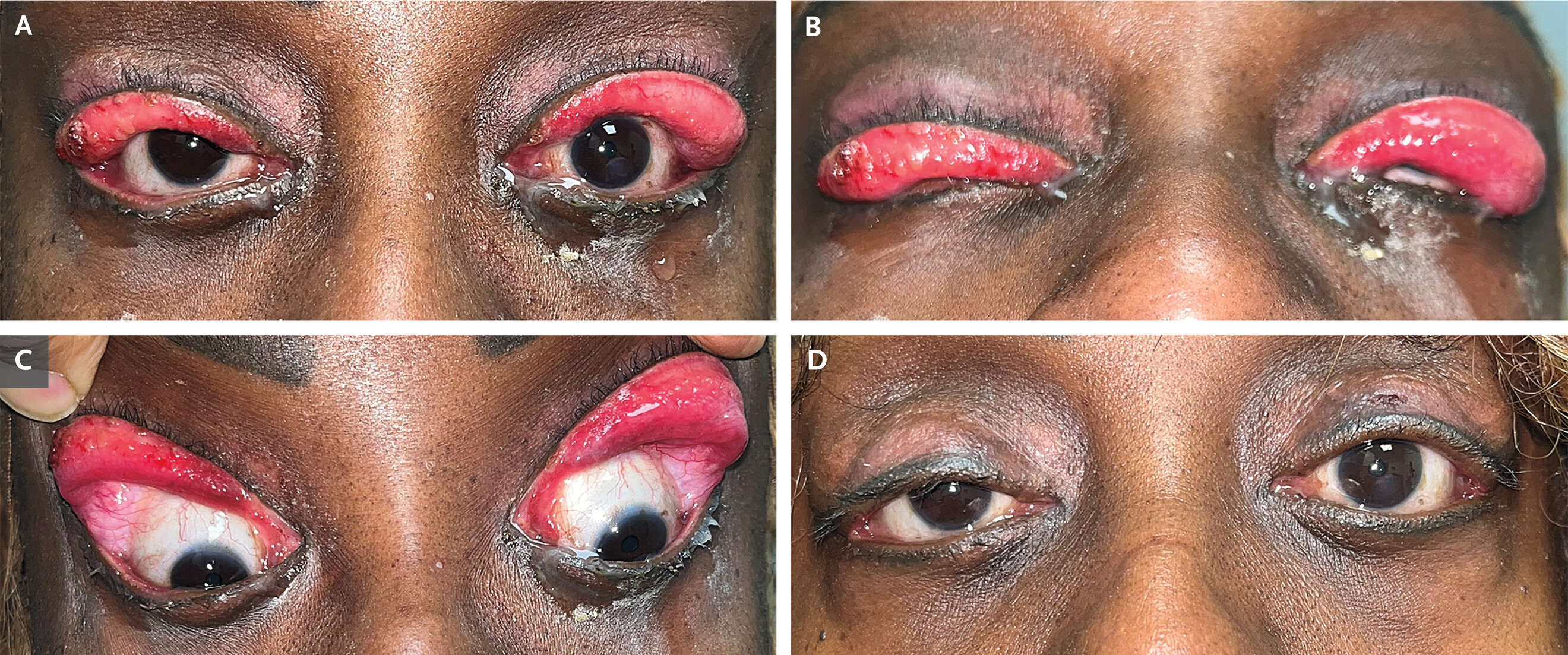
A poor night's sleep might leave you feeling like your eyelids have filled with lead—and keeping them open is the ultimate dead lift. But for some, bad sleep brings on eyelids so droopy and floppy that they can do curl ups on their own.
That was the unfortunate case for a 39-year-old woman who sought care at an ophthalmology clinic in Brooklyn, New York. She told the doctors that for six weeks she felt like she had something in her eyes, and they were watery. By the time of her appointment, her eyelids had rolled up, flipping inside-out on their own—and were staying that way. In the latest issue of the New England Journal of Medicine, doctors report her eye-opening case—and its unexpected solution.
(You can see images of her eyelids—flipped and recovered—here. The images may seem graphic to some, but they are not much worse than that kid in elementary school who would flip their eyelids just to freak everyone out for laughs. You know the one.)
Jay Bhattacharya, director of the National Institutes of Health under the Trump administration, appeared before the Senate Committee on Health, Education, Labor, and Pensions (HELP) Tuesday. In the wide-ranging hearing, Bhattacharya defended the chaotic and disruptive cuts at the institutes he helms while carefully wording responses related to vaccines—seemingly to avoid contradicting his boss, anti-vaccine Health Secretary Robert F. Kennedy Jr.
As Bhattacharya testified, Sen. Bernie Sanders (I-Vt.), the HELP committee's ranking member, released a report outlining the state of the NIH. The report concluded that the Trump administration is "failing American patients," and "destroying medical research through cuts to research grants, terminations of clinical trials, and the chaos it has created."
Since Trump took office, the NIH has terminated or frozen hundreds of millions of dollars for research grants, including $561 million in grants to research the four leading causes of death in America, the report found.
The A.M.A.’s announcement followed a similar recommendation from the American Society of Plastic Surgeons. Other medical groups argued for a more personalized approach.
Lakelands Public Health has confirmed that it is actively responding to a cyberattack discovered on January 29, 2026, which affected some of its internal systems. The organization is sharing information about the Lakelands Public Health cyberattack incident proactively to maintain transparency and public trust.Immediately after detecting the breach, Lakelands Public Health implemented its incident response protocols, secured affected systems, and engaged a leading cybersecurity firm to support the investigation, containment, and recovery efforts. Experts are working closely with the organization to ensure that all systems are restored safely and efficiently.While restoration efforts are underway, some programs and services may experience temporary disruptions. The organization has committed to directly contacting any individuals or partners affected by interruptions.
Critical Public Health Data Remains Secure
Initial investigations indicate that systems managing sensitive public health information, including infectious disease data, immunization records, and sexual health information, were not impacted by the Lakelands Public Health cyberattack. Lakelands Public Health has emphasized that protecting personal information remains a top priority as it continues essential public health operations.Dr. Thomas Piggott, Medical Officer of Health and Chief Executive Officer of Lakelands Public Health, said,
“Our priority response to this event is protecting the information entrusted to us and maintaining continuity of critical public health services. By taking a proactive approach and engaging specialized expertise, we are working diligently to restore systems and keep our community informed.”
The organization serves Peterborough city and county, Northumberland and Haliburton counties, Kawartha Lakes, and the First Nations communities of Curve Lake and Alderville. The cyberattack prompted a review of all systems that could potentially be affected, ensuring that any vulnerabilities are mitigated.
Lakelands Public Health Cyberattack Investigation
Lakelands Public Health has noted that the investigation into the cyberattack is ongoing. While no personal or health information appears to have been compromised, the organization has committed to alerting affected parties should any issues arise as the review continues.Officials have advised that during the restoration period, certain programs and services may remain temporarily offline, and affected individuals will receive direct notifications.The health unit is also closely monitoring its IT infrastructure for unusual activity, and administrators are implementing additional safeguards, including enhanced network monitoring and access controls. These measures are aimed at minimizing risk and ensuring the integrity of public health data during the recovery process.
Proactive Measures Strengthen Cybersecurity for Lakelands Public Health
Residents, partners, and staff are encouraged to remain patient and vigilant as Lakelands Public Health continues to prioritize security, transparency, and the continuity of services. Updates regarding the cyberattack and ongoing recovery efforts are available at LakelandsPH.ca.In response to the incident, Lakelands Public Health has reinforced its commitment to cybersecurity. By engaging specialized expertise and deploying additional monitoring and response tools, the organization aims to reduce the risk of future incidents.Dr. Piggott reinforced the importance of public confidence, stating that the organization will continue to communicate openly and ensure that all necessary steps are taken to protect sensitive information while maintaining public health services without interruption.
A newborn baby has died in New Mexico from a Listeria infection that state health officials say was likely contracted from raw (unpasteurized) milk that the baby's mother drank during pregnancy.
In a news release Tuesday, officials warned people not to consume any raw dairy, highlighting that it can be teeming with a variety of pathogens. Those germs are especially dangerous to pregnant women, as well as young children, the elderly, and people with weakened immune systems.
"Raw milk can contain numerous disease-causing germs, including Listeria, which is bacteria that can cause miscarriage, stillbirth, preterm birth, or fatal infection in newborns, even if the mother is only mildly ill," the New Mexico Department of Health said in the press release.
Parasites and infections that cause blindness and other disabilities were nearly eliminated in some countries, but drug distribution to prevent and treat them was derailed in many places in 2025 after the U.S. cut aid.
A long-term study of 292 families linked fathers’ parenting style to their children’s heart health years later. To researchers’ surprise, no such link was found with mothers.
A debilitating infection from the parasitic Guinea worm is inching closer to global eradication, with an all-time low of only 10 human cases reported worldwide in 2025, the Carter Center announced.
If health workers can fully wipe out the worms, it will be only the second human disease to be eradicated, after smallpox.
Guinea worm (Dracunculus medinensis) is a parasitic nematode transmitted in water. More specifically, it's found in waters that contain small crustacean copepods, which harbor the worm's larvae. If a person consumes water contaminated with Guinea worm, the parasites burrow through the intestinal tract and migrate through the body. About a year later, a spaghetti noodle-length worm emerges from a painful blister, usually in the feet or legs. It can take up to eight weeks for the adult worm to fully emerge. To ease the searing pain, infected people may put their blistered limbs in water, allowing the parasite to release more larvae and continue the cycle.
Jenna Norton last spring organized The Bethesda Declaration, a public letter that denounced what its authors viewed as the administration’s dismantling of the federal biomedical research apparatus.
Younger generations are increasingly ditching smartphones in favor of “dumbphones”—simpler devices with fewer apps, fewer distractions, and less tracking. But what happens when you step away from a device that now functions as your wallet, your memory, and your security key? In this episode, Tom and Scott explore the dumbphone movement through a privacy and […]
When a new presidential administration comes in, it is responsible for filling around 4,000 jobs sprinkled across the federal government’s vast bureaucracy. These political appointees help carry out the president’s agenda, and, at least in theory, make government agencies responsive to elected officials.
Some of these roles—the secretary of state, for example—are well-known. Others, such as the deputy assistant secretary for textiles, consumer goods, materials, critical minerals & metals industry & analysis, are more obscure.
Historically, science agencies like NASA or the National Institutes of Health tend to have fewer political appointees than many other parts of the federal government. Sometimes, very senior roles—with authority over billions of dollars of spending, and the power to shape entire fields of research—are filled without any direct input from the White House or Congress. The arrangement reflects a long-running argument that scientists should oversee the work of funding and conducting research with very little interference from political leaders.
About a decade ago, many media outlets—including WIRED—zeroed in on a weird trend at the intersection of mental health, drug science, and Silicon Valley biohacking: microdosing, or the practice of taking a small amount of a psychedelic drug seeking not full-blown hallucinatory revels but gentler, more stable effects. Typically using psilocybin mushrooms or LSD, the archetypal microdoser sought less melting walls and open-eye kaleidoscopic visuals than boosts in mood and energy, like a gentle spring breeze blowing through the mind.
Anecdotal reports pitched microdosing as a kind of psychedelic Swiss Army knife, providing everything from increased focus to a spiked libido and (perhaps most promisingly) lowered reported levels of depression. It was a miracle for many. Others remained wary. Could 5 percent of a dose of acid really do all that? A new, wide-ranging study by an Australian biopharma company suggests that microdosing’s benefits may indeed be drastically overstated—at least when it comes to addressing symptoms of clinical depression.
A Phase 2B trial of 89 adult patients conducted by Melbourne-based MindBio Therapeutics, investigating the effects of microdosing LSD in the treatment of major depressive disorder, found that the psychedelic was actually outperformed by a placebo. Across an eight-week period, symptoms were gauged using the Montgomery-Åsberg Depression Rating Scale (MADRS), a widely recognized tool for the clinical evaluation of depression.
The Trump administration is delaying the release of TrumpRx, an online platform that lets people buy prescription drugs directly from pharmaceutical companies at a discount, according to Politico. While the reason for the delay is unclear, it comes as Democratic senators raise questions about how the platform will work—and whether it will be legal.
Sens. Dick Durbin (D-Ill.), Elizabeth Warren (D-Mass.), and Peter Welch (D-Vt.) sent a letter to the Office of Inspector General at the Department of Health and Human Services on Thursday seeking answers on how the OIG will oversee the direct-to-consumer (DTC) platform and, specifically, how it will apply the anti-kickback statute.
"Legitimate concerns about inappropriate prescribing, conflicts of interest, and inadequate care have been raised about the exact types of DTC platforms to which TrumpRx would route patients," the senators write.
KINGSTON — Southeast Public Health’s board of health elected Lennox and Addington County Warden Nathan Townend as the new chair during its inaugural meeting of 2026. Read More
Much has happened in a short month since my last column. I’m still digesting all the feelings that are attached to these transitions and reminding myself that change can be an opportunity for new learning, personal growth and reflection. Read More
For the last couple of years, I’ve been following the progress of a group of individuals who believe death is humanity’s “core problem.” Put simply, they say death is wrong—for everyone. They’ve even said it’s morally wrong.
Vitalism is more than a philosophy, though—it’s a movement for hardcore longevity enthusiasts who want to make real progress in finding treatments that slow or reverse aging. Not just through scientific advances, but by persuading influential people to support their movement, and by changing laws and policies to open up access to experimental drugs.
And they’re starting to make progress.
Vitalism was founded by Adam Gries and Nathan Cheng—two men who united over their shared desire to find ways to extend human lifespan. I first saw Cheng speak back in 2023, at Zuzalu, a pop-up city in Montenegro for people who were interested in life extension and some other technologies. (It was an interesting experience—you can read more about it here.)
Zuzalu was where Gries and Cheng officially launched Vitalism. But I’ve been closely following the longevity scene since 2022. That journey took me to Switzerland, Honduras, and a compound in Berkeley, California, where like-minded longevity enthusiasts shared their dreams of life extension.
It also took me to Washington, DC, where, last year, supporters of lifespan extension presented politicians including Mehmet Oz, who currently leads the Centers for Medicare & Medicaid Services, with their case for changes to laws and policies.
The journey has been fascinating, and at times weird and even surreal. I’ve heard biohacking stories that ended with smoking legs. I’ve been told about a multi-partner relationship that might be made possible through the cryopreservation—and subsequent reanimation—of a man and the multiple wives he’s had throughout his life. I’ve had people tell me to my face that they consider themselves eugenicists, and that they believe that parents should select IVF embryos for their propensity for a long life.
I’ve been shouted at and threatened with legal action. I’ve received barefoot hugs. One interviewee told me I needed Botox. It’s been a ride.
My reporting has also made me realize that the current interest in longevity reaches beyond social media influencers and wellness centers. Longevity clinics are growing in number, and there’s been a glut of documentaries about living longer or even forever.
At the same time, powerful people who influence state laws, giant federal funding budgets, and even national health policy are prioritizing the search for treatments that slow or reverse aging. The longevity community was thrilled when longtime supporter Jim O’Neill was made deputy secretary of health and human services last year. Other members of Trump’s administration, including Oz, have spoken about longevity too. “It seems that now there is the most pro-longevity administration in American history,” Gries told me.
I recently spoke to Alicia Jackson, the new director of ARPA-H. The agency, established in 2022 under Joe Biden’s presidency, funds “breakthrough” biomedical research. And it appears to have a new focus on longevity. Jackson previously founded and led Evernow, a company focused on “health and longevity for every woman.”
“There’s a lot of interesting technologies, but they all kind of come back to the same thing: Could we extend life years?” she told me over a Zoom call a few weeks ago. She added that her agency had “incredible support” from “the very top of HHS.” I asked if she was referring to Jim O’Neill. “Yeah,” she said. She wouldn’t go into the specifics.
Gries is right: There is a lot of support for advances in longevity treatments, and some of it is coming from influential people in positions of power. Perhaps the field really is poised for a breakthrough.
And that’s what makes this field so fascinating to cover. Despite the occasional weirdness.
This article first appeared in The Checkup, MIT Technology Review’s weekly biotech newsletter. To receive it in your inbox every Thursday, and read articles like this first, sign up here.
Having a health insurance plan with a high deductible could not only cost you—it could also kill you.
A new study in JAMA Network Open found that people who faced those high out-of-pocket costs as well as a cancer diagnosis had worse overall survival and cancer-specific survival than those with more standard health plans.
The findings, while perhaps not surprising, are a stark reminder of the fraught decisions Americans face as the price of health care only continues to rise and more people try to offset costs by accepting insurance plans with higher deductibles—that is, higher out-of-pocket costs they have to pay before their health insurance provider starts paying its share.
At its first meeting of 2026, and just one year since officially amalgamating three regional health units into one, Southeast Public Health’s board of health and health unit staff continued to clash over the communication of merger plans. Read More
A Texas fight with a nurse practitioner may eventually push the Supreme Court to settle an intensifying battle between states with strict abortion-ban laws and those with shield laws to protect abortion providers supporting out-of-state patients.
In a lawsuit filed Tuesday, Texas Attorney General Ken Paxton accused Debra Lynch, a Delaware-based nurse practitioner, of breaking Texas laws by shipping abortion pills that Lynch once estimated last January facilitated "up to 162 abortions per week" in the state.
"No one, regardless of where they live, will be freely allowed to aid in the murder of unborn children in Texas," Paxton's press release said.
Humans can’t live without lungs. And yet for 48 hours, in a surgical suite at Northwestern University, a 33-year-old man lived with an empty cavity in his chest where his lungs used to be. He was kept alive by a custom-engineered artificial device that represented a desperate last-ditch effort by his doctors. The custom hardware solved a physiological puzzle that has made bilateral pneumonectomy, the removal of both lungs, extremely risky before now.
The artificial lung system was built by the team of Ankit Bharat, a surgeon and researcher at Northwestern. It successfully kept a critically ill patient alive long enough to enable a double lung transplant, temporarily replacing his entire pulmonary system with a synthetic surrogate. The system creates a blueprint for saving people previously considered beyond hope by transplant teams.
Melting lungs
The patient, a once-healthy 33-year-old, arrived at the hospital with Influenza B complicated by a secondary, severe infection of Pseudomonas aeruginosa, a bacterium that in this case proved resistant even to carbapenems—our antibiotics of last resort. This combination of infections triggered acute respiratory distress syndrome (ARDS), a condition where the lungs become so inflamed and fluid-filled that oxygen can no longer reach the blood.
“Who here believes involuntary death is a good thing?”
Nathan Cheng has been delivering similar versions of this speech over the last couple of years, so I knew what was coming. He was about to try to convince the 80 or so people in the audience that death is bad. And that defeating it should be humanity’s number one priority—quite literally, that it should come above all else in the social and political hierarchy.
“If you believe that life is good and there’s inherent moral value to life,” he told them, “it stands to reason that the ultimate logical conclusion here is that we should try to extend lifespan indefinitely.”
Solving aging, he added, is “a problem that has an incredible moral duty for all of us to get involved in.”
It was the end of April, and the crowd—with its whoops and yeahs—certainly seemed convinced. They’d gathered at a compound in Berkeley, California, for a three-day event called the Vitalist Bay Summit. It was part of a longer, two-month residency (simply called Vitalist Bay) that hosted various events to explore tools—from drug regulation to cryonics—that might be deployed in the fight against death. One of the main goals, though, was to spread the word of Vitalism, a somewhat radical movement established by Cheng and his colleague Adam Gries a few years ago.
No relation to the lowercase vitalism of old, this Vitalism has a foundational philosophy that’s deceptively simple: to acknowledge that death is bad and life is good. The strategy for executing it, though, is far more obviously complicated: to launch a longevity revolution.
Interest in longevity has certainly taken off in recent years, but as the Vitalists see it, it has a branding problem. The term “longevity” has been used to sell supplements with no evidence behind them, “anti-aging” has been used by clinics to sell treatments, and “transhumanism” relates to ideas that go well beyond the scope of defeating death. Not everyone in the broader longevity space shares Vitalists’ commitment to actually making death obsolete. As Gries, a longtime longevity devotee who has largely become the enthusiastic public face of Vitalism, said in an online presentation about the movement in 2024, “We needed some new word.”
“Vitalism” became a clean slate: They would start a movement to defeat death, and make that goal the driving force behind the actions of individuals, societies, and nations. Longevity could no longer be a sideshow. For Vitalism to succeed, budgets would need to change. Policy would need to change. Culture would need to change. Consider it longevity for the most hardcore adherents—a sweeping mission to which nothing short of total devotion will do.
“The idea is to change the systems and the priorities of society at the highest levels,” Gries said in the presentation.
To be clear, the effective anti-aging treatments the Vitalists are after don’t yet exist. But that’s sort of the point: They believe they could exist if Vitalists are able to spread their gospel, influence science, gain followers, get cash, and ultimately reshape government policies and priorities.
For the past few years, Gries and Cheng have been working to recruit lobbyists, academics, biotech CEOs, high-net-worth individuals, and even politicians into the movement, and they’ve formally established a nonprofit foundation “to accelerate Vitalism.” Today, there’s a growing number of Vitalists (some paying foundation members, others more informal followers, and still others who support the cause but won’t publicly admit as much), and the foundation has started “certifying” qualifying biotech companies as Vitalist organizations. Perhaps most consequentially, Gries, Cheng, and their peers are also getting involved in shaping US state laws that make unproven, experimental treatments more accessible. They hope to be able to do the same at the national level.
VITALISMFOUNDATION.ORG
VITALISMFOUNDATION.ORG
Vitalism cofounders Nathan Cheng and Adam Gries want to launch a longevity revolution.
All this is helping Vitalists grow in prominence, if not also power. In the past, people who have spoken of living forever or making death “optional” have been dismissed by their academic colleagues. I’ve been covering the broader field of aging science for a decade, and I’ve seen scientists roll their eyes, shrug their shoulders, and turn their backs on people who have talked this way. That’s not the case for the Vitalists.
Even the scientists who think that Vitalist ideas of defeating death are wacky, unattainable ones, with the potential to discredit their field, have shown up on stage with Vitalism’s founders, and these serious researchers provide a platform for them at more traditionally academic events.
I saw this collegiality firsthand at Vitalist Bay. Faculty members from Harvard, Stanford, and the University of California, Berkeley, all spoke at events. Eric Verdin, the prominent researcher who directs the Buck Institute for Research on Aging in Novato, California, had also planned to speak, although a scheduling clash meant he couldn’t make it in the end. “I have very different ideas in terms of what’s doable,” he told me. “But that’s part of the [longevity] movement—there’s freedom for people to say whatever they want.”
Many other well-respected scientists attended, including representatives of ARPA-H, the US federal agency for health research and breakthrough technologies. And as I left for a different event on longevity in Washington, DC, just after the Vitalist Bay Summit, a sizable group of Vitalist Bay attendees headed that way too, to make the case for longevity to US lawmakers.
The Vitalists feel that momentum is building, not just for the science of aging and the development of lifespan-extending therapies, but for the acceptance of their philosophy that defeating death should be humanity’s top concern.
This, of course, sparks some pretty profound questions. What would a society without death look like—and would we even want it? After all, death has become an important part of human culture the world over. And even if Vitalists aren’t destined to realize their lofty goal, their growing influence could still have implications for us all. As they run more labs and companies, and insert themselves into the making of laws and policy, perhaps they will discover treatments that really do slow or even reverse aging. In the meantime, though, some ethicists are concerned that experimental and unproven medicines—including potentially dangerous ones—are becoming more accessible, in some cases with little to no oversight.
Gries, ultimately, has a different view of the ethics here. He thinks that being “okay with death” is what disqualifies a person from being considered ethical. “Death is just wrong,” he says. “It’s not just wrong for some people. It’s wrong for all people.”
The birth of a revolution
When I arrived at the Vitalist Bay Summit on April 25, I noticed that the venue was equipped with everything a longevity enthusiast might need: napping rooms, a DEXA body-composition scanner, a sauna in a bus, and, for those so inclined, 24-hour karaoke.
I was told that around 300 people had signed up for that day’s events, which was more than had attended the previous week. That might have been because arguably the world’s most famous longevity enthusiast, Bryan Johnson, was about to make an appearance. (If you’re curious to know more about what Johnson was doing there, you can read about our conversation here.)
The key to Vitalism has always been that“death is humanity’s core problem, and aging its primary agent,” cofounder Adam Gries told me. “So it was, and so it has continued, as it was foretold.”
But Gries, another man in his 40s who doesn’t want to die, was the first to address the audience that day. Athletic and energetic, he bounded across a stage wearing bright yellow shorts and a long-sleeved shirt imploring people to “Choose Life: VITALISM.”
Gries is a tech entrepreneur who describes himself as a self-taught software engineer who’s “good at virality.” He’s been building companies since he was in college in the 2000s, and grew his personal wealth by selling them.
As with many other devotees to the cause, his deep interest in life extension was sparked by Aubrey de Grey, a controversial researcher with an iconic long beard and matching ponytail. He’s known widely both for his optimistic views about “defeating aging” and for having reportedly made sexual comments to two longevity entrepreneurs. (In an email, de Grey said he’s “never disputed” one of these remarks but denied having made the other. “My continued standing within the longevity community speaks for itself,” he added.)
In an influential 2005 TED Talk (which has over 4.8 million views), de Grey predicted that people would live to 1,000 and spoke of the possibility of new technologies that would continue to stave off death, allowing some to avoid it indefinitely. (In a podcast recorded last year, Cheng described a recording of this talk as “the OG longevity-pilling YouTube video.”)
Many Vitalists have been influenced by controversial longevity researcher Aubrey de Grey. Cheng called his 2005 TED Talk “the OG longevity-pilling YouTube video.”
PETER SEARLE/CAMERA PRESS/REDUX
“It was kind of evident to me that life is great,” says Gries. “So I’m kind of like, why would I not want to live?”
A second turning point for Gries came during the early stages of the covid-19 pandemic, when he essentially bet against companies that he thought would collapse. “I made this 50 [fold] return,” he says. “It was kind of like living through The Big Short.”
Gries and his wife fled from San Francisco to Israel, where he grew up, and later traveled to Taiwan, where he’d obtained a “golden visa” and which was, at the time, one of only two countries that had not reported a single case of covid. His growing wealth afforded him the opportunity to take time from work and think about the purpose of life. “My answer was: Life is the purpose of life,” he says. He didn’t want to die. He didn’t want to experience the “journey of decrepitude” that aging often involves.
So he decided to dedicate himself to the longevity cause. He went about looking up others who seemed as invested as he was. In 2021 his search led him to Cheng, a Chinese-Canadian entrepreneur based in Toronto. He had dropped out of a physics PhD a few years earlier after experiencing what he describes on his website as “a massive existential crisis” and shifted his focus to “radical longevity.” (Cheng did not respond to email requests for an interview.)
The pair “hit it off immediately,” says Gries, and they spent the following two years trying to figure out what they could do. The solution they finally settled on: revolution.
After all, Gries reasons, that’s how significant religious and social movements have happened in the past. He says they sought inspiration from the French and American Revolutions, among others. The idea was to start with some kind of “enlightenment,” and with a “hardcore group,” to pursue significant social change with global ramifications.
“We were convinced that without a revolution,” Gries says, “we were as good as dead.”
A home for believers
Early on, they wrote a Vitalist declaration, a white paper that lists five core statements for believers:
Life and health are good. Death is humanity’s core problem, and aging its primary agent.
Aging causes immense suffering, and obviating aging is scientifically plausible.
Humanity should apply the necessary resources to reach freedom from aging as soon as possible.
I will work on or support others to work on reaching unlimited healthy human lifespan.
I will carry the message against aging and death.
While it’s not an explicit part of the manifesto, it was important to them to think about it as a moral philosophy as well as a movement. As Cheng said at the time, morality “guides most of the actions of our lives.” The same should be true of Vitalism, he suggested.
Gries has echoed this idea. The belief that “death is morally bad” is necessary to encourage behavior change, he told me in 2024. It is a moral drive, or moral purpose, that pushes people to do difficult things, he added.
Revolution, after all, is difficult. And to succeed—to “get unlimited great health to the top of the priority list,” as Gries says—the movement would need to infiltrate the government and shape policy decisions and national budgets. The Apollo program got people to the moon with less than 1% of US GDP; imagine, Gries asks, what we could do to human longevity with a mere 1% of GDP?
It makes sense, then, that Gries and Cheng launched Vitalism in 2023 at Zuzalu, a “pop-up city” in Montenegro that provided a two-month home for like-minded longevity enthusiasts. The gathering was in some ways a loose prototype for what they wanted to accomplish. Cheng spoke there of how they wanted to persuade 10,000 or so Vitalists to move to Rhode Island. Not only was it close to the biotech hub of Boston, but they believed it had a small enough population for an influx of new voters sharing their philosophy to influence local and state elections. “Five to ten thousand people—that’s all we need,” he said. Or if not Rhode Island, another small-ish US state, where they could still change state policy from the inside.
The ultimate goal was to recruit Vitalists to help them establish a “longevity state”—a recognized jurisdiction that “prioritizes doing something about aging,” Cheng said, perhaps by loosening regulations on clinical trials or supporting biohacking.
Bryan Johnson, who is perhaps the world’s most famous longevity enthusiast, spoke at Vitalist Bay and is trying to start a Don’t Die religion.
AGATON STROM/REDUX PICTURES
This idea is popular among many vocal members of the Vitalism community. It borrows from the concept of the “network state” developed by former Coinbase CTO Balaji Srinivasan, defined as a new city or country that runs on cryptocurrency; focuses on a goal, in this case extending human lifespan; and “eventually gains diplomatic recognition from preexisting states.”
Some people not interested in dying have made progress toward realizing such a domain. Following the success of Zuzalu, one of the event’s organizers, Laurence Ion, a young cryptocurrency investor and self-proclaimed Vitalist, joined a fellow longevity enthusiast named Niklas Anzinger to organize a sequel in Próspera, the private “special economic zone” on the Honduran island of Roatán. They called their “pop-up city” Vitalia.
I visited shortly after it launched in January 2024. The goal was to create a low-regulation biotech hub to fast-track the development of anti-aging drugs, though the “city” was more like a gated resort that hosted talks from a mix of respected academics, biohackers, biotech CEOs, and straight-up eugenicists. There was a strong sense of community—many attendees were living with or near each other, after all. A huge canvas where attendees could leave notes included missives like “Don’t die,” “I love you,” and “Meet technoradicals building the future!”
But Vitalia was short-lived, with events ending by the start of March 2024. And while many of the vibes were similar to what I’d later see at Vitalist Bay, the temporary nature of Vitalia didn’t quite match the ambition of Gries and Cheng.
Patri Friedman, a 49-year-old libertarian and grandson of the economist Milton Friedman who says he attended Zuzalu, Vitalia, and Vitalist Bay, envisions something potentially even bolder. He’s the founder of the Seasteading Institute, which has the goal of “building startup communities that float on the ocean with any measure of political autonomy” and has received funding and support from the billionaire Peter Thiel. Friedman also founded Pronomos Capital, a venture capital fund that invests in projects focused on “building the cities of tomorrow.”
His company is exploring various types of potential network states, but he says he’s found that medical tourism—and, specifically, a hunger for life extension—dominates the field. “People do not want this ‘10 years and a billion dollars to pass a drug’ thing with the FDA,” says Friedman. (While he doesn’t call himself a Vitalist, partly because he’s “almost never going to agree with” any kind of decree, Friedman holds what you might consider similarly staunch sentiments about death, which he referred to as “murder by omission.” When I asked him if he has a target age he’d like to reach, he told me he found the question “mind-bogglingly strange” and “insane.” “How could you possibly be like: Yes, please murder me at this time?” he replied. “I can always fucking shoot myself in the head—I don’t need anybody’s help.”)
But even as Vitalists and those aligned with their beliefs embrace longevity states, Gries and Cheng are reassessing their former ambitions. The network-state approach has limits, Gries tells me. And encouraging thousands of people to move to Rhode Island wasn’t as straightforward as they’d hoped it might be.
Not because he can’t find tens of thousands of Vitalists, Gries stresses—but most of them are unwilling to move their lives for the sake of influencing the policy of another state. He compares Vitalism to a startup, with a longevity state as its product. For the time being, at least, there isn’t enough consumer appetite for that product, he says.
The past year shows that it may in fact be easier to lobby legislators in states that are already friendly to deregulation. Anzinger and a lobbying group called the Alliance for Longevity Initiatives (A4LI) were integral to making Montana the first US hub for experimental medical treatments, with a new law to allow clinics to sell experimental therapies once they have been through preliminary safety tests (which don’t reveal whether a drug actually works). But Gries and his Vitalist colleagues also played a role—“providing feedback, talking to lawmakers … brainstorming [and] suggesting ideas,” Gries says.
The Vitalist crew has been in conversation with lawmakers in New Hampshire, too. In an email in December, Gries and Cheng claimed they’d “helped to get right-to-try laws passed” in the state—an apparent reference to the recent expansion of a law to make more unapproved treatments accessible to people with terminal illnesses. Meanwhile, three other bills that expand access even further are under consideration.
Ultimately, Gries stresses, Vitalism is “agnostic to the fixing strategies” that will help them meet their goals. There is, though, at least one strategy he’s steadfast about: building influence.
Only the hardcore
To trigger a revolution, the Vitalists may need to recruit only around 3% or 4% of “society” to their movement, Gries believes. (Granted, that does still mean hundreds of millions of people.) “If you want people to take action, you need to focus on a small number of very high-leverage people,” he tells me.
That, perhaps unsurprisingly, includes wealthy individuals with “a net worth of $10 million or above,” he says. He wants to understand why (with some high-profile exceptions, including Thiel, who has been investing in longevity-related companies and foundations for decades) most uber-wealthy people don’t invest in the field—and how he might persuade them to do so. He won’t reveal the names of anyone he’s having conversations with.
These “high-leverage” people might also include, Gries says, well-respected academics, leaders of influential think tanks, politicians and policymakers, and others who work in government agencies.
A revolution needs to find its foot soldiers. And at the most basic level, that will mean boosting the visibility of the Vitalism brand—partly through events like Vitalist Bay, but also by encouraging others, particularly in the biotech space, to sign on. Cheng talks of putting out a “bat signal” for like-minded people, and he and Gries say that Vitalism has brought together people who have gone on to collaborate or form companies.
There’s also their nonprofit Vitalism International Foundation, whose supporters can opt to become “mobilized Vitalists” with monthly payments of $29 or more, depending on their level of commitment. In addition, the foundation works with longevity biotech companies to recognize those that are “aligned” with its goals as officially certified Vitalist organizations. “Designation may be revoked if an organization adopts apologetic narratives that accept aging or death,” according to the website. At the time of writing, that site lists 16 certified Vitalist organizations, including cryopreservation companies, a longevity clinic, and several research companies.
One of them is Shift Bioscience, a company using CRISPR and aging clocks—which attempt to measure biological age—to identify genes that might play a significant role in the aging process and potentially reverse it. It says it has found a single gene that can rejuvenate multiple types of cells.
Shift cofounder Daniel Ives, who holds degrees in mitochondrial and computational biology, tells me he was also won over to the longevity cause by de Grey’s 2005 TED Talk. He now has a countdown on his computer: “It’s my days till death,” he says—around 22,000 days left. “I’m using that to keep myself focused.”
Ives calls himself the “Vitalist CEO” of Shift Bioscience. He thinks the label is important first as a way for like-minded people to find and support each other, grow their movement, and make the quest for longevity mainstream. Second, he says, it provides a way to appeal to “hardcore” lifespan extensionists, given that others in the wellness and cosmetics industry have adopted the term “longevity” without truly applying themselves to finding rejuvenation therapies. He refers to unnamed companies and individuals who claim that drinking juices, for example, can reverse aging by five years or so.
“You don’t have to convince the mainstream,” says Mark Hamalainen, a contributor to the Vitalism white paper. Though “kind of a terrible example,”he notes, Stalinism started small. “Sometimes you just have to convince the right people.”
“Somebody will make these claims and basically throw legitimate science under the bus,” he says. He doesn’t want spurious claims made on social media to get lumped in with the company’s serious molecular biology. Shift’s head of machine learning, Lucas Paulo de Lima Camillo, was recently awarded a $10,000 prize by the well-respected Biomarkers of Aging Consortium for an aging clock he developed.
Another out-and-proud Vitalist CEO is Anar Isman, the cofounder of AgelessRx, a telehealth provider that offers prescriptions for purported longevity drugs—and a certified Vitalist organization. (Isman, who is in his early 40s, used to work at a hedge fund but was inspired to join the longevity field by—you guessed it—de Grey.)
During a panel session at Vitalist Bay, he stressed that he too saw longevity as a movement—and a revolution—rather than an industry. But he also claimed his company wasn’t doing too badly commercially. “We’ve had a lot of demand,” he said. “We’ve got $60 million plus in annual revenue.”
Many of his customers come to the site looking for treatments for specific ailments, he tells me. He views each as an opportunity to “evangelize” his views on “radical life extension.” “I don’t see a difference between … dying tomorrow or dying in 30 years,” he says. He wants to live “at least 100 more” years.
CHRIS LABROOY
Vitalism, though, isn’t just appealing to commercial researchers. Mark Hamalainen, a 41-year-old science and engineering advisor at ARPA-H, describes himself as a Vitalist. He says he “kind of got roped into” Vitalism because he also works with Cheng—they founded the Longevity Biotech Fellowship, which supports new entrants to the field through mentoring programs. “I kind of view it as a more appealing rebranding of some of the less radical aspects of transhumanism,” he says. Transhumanism—the position that we can use technologies to enhance humans beyond the current limits of biology—covers a broad terrain, but “Vitalism is like: Can we just solve this death thing first? It’s a philosophy that’s easy to get behind.”
In government, he works with individuals like Jean Hébert, a former professor of genetics and neuroscience who has investigated the possibility of rejuvenating the brain by gradually replacing parts of it; Hébert has said that “[his] mission is to beat aging.” He spoke at Zuzalu and Vitalist Bay.
Andrew Brack, who serves as the program manager for proactive health at ARPA-H, was at Vitalist Bay, too. Both Brack and Hébert oversee healthy federal budgets—Hébert’s brain replacement project was granted $110 million in 2024, for example.
Neither Hébert nor Brack has publicly described himself as a Vitalist, and Hébert wouldn’t agree to speak to me without the approval of ARPA-H’s press office, which didn’t respond to multiple requests for an interview with him or Brack. Brack did not respond to direct requests for an interview.
Gries says he thinks that “many people at [the US Department of Health and Human Services], including all agencies, have a longevity-positive view and probably agree with a lot of the ideas Vitalism stands for.” And he is hoping to help secure federal positions for others who are similarly aligned with his philosophy. On both Christmas Eve and New Year’s Eve last year, Gries and Cheng sent fundraising emails describing an “outreach effort” to find applicants for six open government positions that, together, would control billions of dollars in federal funding. “Qualified, mission-aligned candidates we’d love to support do exist, but they need to be found and encouraged to apply,” the pair wrote in the second email. “We’re starting a systematic search to reach, screen, and support the best candidates.”
Hamalainen supports Gries’s plan to target high-leverage individuals. “You don’t have to convince the mainstream,” he says. Though “kind of a terrible example,” Hamalainen notes, Stalinism started small. “Sometimes you just have to convince the right people.”
One of the “right” people may be the man who inspired Gries, Hamalainen, Ives, Isman, and so many others to pursue longevity in the first place: de Grey. He’s now a paid-up Vitalist and even spoke at Vitalist Bay. Having been in the field for over 20 years, de Grey tells me, he’s seen various terms fall in and out of favor. Those terms now have “baggage that gets in the way,” he says. “Sometimes it’s useful to have a new term.”
The sometimes quiet (sometimes powerful, sometimes influential) Vitalists
Though one of the five principles of Vitalism is a promise to “carry the message,” some people who agree with its ideas are reluctant to go public, including some signed-up Vitalists. I’ve asked Gries multiple times over several years, but he won’t reveal how many Vitalists there are, let alone who makes up the membership.
Even some of the founders of Vitalism don’t want to be public about it. Around 30 people were involved in developing the movement, Gries says—but only 22 are named as contributors to the Vitalism white paper (with Gries as its author), including Cheng, Vitalia’s Ion, and ARPA-H’s Hamalainen. Gries won’t reveal the names of the others. He acknowledges that some people just don’t like to publicly affiliate with any organization. That’s certainly what I’ve found when I’ve asked members of the longevity community if they’re Vitalists. Many said they agreed with the Vitalist declaration, and that they liked and supported what Gries was doing. But they didn’t want the label.
Some people worry that associating with a belief system that sounds a bit religious—even cult-like, some say—won’t do the cause any favors. Others have a problem with the specific wording of the declaration.
For instance, Anzinger—the other Vitalia founder—won’t call himself a Vitalist. He says he respects the mission, but that the declaration is “a bit poetic” for his liking.
And Dylan Livingston, CEO of A4LI and arguably one of the most influential longevity enthusiasts out there, won’t describe himself as a Vitalist either.
Many other longevity biotech CEOs also shy away from the label—including Emil Kendziorra, who runs the human cryopreservation company Tomorrow Bio, even though that’s a certified Vitalist organization. Kendziorra says he agrees with most of the Vitalist declaration but thinks it is too “absolutist.” He also doesn’t want to imply that the pursuit of longevity should be positioned above war, hunger, and other humanitarian issues. (Gries has heard this argument before, and counters that both the vast spending on health care for people in the last years of their life and the use of lockdown strategies during the covid pandemic suggest that, deep down, lifespan extension is “society’s revealed preference.”)
Still, because Kendziorra agrees with almost everything in the declaration, he believes that “pushing it forward” and bringing more attention to the field by labeling his company a Vitalist organization is a good thing. “It’s to support other people who want to move the world in that direction,” he says. (He also offered Vitalist Bay attendees a discount on his cryopreservation services.)
“There’s a lot of closeted scientists working in our field, and they get really excited about lifespans increasing,” explains Ives of Shift Bioscience. “But you’ll get people who’ll accuse you of being a lunatic that wants to be immortal.” He claims that people who represent biotech companies tell him “all the time” that they are secretly longevity companies but avoid using the term because they don’t want funders or collaborators to be “put off.”
Ultimately, it may not really matter how much people adopt the Vitalist label as long as the ideas break through. “It’s pretty simple. [The Vitalist declaration] has five points—if you agree with the five points, you are a Vitalist,” says Hamalainen. “You don’t have to be public about it.” He says he’s spoken to others about “coming out of the closet” and that it’s been going pretty well.
Gries puts it more bluntly: “If you agree with the Vitalist declaration, you are a Vitalist.”
And he hints that there are now many people in powerful positions—including in the Trump administration—who share his views, even if they don’t openly identify as Vitalists.
Jim O’Neill, the deputy secretary of health and human services, is one of the highest-profile longevity enthusiasts serving in government. Gries says, “It seems that now there is the most pro-longevity administration in American history.”
AMY ROSSETTI/DEPARTMENT OF HEALTH AND HUMAN SERVICES VIA AP
O’Neill has long been interested in both longevity and the idea of creating new jurisdictions. Until March 2024, he served on the board of directors of Friedman’s Seasteading Institute. He also served as CEO of the SENS Research Foundation, a longevity organization founded by de Grey, between 2019 and 2021, and he represented Thiel as a board member there for many years. Many people in the longevity community say they know him personally, or have at least met him. (Tristan Roberts, a biohacker who used to work with a biotech company operating in Próspera, tells me he served O’Neill gin when he visited his Burning Man camp, which he describes as a “technology gay camp from San Francisco and New York.” Hamalainen also recalls meeting O’Neill at Burning Man, at a “techy, futurist” camp.) (Neither O’Neill nor representatives from the Department of Health and Human Services responded to a request to comment about this.)
O’Neill’s views are arguably becoming less fringe in DC these days. The day after the Vitalist Bay Summit, A4LI was hosting its own summit in the capital with the goal of “bringing together leaders, advocates, and innovators from around the globe to advance legislative initiatives that promote a healthier human lifespan.” I recognized lots of Vitalist Bay attendees there, albeit in more formal attire.
The DC event took place over three days in late April. The first two involved talks by longevity enthusiasts across the spectrum, including scientists, lawyers, and biotech CEOs. Vitalia’s Anzinger spoke about the success he’d had in Próspera, and ARPA-H’s Brack talked about work his agency was doing. (Hamalainen was also there, although he said he was not representing ARPA-H.)
But the third day was different and made me think Gries may be right about Vitalism’s growing reach. It began with a congressional briefing on Capitol Hill, during which Representative Gus Bilirakis, a Republican from Florida, asked, “Who doesn’t want to live longer, right?” As he explained, “Longevity science … directly aligns with the goals of the Make America Healthy Again movement.”
“There’s a lot of closeted scientists working in our field, and they get really excited about lifespans increasing,” says Daniel Ives of Shift Bioscience. “But you’ll get people who’ll accuse you of being a lunatic that wants to be immortal.”
Bilirakis and Representative Paul Tonko, a New York Democrat, were followed by Mehmet Oz, the former TV doctor who now leads the Centers for Medicare and Medicaid Services; he opened with typical MAHA talking points about chronic disease and said US citizens have a “patriotic duty” to stay healthy to keep medical costs down. The audience was enthralled as Oz talked about senescent cells, the zombie-like aged cells that are thought to be responsible for some age-related damage to organs and tissues. (The offices of Bilirakis and Tonko did not respond to a request for comment; neither did the Centers for Medicare and Medicaid Services.)
And while none of the speakers went anywhere near the concept of radical life extension, the Vitalists in the audience were suitably encouraged.
Gries is too: “It seems that now there is the most pro-longevity administration in American history.”
The fate of “immortality quests”
Whether or not Vitalism starts a revolution, it will almost always be controversial in some quarters. While believers see an auspicious future, others are far less certain of the benefits of a world designed to defeat death.
Gries and Cheng often make the case for deregulation in their presentations. But ethicists—and even some members of the longevity community—point out that this comes with risks. Some question whether it is ever ethical to sell a “treatment” without some idea of how likely it is to benefit the person buying and taking it. Enthusiasts counter with arguments about bodily autonomy. And they hope Montana is just the start.
Then there’s the bigger picture. Is it really that great not to die … ever? Some ethicists argue that for many cultures, death is what gives meaning to life.
Sergio Imparato, a moral philosopher and medical ethicist at Harvard University, believes that death itself has important moral meaning. We know our lives will end, and our actions have value precisely because our time is limited, he says. Imparato is concerned that Vitalists are ultimately seeking to change what it means to be human—a decision that should involve all members of society.
Alberto Giubilini, a philosopher at the University of Oxford, agrees. “Death is a defining feature of humanity,” he says. “Our psychology, our cultures, our rituals, our societies, are built around the idea of coping with death … it’s part of human nature.”
CHRIS LABROOY
Imparato’s family is from Naples, Italy, where poor residents were once laid to rest in shared burial sites, with no headstones to identify them. He tells me how the locals came to visit, clean, and even “adopt” the skulls as family members. It became a weekly ritual for members of the community, including his grandmother, who was a young girl at the time. “It speaks to what I consider the cultural relevance of death,” he says. “It’s the perfect counterpoint to … the Vitalist conception of life.”
Gries seems aware of the stigma around such “immortality quests,” as Imparato calls them. In his presentations, Gries shares lists of words that Vitalists should try to avoid—like “eternity,” “radical,” and “forever,” as well as any religious terms.
He also appears to be dropping, at least publicly, the idea that Vitalism is a “moral” movement. Morality was “never part of the Vitalist declaration,” Gries told me in September. When I asked him why he had changed his position on this, he dismissed the question. “Our point … was always that death is humanity’s core problem, and aging its primary agent,” he told me. “So it was, and so it has continued, as it was foretold.”
But despite these attempts to tweak and control the narrative, Vitalism appears to be opening the door to an incredibly wide range of sentiments in longevity science. A decade ago, I don’t think there would have been any way that the views espoused by Gries, Anzinger, and others who support Vitalist sentiments would have been accepted by the scientific establishment. After all, these are people who publicly state they hope to live indefinitely and who have no training in the science of aging, and who are open about their aims to find ways to evade the restrictions set forth by regulatory agencies like the FDA—all factors that might have rendered them outcasts not that long ago.
But Gries and peers had success in Montana. Influential scientists and policymakers attend Vitalism events, and Vitalists are featured regularly at more mainstream longevity events. Last year’s Aging Research and Drug Discovery (ARDD) conference in Copenhagen—widely recognized as the most important meeting in aging science—was sponsored in part by Anzinger’s new Próspera venture, Infinita City, as well as by several organizations that are either certified Vitalist or led by Vitalists.
“I was thinking that maybe what I was doing was very fringe or out there,” Anzinger, the non-Vitalist supporter of Vitalism, admits. “But no—I feel … loads of support.”
There was certainly an air of optimism at the Vitalist Bay Summit in Berkeley. Gries’s positivity is infectious. “All the people who want a fun and awesome surprise gift, come on over!” he called out early on the first day. “Raise your voice if you’re excited!” The audience whooped in response. He then proceeded to tell everyone, Oprah Winfrey–style, that they were all getting a free continuous glucose monitor. “You get a CGM! You get a CGM!” Plenty of attendees actually attached them to their arms on the spot.
Every revolution has to start somewhere, right?
This piece has been updated to clarify a quote from Mark Hamalainen.
The explosive measles outbreak in South Carolina has now reached 789 cases, breaking Texas's outbreak record last year of 762 cases, which at the time was the largest outbreak in the US since measles was declared eliminated from the US in 2000. The country is at grave risk of losing its elimination status in the coming months due to continuous spread.
With Texas' outbreak last year—which spanned January to August and spread to additional states—the US saw the largest measles case total since 1991, with 2,255 confirmed cases. Now, with South Carolina's unbridled outbreak, 2026 is already looking like it will be another record year.
Though South Carolina's outbreak began in October, the spread of the disease has dramatically accelerated this month, with cases jumping from 218 on December 28 to 789 on January 27.

 Login
Login